
Pulp Fiction, 1865 · page 213 of 400
The Argosy — page 213: what you’re looking at
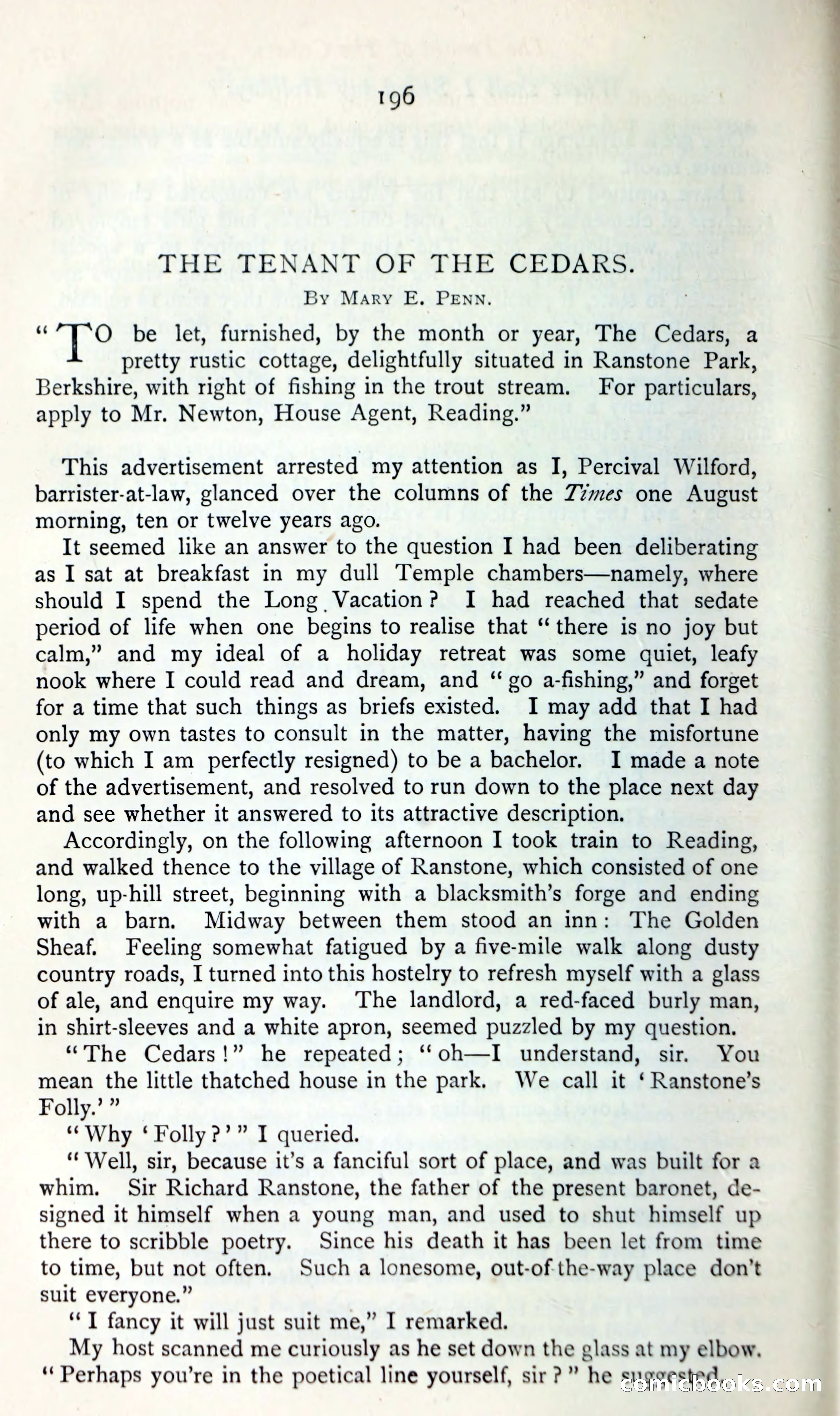
A restored page from Pulp Fiction, 1865. Page through the whole issue in the reader above.
📄 Transcribed text from this page (OCR, searchable)
Machine-transcribed from the original scan — historical spelling and the odd misread are preserved.
THE TENANT OF THE CEDARS. By Mary E. PENN. ‘ ae O be let, furnished, by the month or year, The Cedars, a pretty rustic cottage, delightfully situated in Ranstone Park, Berkshire, with right of fishing in the trout stream. For particulars, apply to Mr. Newton, House Agent, Reading.” This advertisement arrested my attention as I, Percival Wilford, barrister-at-law, glanced over the columns of the Z7mes one August morning, ten or twelve years ago. It seemed like an answer to the question I had been deliberating as I sat at breakfast in my dull Temple chambers—namely, where should I spend the Long Vacation? I had reached that sedate period of life when one begins to realise that “there is no joy but calm,” and my ideal of a holiday retreat was some quiet, leafy nook where I could read and dream, and “go a-fishing,” and forget for a time that such things as briefs existed. I may add that I had only my own tastes to consult in the matter, having the misfortune (to which I am perfectly resigned) to be a bachelor. I made a note of the advertisement, and resolved to run down to the place next day and see whether it answered to its attractive description. Accordingly, on the following afternoon I took train to Reading, and walked thence to the village of Ranstone, which consisted of one long, up-hill street, beginning with a blacksmith’s forge and ending with a barn. Midway between them stood an inn: The Golden Sheaf. Feeling somewhat fatigued by a five-mile walk along dusty country roads, I turned into this hostelry to refresh myself with a glass of ale, and enquire my way. ‘The landlord, a red-faced burly man, in shirt-sleeves and a white apron, seemed puzzled by my question. “The Cedars!” he repeated; ‘‘oh—lI understand, sir. You mean the little thatched house in the park. We call it ‘ Ranstone’s Folly.’ ” ‘Why ‘ Folly ?’” I queried. ‘Well, sir, because it’s a fanciful sort of place, and was built for a whim. Sir Richard Ranstone, the father of the present baronet, de- signed it himself when a young man, and used to shut himself up there to scribble poetry. Since his death it has been let from time to time, but not often. Such a lonesome, out-of-the-way place don’t suit everyone.” ‘‘] fancy it will just suit me,” I remarked. My host scanned me curiously as he set down the glass at my elbow. ‘Perhaps you're in the poetical line yourself, sir?” he sngvested,.. cS (E@) m , . :