
Pulp Fiction, 1865 · page 97 of 399
The Argosy — page 97: what you’re looking at
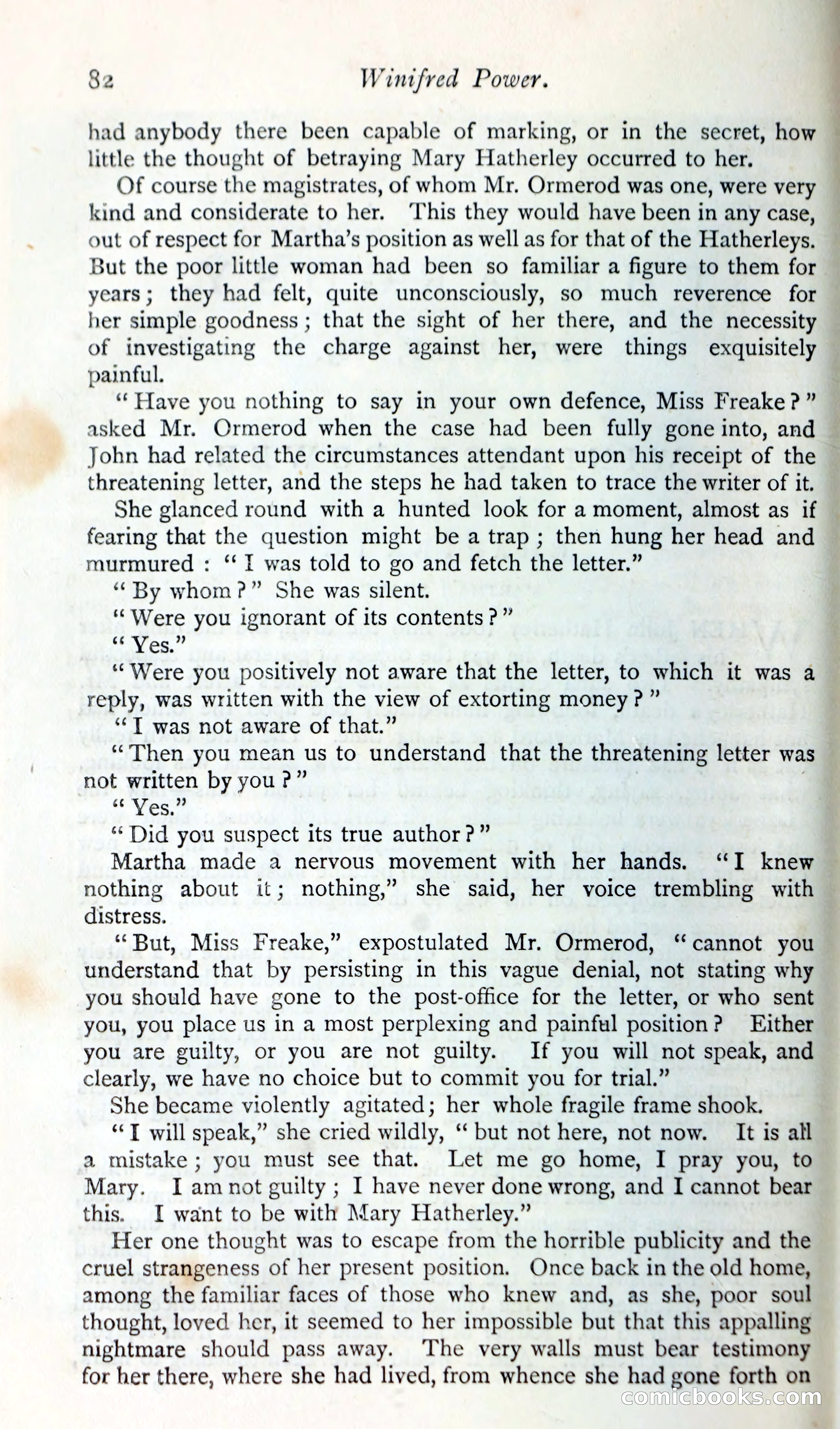
A restored page from Pulp Fiction, 1865. Page through the whole issue in the reader above.
📄 Transcribed text from this page (OCR, searchable)
Machine-transcribed from the original scan — historical spelling and the odd misread are preserved.
82 Winifred Power. had anybody there been capable of marking, or in the secret, how — little the thought of betraying Mary Hatherley occurred to her, | Of course the magistrates, of whom Mr. Ormerod was one, were very kind and considerate to her. ‘This they would have been in any case, out of respect for Martha’s position as well as for that of the Hatherleys. But the poor little woman had been so familiar a figure to them for years; they had felt, quite unconsciously, so much reverence for her simple goodness ; that the sight of her there, and the necessity of investigating the charge against her, were things exquisitely painful. ‘Have you nothing to say in your own defence, Miss Freake ? ” asked Mr. Ormerod when the case had been fully gone into, and John had related the circumstances attendant upon his receipt of the threatening letter, and the steps he had taken to trace the writer of it. She glanced round with a hunted look for a moment, almost as if — fearing that the question might be a trap ; then hung her head and murmured : ‘‘ I was told to go and fetch the letter.” ‘“By whom?” She was silent. ‘Were you ignorant of its contents ? ” es. ‘‘Were you positively not aware that the letter, to which it was a reply, was written with the view of extorting money P ” ‘“‘T was not aware of that.” “Then you mean us to understand that the threatening letter was — not written by you ?” —@ 6¢ Yes,” ‘Did you suspect its true author?” Martha made a nervous movement with her hands. “I knew nothing about it; nothing,” she said, her voice trembling with distress. ‘But, Miss Freake,” expostulated Mr. Ormerod, “cannot you understand that by persisting in this vague denial, not stating why you should have gone to the post-office for the letter, or who sent you, you place us in a most perplexing and painful position? Either you are guilty, or you are not guilty. If you will not speak, and clearly, we have no choice but to commit you for trial.” She became violently agitated; her whole fragile frame shook. ‘“‘T will speak,” she cried wildly, “‘ but not here, not now. It is all a mistake ; you must see that. Let me go home, I pray you, to Mary. I amnot guilty; I have never done wrong, and I cannot bear this. I want to be with Mary Hatherley.” Her one thought was to escape from the horrible publicity and the cruel strangeness of her present position. Once back in the old home, among the familiar faces of those who knew and, as she, poor soul thought, loved her, it seemed to her impossible but that this appalling nightmare should pass away. ‘The very walls must bear testimony for her there, where she had lived, from whence she had gone forth on CORNICLHOOOXKS. EO