
Pulp Fiction, 1865 · page 69 of 399
The Argosy — page 69: what you’re looking at
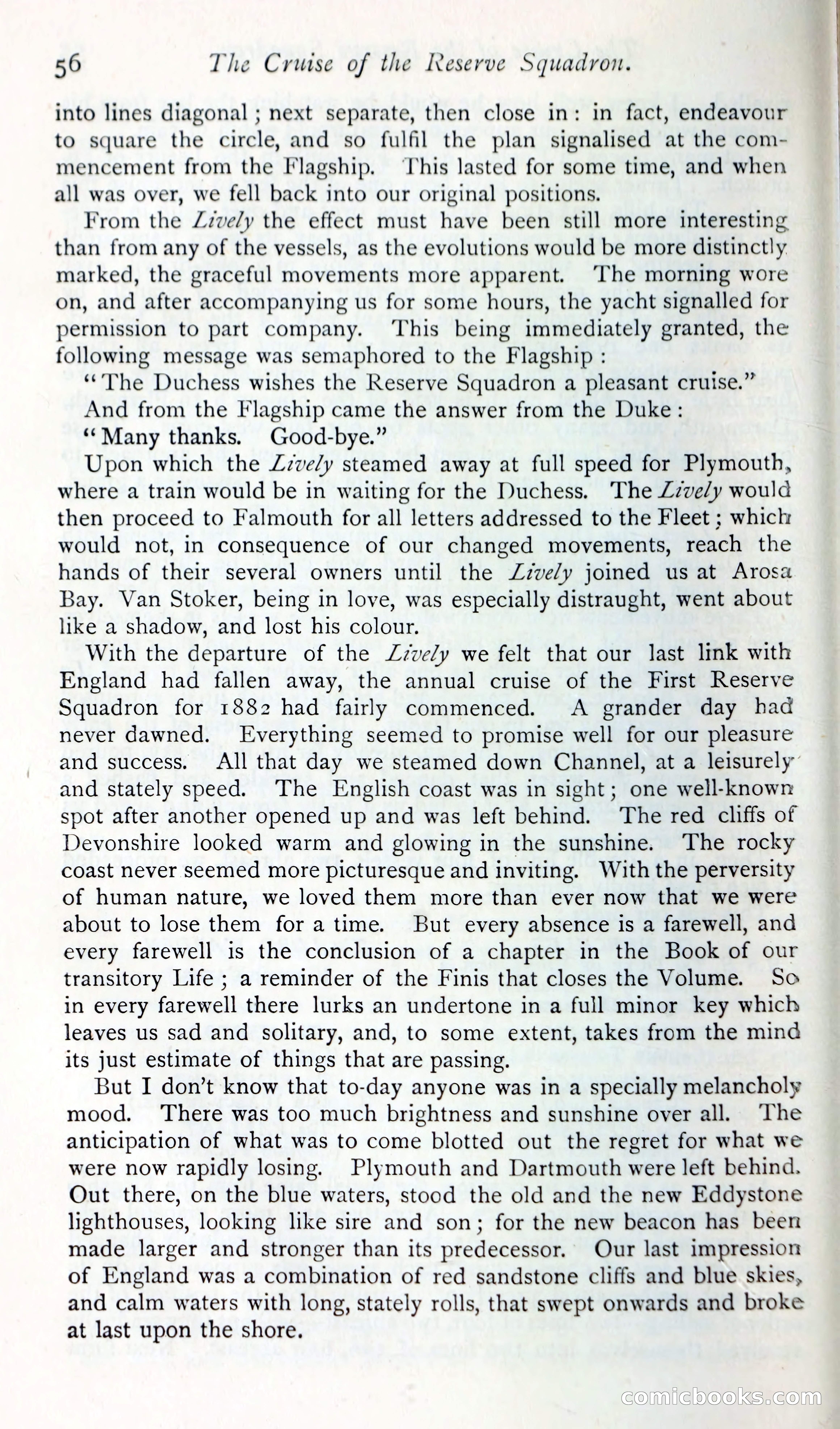
A restored page from Pulp Fiction, 1865. Page through the whole issue in the reader above.
📄 Transcribed text from this page (OCR, searchable)
Machine-transcribed from the original scan — historical spelling and the odd misread are preserved.
56 The Cruse of the Reserve Squadron. into lines diagonal ; next separate, then close in: in fact, endeavour to square the circle, and so fulfil the plan signalised at the com- mencement from the Flagship. ‘This lasted for some time, and when all was over, we fell back into our original positions. From the Zzve/y the effect must have been still more interesting than from any of the vessels, as the evolutions would be more distinctly marked, the graceful movements more apparent. ‘The morning wore on, and after accompanying us for some hours, the yacht signalled for permission to part company. ‘This being immediately granted, the following message was semaphored to the Flagship : ‘The Duchess wishes the Reserve Squadron a pleasant cruise.” And from the Flagship came the answer from the Duke: ‘“Many thanks. Good-bye.” Upon which the Zzve/y steamed away at full speed for Plymouth, where a train would be in waiting for the Duchess. The Zzvely would then proceed to Falmouth for all letters addressed to the Fleet ; which would not, in consequence of our changed movements, reach the hands of their several owners until the Zzve/y joined us at Arosa Bay. Van Stoker, being in love, was especially distraught, went about like a shadow, and lost his colour. With the departure of the Zzve/y we felt that our last link with England had fallen away, the annual cruise of the First Reserve Squadron for 1882 had fairly commenced. A grander day had never dawned. Everything seemed to promise well for our pleasure and success. All that day we steamed down Channel, at a leisurely’ and stately speed. ‘The English coast was in sight; one well-known spot after another opened up and was left behind. The red cliffs of Devonshire looked warm and glowing in the sunshine. The rocky coast never seemed more picturesque and inviting. With the perversity of human nature, we loved them more than ever now that we were about to lose them for atime. But every absence is a farewell, and every farewell is the conclusion of a chapter in the Book of our transitory Life ; a reminder of the Finis that closes the Volume. So in every farewell there lurks an undertone in a full minor key which leaves us sad and solitary, and, to some extent, takes from the mind its just estimate of things that are passing. But I don’t know that to-day anyone was in a specially melancholy mood. There was too much brightness and sunshine over all. ‘The anticipation of what was to come blotted out the regret for what we were now rapidly losing. Plymouth and Dartmouth were left behind. Out there, on the blue waters, stood the old and the new Eddystone lighthouses, looking like sire and son; for the new beacon has been made larger and stronger than its predecessor. Our last impression of England was a combination of red sandstone cliffs and blue skies, and calm waters with long, stately rolls, that swept onwards and broke at last upon the shore. CORmmiclooolkx<s.CcoOnn