
Pulp Fiction, 1865 · page 60 of 399
The Argosy — page 60: what you’re looking at
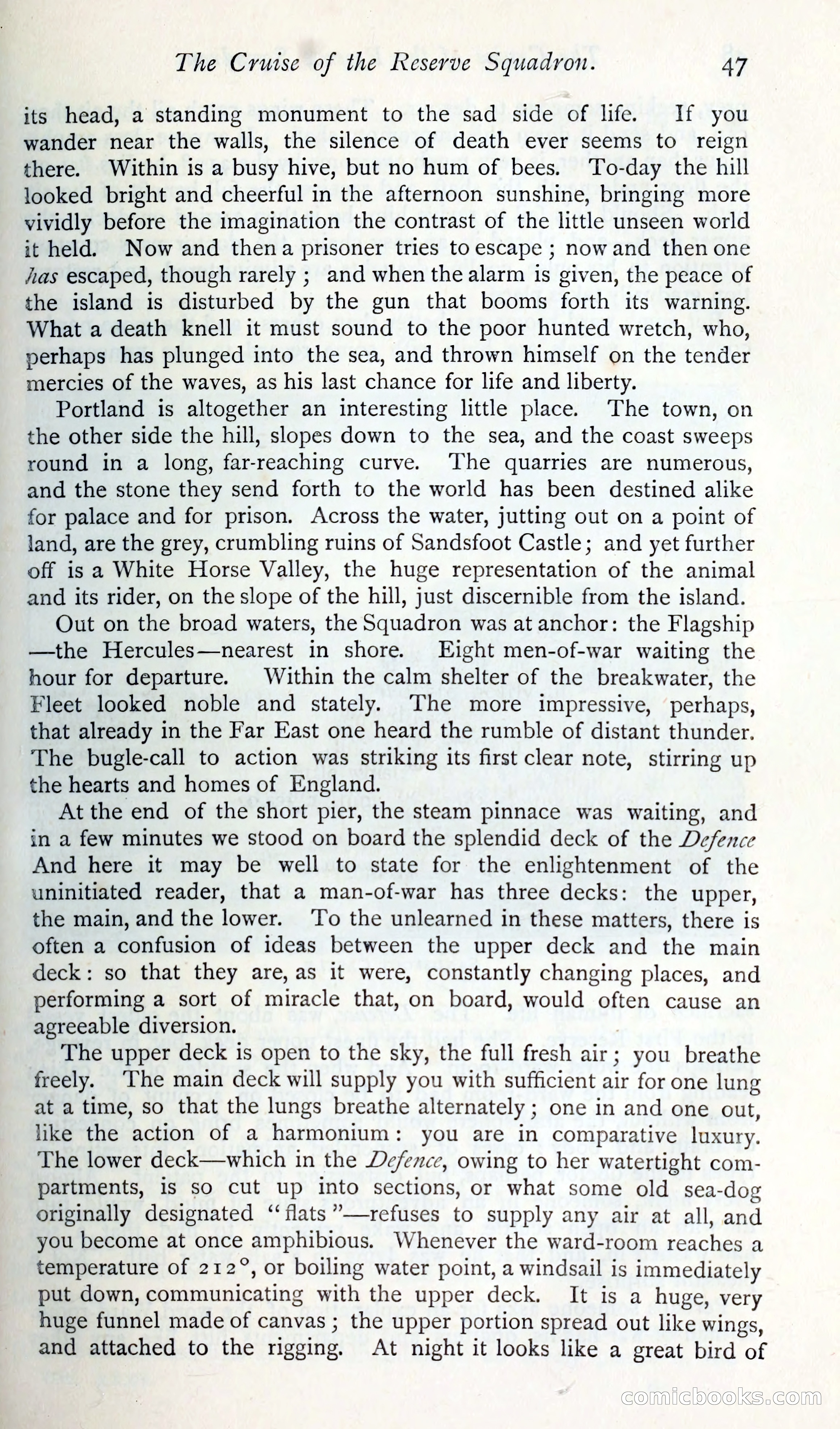
A restored page from Pulp Fiction, 1865. Page through the whole issue in the reader above.
📄 Transcribed text from this page (OCR, searchable)
Machine-transcribed from the original scan — historical spelling and the odd misread are preserved.
The Cruse of the Reserve Squadron. A”7 its head, a standing monument to the sad side of life. If you wander near the walls, the silence of death ever seems to reign there. Within is a busy hive, but no hum of bees. ‘To-day the hill looked bright and cheerful in the afternoon sunshine, bringing more vividly before the imagination the contrast of the little unseen world it held. Now and thena prisoner tries to escape ; nowand then one has escaped, though rarely ; and when the alarm is given, the peace of the island is disturbed by the gun that booms forth its warning. What a death knell it must sound to the poor hunted wretch, who, perhaps has plunged into the sea, and thrown himself on the tender mercies of the waves, as his last chance for life and liberty. Portland is altogether an interesting little place. The town, on the other side the hill, slopes down to the sea, and the coast sweeps round in a long, far-reaching curve. ‘The quarries are numerous, and the stone they send forth to the world has been destined alike for palace and for prison. Across the water, jutting out on a point of land, are the grey, crumbling ruins of Sandsfoot Castle; and yet further off is a White Horse Valley, the huge representation of the animal and its rider, on the slope of the hill, just discernible from the island. Out on the broad waters, the Squadron was at anchor: the Flagship —the Hercules—nearest in shore. Eight men-of-war waiting the hour for departure. Within the calm shelter of the breakwater, the Fleet looked noble and stately. The more impressive, perhaps, that already in the Far East one heard the rumble of distant thunder. The bugle-call to action was striking its first clear note, stirring up the hearts and homes of England. At the end of the short pier, the steam pinnace was waiting, and in a few minutes we stood on board the splendid deck of the Defence And here it may be well to state for the enlightenment of the uninitiated reader, that a man-of-war has three decks: the upper, the main, and the lower. ‘To the unlearned in these matters, there is often a confusion of ideas between the upper deck and the main deck: so that they are, as it were, constantly changing places, and performing a sort of miracle that, on board, would often cause an agreeable diversion. The upper deck is open to the sky, the full fresh air; you breathe freely. ‘The main deck will supply you with sufficient air for one lung at a time, so that the lungs breathe alternately ; one in and one out, like the action of a harmonium: you are in comparative luxury. The lower deck—which in the Defence, owing to her watertight com- partments, is so cut up into sections, or what some old sea-dog originally designated ‘‘flats”»—-refuses to supply any air at all, and you become at once amphibious. Whenever the ward-room reaches a temperature of 212°, or boiling water point, a windsail is immediately put down, communicating with the upper deck. It is a huge, very huge funnel made of canvas ; the upper portion spread out like wings, and attached to the rigging. At night it looks like a great bird of EORnnicloooks