
Pulp Fiction, 1865 · page 53 of 399
The Argosy — page 53: what you’re looking at
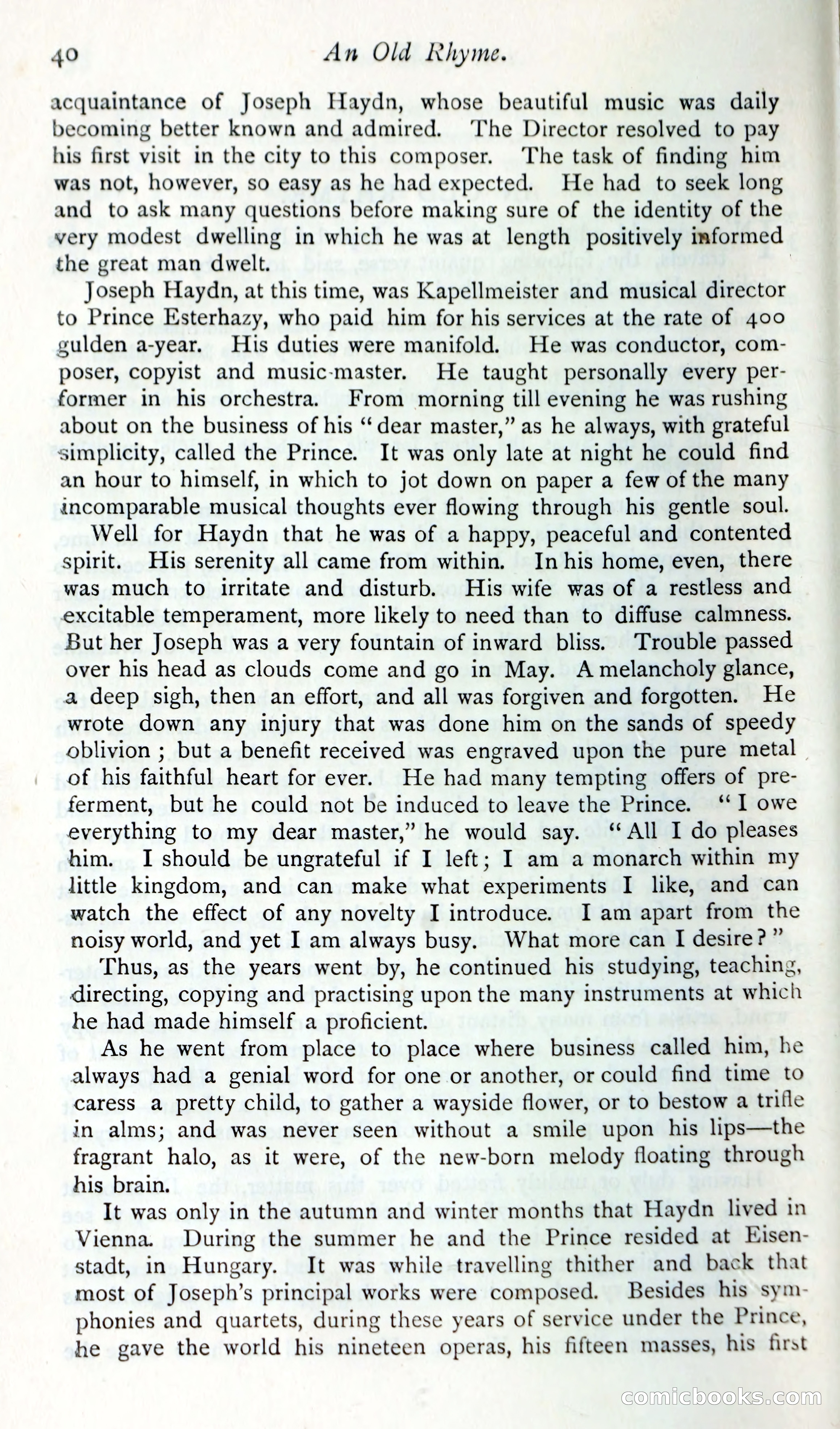
A restored page from Pulp Fiction, 1865. Page through the whole issue in the reader above.
📄 Transcribed text from this page (OCR, searchable)
Machine-transcribed from the original scan — historical spelling and the odd misread are preserved.
40 An Old Rhyme. acquaintance of Joseph Haydn, whose beautiful music was daily becoming better known and admired. ‘The Director resolved to pay his first visit in the city to this composer. ‘The task of finding him was not, however, so easy as he had expected. He had to seek long and to ask many questions before making sure of the identity of the very modest dwelling in which he was at length positively informed the great man dwelt. | Joseph Haydn, at this time, was Kapellmeister and musical director to Prince Esterhazy, who paid him for his services at the rate of 400 gulden a-year. His duties were manifold. He was conductor, com- poser, copyist and music-master. He taught personally every per- former in his orchestra. From morning till evening he was rushing about on the business of his “‘ dear master,” as he always, with grateful simplicity, called the Prince. It was only late at night he could find an hour to himself, in which to jot down on paper a few of the many incomparable musical thoughts ever flowing through his gentle soul. Well for Haydn that he was of a happy, peaceful and contented spirit. His serenity all came from within. In his home, even, there was much to irritate and disturb. His wife was of a restless and excitable temperament, more likely to need than to diffuse calmness. But her Joseph was a very fountain of inward bliss. Trouble passed over his head as clouds come and go in May. A melancholy glance, a deep sigh, then an effort, and all was forgiven and forgotten. He wrote down any injury that was done him on the sands of speedy oblivion ; but a benefit received was engraved upon the pure metal - of his faithful heart for ever. He had many tempting offers of pre- ferment, but he could not be induced to leave the Prince. ‘“‘ 1 owe everything to my dear master,” he would say. ‘All I do pleases him. I should be ungrateful if I left; I am a monarch within my little kingdom, and can make what experiments I like, and can watch the effect of any novelty I introduce. Iam apart from the noisy world, and yet I am always busy. What more can I desire?” Thus, as the years went by, he continued his studying, teaching, directing, copying and practising upon the many instruments at which he had made himself a proficient. As he went from place to place where business called him, he always had a genial word for one or another, or could find time to caress a pretty child, to gather a wayside flower, or to bestow a trifle in alms; and was never seen without a smile upon his lips—the fragrant halo, as it were, of the new-born melody floating through his brain. It was only in the autumn and winter months that Haydn lived in Vienna. During the summer he and the Prince resided at Eisen- stadt, in Hungary. It was while travelling thither and back that most of Joseph’s principal works were composed. Besides his sym- phonies and quartets, during these years of service under the Prince, he gave the world his nineteen operas, his fifteen masses, his first COnmiclboookxs.Cconn