
Pulp Fiction, 1865 · page 48 of 399
The Argosy — page 48: what you’re looking at
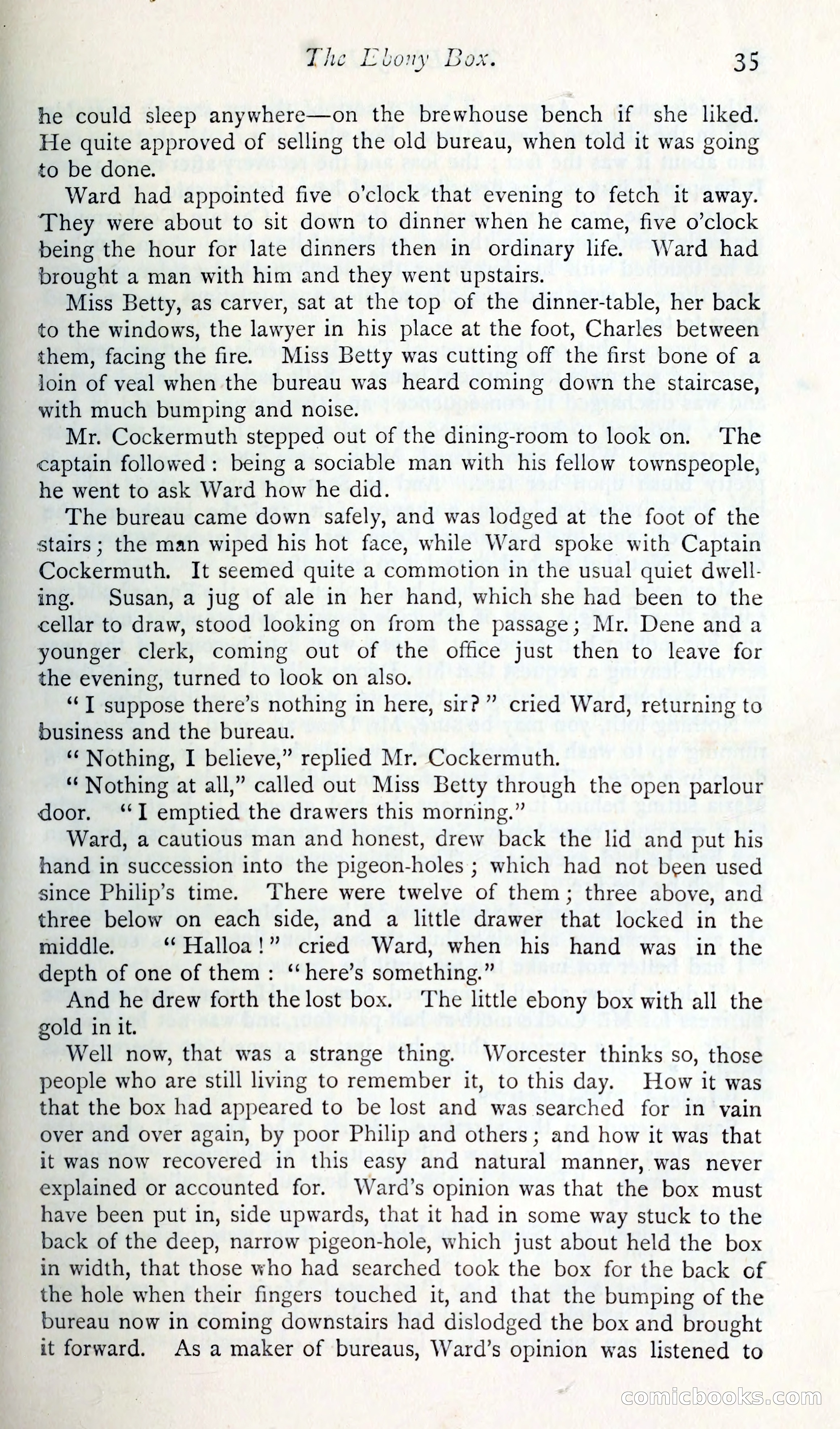
A restored page from Pulp Fiction, 1865. Page through the whole issue in the reader above.
📄 Transcribed text from this page (OCR, searchable)
Machine-transcribed from the original scan — historical spelling and the odd misread are preserved.
ie LE bony Box, 35 he could sleep anywhere—on the brewhouse bench if she liked. He quite approved of selling the old bureau, when told it was going to be done. Ward had appointed five o’clock that evening to fetch it away. They were about to sit down to dinner when he came, five o’clock being the hour for late dinners then in ordinary life. Ward had brought a man with him and they went upstairs. Miss Betty, as carver, sat at the top of the dinner-table, her back to the windows, the lawyer in his place at the foot, Charles between them, facing the fire. Miss Betty was cutting off the first bone of a loin of veal when the bureau was heard coming down the staircase, with much bumping and noise. Mr. Cockermuth stepped out of the dining-room to look on. The captain followed: being a sociable man with his fellow townspeople, he went to ask Ward how he did. The bureau came down safely, and was lodged at the foot of the stairs; the man wiped his hot face, while Ward spoke with Captain Cockermuth. It seemed quite a commotion in the usual quiet dwell- ing. Susan, a jug of ale in her hand, which she had been to the cellar to draw, stood looking on from the passage; Mr. Dene and a younger clerk, coming out of the office just then to leave for the evening, turned to look on also. ‘“¢] suppose there’s nothing in here, sir?” cried Ward, returning to business and the bureau. *‘ Nothing, I believe,” replied Mr. Cockermuth. Nothing at all,” called out Miss Betty through the open parlour door. ‘‘I emptied the drawers this morning.” Ward, a cautious man and honest, drew back the lid and put his hand in succession into the pigeon-holes; which had not been used since Philip’s time. ‘There were twelve of them; three above, and three below on each side, and a little drawer that locked in the middle. * Halloa!” cried Ward, when his hand was in the depth of one of them: ‘‘here’s something.” And he drew forth the lost box. ‘The little ebony box with all the gold in it. Well now, that was a strange thing. Worcester thinks so, those people who are still living to remember it, to this day. How it was that the box had appeared to be lost and was searched for in vain over and over again, by poor Philip and others; and how it was that it was now recovered in this easy and natural manner, was never explained or accounted for. Ward’s opinion was that the box must have been put in, side upwards, that it had in some way stuck to the back of the deep, narrow pigeon-hole, which just about held the box in width, that those who had searched took the box for the back of the hole when their fingers touched it, and that the bumping of the bureau now 1n coming downstairs had dislodged the box and brought it forward. As a maker of bureaus, Ward’s opinion was listened to ECOMICOOOKS