
Pulp Fiction, 1865 · page 36 of 399
The Argosy — page 36: what you’re looking at
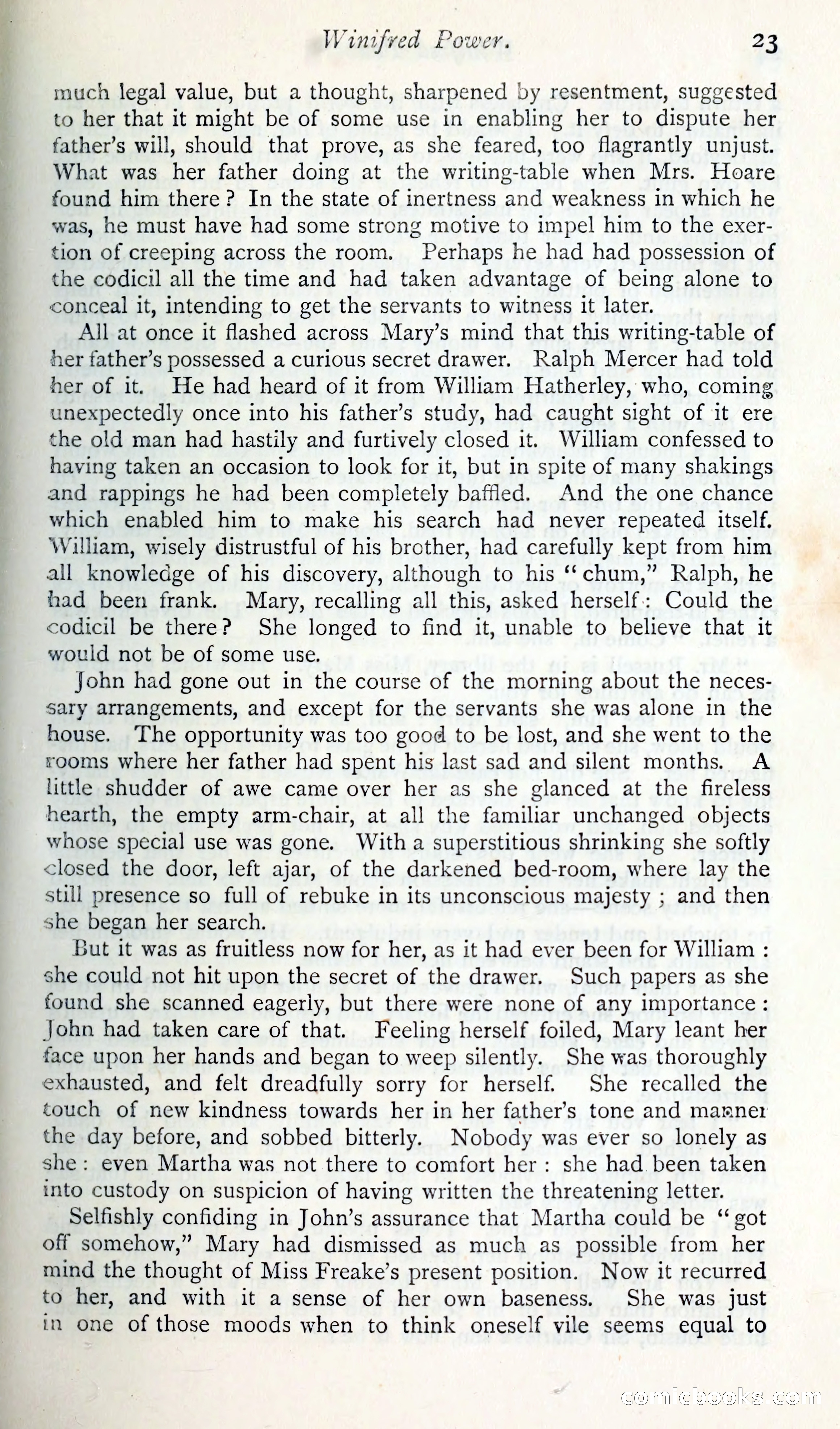
A restored page from Pulp Fiction, 1865. Page through the whole issue in the reader above.
📄 Transcribed text from this page (OCR, searchable)
Machine-transcribed from the original scan — historical spelling and the odd misread are preserved.
Winifred Power. 23 much legal value, but a thought, sharpened by resentment, suggested to her that it might be of some use in enabling her to dispute her father’s will, should that prove, as she feared, too flagrantly unjust. What was her father doing at the writing-table when Mrs. Hoare found him there? In the state of inertness and weakness in which he was, he must have had some strong motive to impel him to the exer- tion of creeping across the room. Perhaps he had had possession of the codicil all the time and had taken advantage of being alone to conceal it, intending to get the servants to witness it later. All at once it flashed across Mary’s mind that this writing-table of her father’s possessed a curious secret drawer. Ralph Mercer had told her of it. He had heard of it from William Hatherley, who, coming unexpectedly once into his father’s study, had caught sight of it ere the old man had hastily and furtively closed it. William confessed to having taken an occasion to look for it, but in spite of many shakings and rappings he had been completely baffled. And the one chance which enabled him to make his search had never repeated itself. William, wisely distrustful of his brother, had carefully kept from him all knowledge of his discovery, although to his ‘‘chum,” Ralph, he had been frank. Mary, recalling all this, asked herself: Could the codicil be there? She longed to find it, unable to believe that it would not be of some use. John had gone out in the course of the morning about the neces- sary arrangements, and except for the servants she was alone in the house. ‘The opportunity was too good to be lost, and she went to the rooms where her father had spent his last sad and silent months. A little shudder of awe came over her as she glanced at the fireless hearth, the empty arm-chair, at all the familiar unchanged objects whose special use was gone. With a superstitious shrinking she softly <losed the door, left ajar, of the darkened bed-room, where lay the still presence so full of rebuke in its unconscious majesty ; and then she began her search. But it was as fruitless now for her, as it had ever been for William : she could not hit upon the secret of the drawer. Such papers as she found she scanned eagerly, but there were none of any importance: John had taken care of that. Feeling herself foiled, Mary leant her face upon her hands and began to weep silently. She was thoroughly exhausted, and felt dreadfully sorry for herself. She recalled the ¢ouch of new kindness towards her in her father’s tone and marner the day before, and sobbed bitterly. Nobody was ever so lonely as she: even Martha was not there to comfort her: she had been taken into custody on suspicion of having written the threatening letter. selfishly confiding in John’s assurance that Martha could be “ got off somehow,” Mary had dismissed as much as possible from her mind the thought of Miss Freake’s present position. Now it recurred to her, and with it a sense of her own baseness. She was just in one of those moods when to think oneself vile seems equal to EOnnicloooks (C©)