
Pulp Fiction, 1865 · page 32 of 399
The Argosy — page 32: what you’re looking at
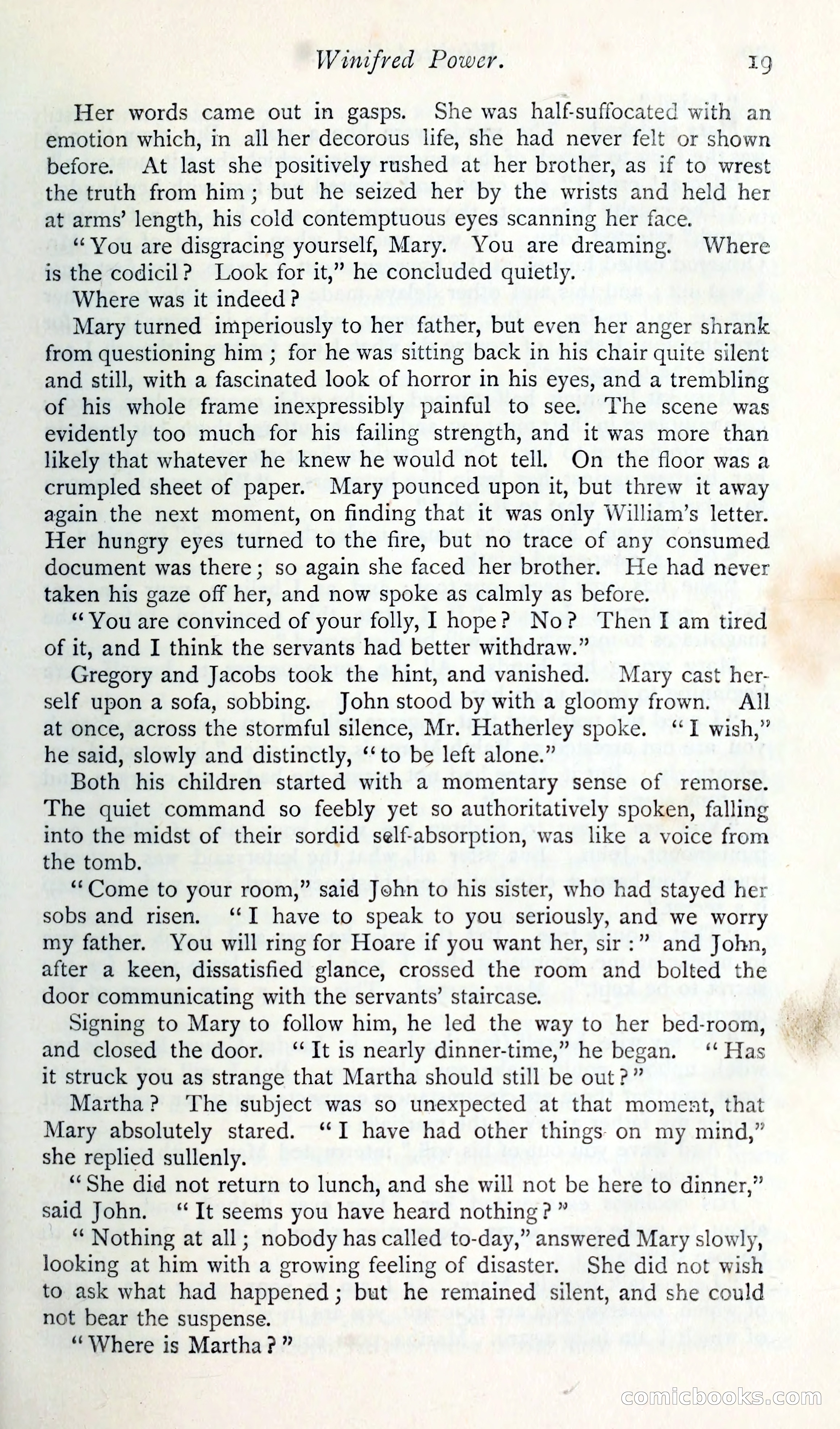
A restored page from Pulp Fiction, 1865. Page through the whole issue in the reader above.
📄 Transcribed text from this page (OCR, searchable)
Machine-transcribed from the original scan — historical spelling and the odd misread are preserved.
Winifred Power. 1g Her words came out in gasps. She was half-suffocated with an emotion which, in all her decorous life, she had never felt or shown before. At last she positively rushed at her brother, as if to wrest the truth from him; but he seized her by the wrists and held her at arms’ length, his cold contemptuous eyes scanning her face. “You are disgracing yourself, Mary. You are dreaming. Where is the codicil? Look for it,” he concluded quietly. Where was it indeed? Mary turned imperiously to her father, but even her anger shrank from questioning him ; for he was sitting back in his chair quite silent and still, with a fascinated look of horror in his eyes, and a trembling of his whole frame inexpressibly painful to see. The scene was evidently too much for his failing strength, and it was more than likely that whatever he knew he would not tell. On the floor was a crumpled sheet of paper. Mary pounced upon it, but threw it away again the next moment, on finding that it was only William’s letter. Her hungry eyes turned to the fire, but no trace of any consumed document was there; so again she faced her brother. He had never taken his gaze off her, and now spoke as calmly as before. “You are convinced of your folly, 1 hope? No? ThenI am tired of it, and I think the servants had better withdraw.” Gregory and Jacobs took the hint, and vanished. Mary cast her- self upon a sofa, sobbing. John stood by with a gloomy frown. All at once, across the stormful silence, Mr. Hatherley spoke. ‘I wish,” he said, slowly and distinctly, ‘‘to be left alone.” Both his children started with a momentary sense of remorse. The quiet command so feebly yet so authoritatively spoken, falling into the midst of their sordid self-absorption, was like a voice from the tomb. ‘“‘Come to your room,” said John to his sister, who had stayed her sobs and risen. ‘‘I have to speak to you seriously, and we worry my father. You will ring for Hoare if you want her, sir:” and John, after a keen, dissatisfied glance, crossed the room and bolted the door communicating with the servants’ staircase. Signing to Mary to follow him, he led the way to her bed-room, and closed the door. “It is nearly dinner-time,” he began. ‘Has it struck you as strange that Martha should still be out?” Ma;xtha? ‘The subject was so unexpected at that moment, that Mary absolutely stared. ‘‘I have had other things: on my mind,” she replied sullenly. | ‘She did not return to lunch, and she will not be here to dinner,” said John. ‘It seems you have heard nothing ? ” ** Nothing at all; nobody has called to-day,” answered Mary slowly, looking at him with a growing feeling of disaster. She did not wish to ask what had happened; but he remained silent, and she could not bear the suspense. “Where is Martha?” ECOnnicloooks (CO)