
Pulp Fiction, 1865 · page 261 of 399
The Argosy — page 261: what you’re looking at
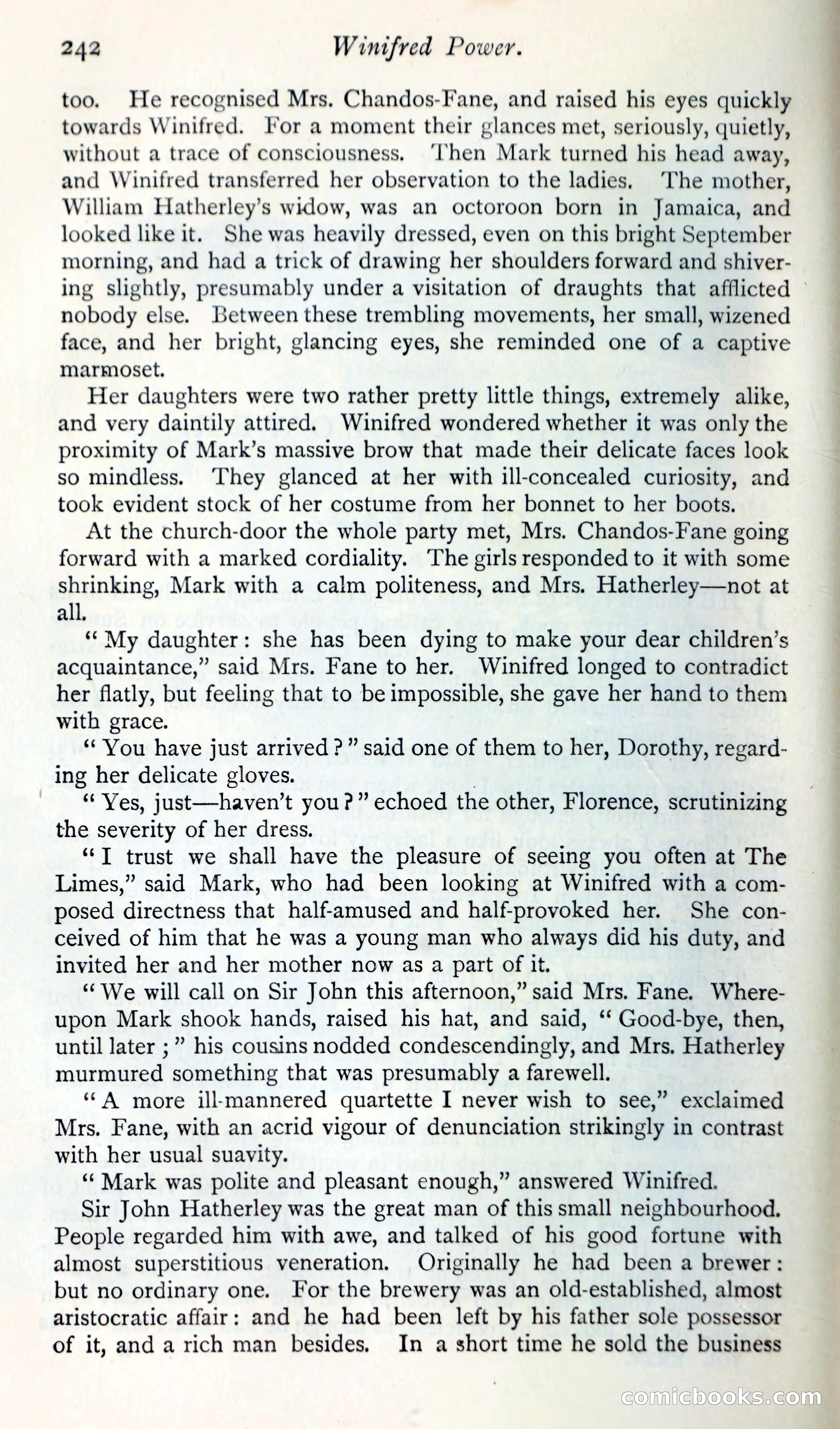
A restored page from Pulp Fiction, 1865. Page through the whole issue in the reader above.
📄 Transcribed text from this page (OCR, searchable)
Machine-transcribed from the original scan — historical spelling and the odd misread are preserved.
242 Winifred Power. too. He recognised Mrs. Chandos-Fane, and raised his eyes quickly towards Winifred. For a moment their glances met, seriously, quietly, without a trace of consciousness. ‘hen Mark turned his head away, and Winifred transferred her observation to the ladies, ‘The mother, William Hatherley’s widow, was an octoroon born in Jamaica, and looked like it. She was heavily dressed, even on this bright September morning, and had a trick of drawing her shoulders forward and shiver- ing slightly, presumably under a visitation of draughts that afflicted nobody else. Between these trembling movements, her small, wizened face, and her bright, glancing eyes, she reminded one of a captive marmoset. Her daughters were two rather pretty little things, extremely alike, and very daintily attired. Winifred wondered whether it was only the proximity of Mark’s massive brow that made their delicate faces look so mindless. ‘They glanced at her with ill-concealed curiosity, and took evident stock of her costume from her bonnet to her boots. At the church-door the whole party met, Mrs. Chandos-Fane going forward with a marked cordiality. The girls responded to it with some shrinking, Mark with a calm politeness, and Mrs. Hatherley—not at all, ‘‘ My daughter: she has been dying to make your dear children’s acquaintance,” said Mrs. Fane to her. Winifred longed to contradict her flatly, but feeling that to be impossible, she gave her hand to them with grace. “You have just arrived ?” said one of them to her, Dorothy, regard- ing her delicate gloves. 3 “Yes, just—haven’t you?” echoed the other, Florence, scrutinizing the severity of her dress. ‘‘T trust we shall have the pleasure of seeing you often at The Limes,” said Mark, who had been looking at Winifred with a com- posed directness that half-amused and half-provoked her. She con- ceived of him that he was a young man who always did his duty, and invited her and her mother now as a part of it. ‘We will call on Sir John this afternoon,” said Mrs. Fane. Where- upon Mark shook hands, raised his hat, and said, ‘‘ Good-bye, then, until later ;” his cousins nodded condescendingly, and Mrs, Hatherley murmured something that was presumably a farewell. ‘‘A more ill-mannered quartette I never wish to see,” exclaimed Mrs. Fane, with an acrid vigour of denunciation strikingly in contrast with her usual suavity. ‘¢ Mark was polite and pleasant enough,” answered Winifred. Sir John Hatherley was the great man of this small neighbourhood. People regarded him with awe, and talked of his good fortune with almost superstitious veneration. Originally he had been a brewer: but no ordinary one. For the brewery was an old-established, almost aristocratic affair: and he had been left by his father sole possessor of it, and a rich man besides. In a short time he sold the business Gomicbooks.co