
Pulp Fiction, 1865 · page 249 of 399
The Argosy — page 249: what you’re looking at
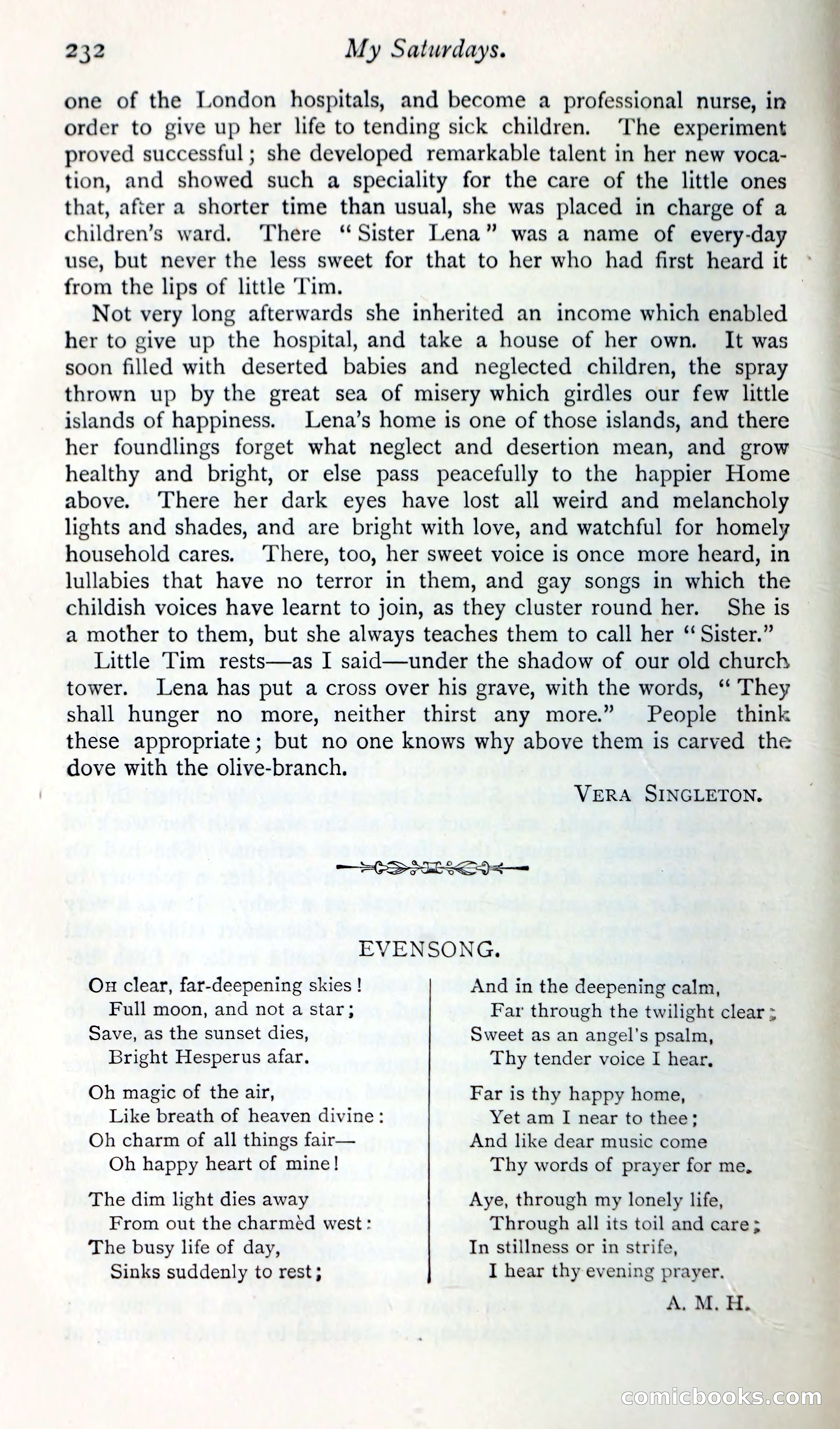
A restored page from Pulp Fiction, 1865. Page through the whole issue in the reader above.
📄 Transcribed text from this page (OCR, searchable)
Machine-transcribed from the original scan — historical spelling and the odd misread are preserved.
232 My Saturdays. one of the London hospitals, and become a professional nurse, in order to give up her life to tending sick children. ‘The experiment proved successful; she developed remarkable talent in her new voca- tion, and showed such a speciality for the care of the little ones that, after a shorter time than usual, she was placed in charge of a children’s ward. There “Sister Lena” was a name of every-day use, but never the less sweet for that to her who had first heard it > from the lips of little ‘Tim. Not very long afterwards she inherited an income which enabled her to give up the hospital, and take a house of her own. It was soon filled with deserted babies and neglected children, the spray thrown up by the great sea of misery which girdles our few little islands of happiness. Lena’s home is one of those islands, and there her foundlings forget what neglect and desertion mean, and grow healthy and bright, or else pass peacefully to the happier Home above. ‘There her dark eyes have lost all weird and melancholy lights and shades, and are bright with love, and watchful for homely household cares. ‘There, too, her sweet voice is once more heard, in lullabies that have no terror in them, and gay songs in which the childish voices have learnt to join, as they cluster round her. She is a mother to them, but she always teaches them to call her ‘ Sister.” Little Tim rests—as J said—under the shadow of our old church tower. Lena has put a cross over his grave, with the words, ‘“‘ They shall hunger no more, neither thirst any more.” People think these appropriate; but no one knows why above them is carved the dove with the olive-branch. VERA SINGLETON. SS aia EVENSONG. Ou clear, far-deepening skies ! And in the deepening calm, Full moon, and not a star; Far through the twilight clear ; Save, as the sunset dies, Sweet as an angel’s psalm, Bright Hesperus afar. Thy tender voice I hear, Oh magic of the air, Far is thy happy home, Like breath of heaven divine: Yet am I near to thee; Oh charm of all things fair— And like dear music come Oh happy heart of mine! Thy words of prayer for me, The dim light dies away Aye, through my lonely life, From out the charmed west: Through all its toil and care; The busy life of day, In stillness or in strife, Sinks suddenly to rest; I hear thy evening prayer. A, M, H, Gomicbooks.¢o