
Pulp Fiction, 1865 · page 239 of 399
The Argosy — page 239: what you’re looking at
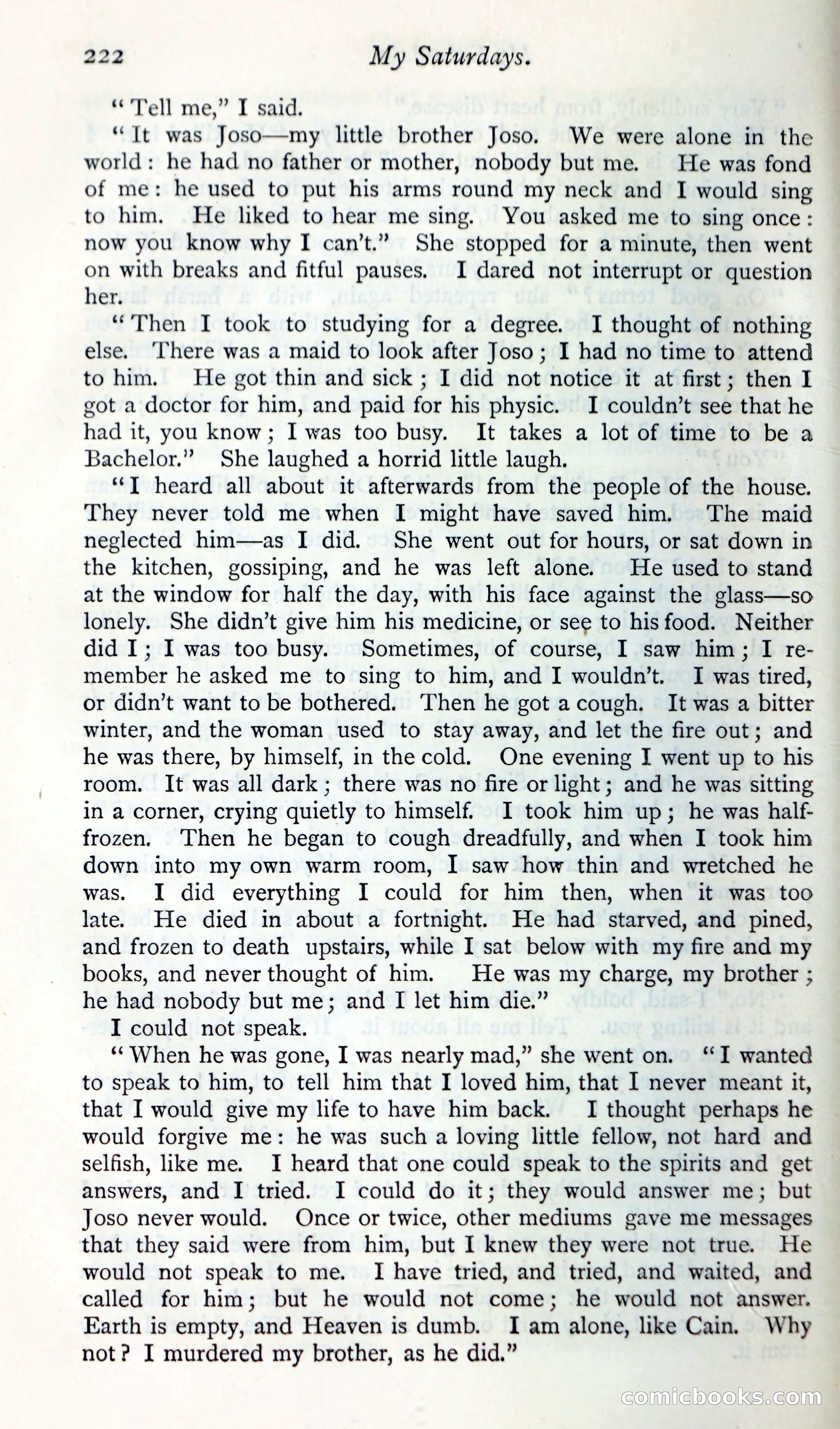
A restored page from Pulp Fiction, 1865. Page through the whole issue in the reader above.
📄 Transcribed text from this page (OCR, searchable)
Machine-transcribed from the original scan — historical spelling and the odd misread are preserved.
222 My Saturdays. Tell me,” I said. “Tt was Joso—my little brother Joso. We were alone in the world: he had no father or mother, nobody but me. He was fond of me: he used to put his arms round my neck and I would sing to him. He hked to hear me sing. You asked me to sing once: now you know why I can’t.” She stopped for a minute, then went on with breaks and fitful pauses. I dared not interrupt or question her. “Then I took to studying for a degree. I thought of nothing else. ‘There was a maid to look after Joso; I had no time to attend to him. He got thin and sick ; I did not notice it at first; then I got a doctor for him, and paid for his physic. I couldn’t see that he had it, you know; I was too busy. It takes a lot of time to be a Bachelor.” She laughed a horrid little laugh. ‘‘T heard all about it afterwards from the people of the house. They never told me when I might have saved him. The maid neglected him—as I did. She went out for hours, or sat down in the kitchen, gossiping, and he was left alone. He used to stand at the window for half the day, with his face against the glass—so lonely. She didn’t give him his medicine, or see to his food. Neither did I; I was too busy. Sometimes, of course, I saw him; I re- member he asked me to sing to him, and I wouldn’t. I was tired, or didn’t want to be bothered. Then he got acough. It was a bitter winter, and the woman used to stay away, and let the fire out; and he was there, by himself, in the cold. One evening I went up to his room. It was all dark; there was no fire or light; and he was sitting in a corner, crying quietly to himself. I took him up; he was half- frozen. ‘Then he began to cough dreadfully, and when I took him down into my own warm room, I saw how thin and wretched he was. I did everything I could for him then, when it was too late. He died in about a fortnight. He had starved, and pined, and frozen to death upstairs, while I sat below with my fire and my books, and never thought of him. He was my charge, my brother ; he had nobody but me; and I let him die.” I could not speak. ‘‘'‘When he was gone, I was nearly mad,” she went on. “I wanted to speak to him, to tell him that I loved him, that I never meant it, that I would give my life to have him back. I thought perhaps he would forgive me: he was such a loving little fellow, not hard and selfish, like me. I heard that one could speak to the spirits and get answers, and I tried. I could do it; they would answer me; but Joso never would. Once or twice, other mediums gave me messages that they said were from him, but I knew they were not true. He would not speak to me. I have tried, and tried, and waited, and called for him; but he would not come; he would not answer. Earth is empty, and Heaven is dumb. I am alone, like Cain. Why not? I murdered my brother, as he did.” CORNICE OOOKS. COA