
Pulp Fiction, 1865 · page 231 of 399
The Argosy — page 231: what you’re looking at
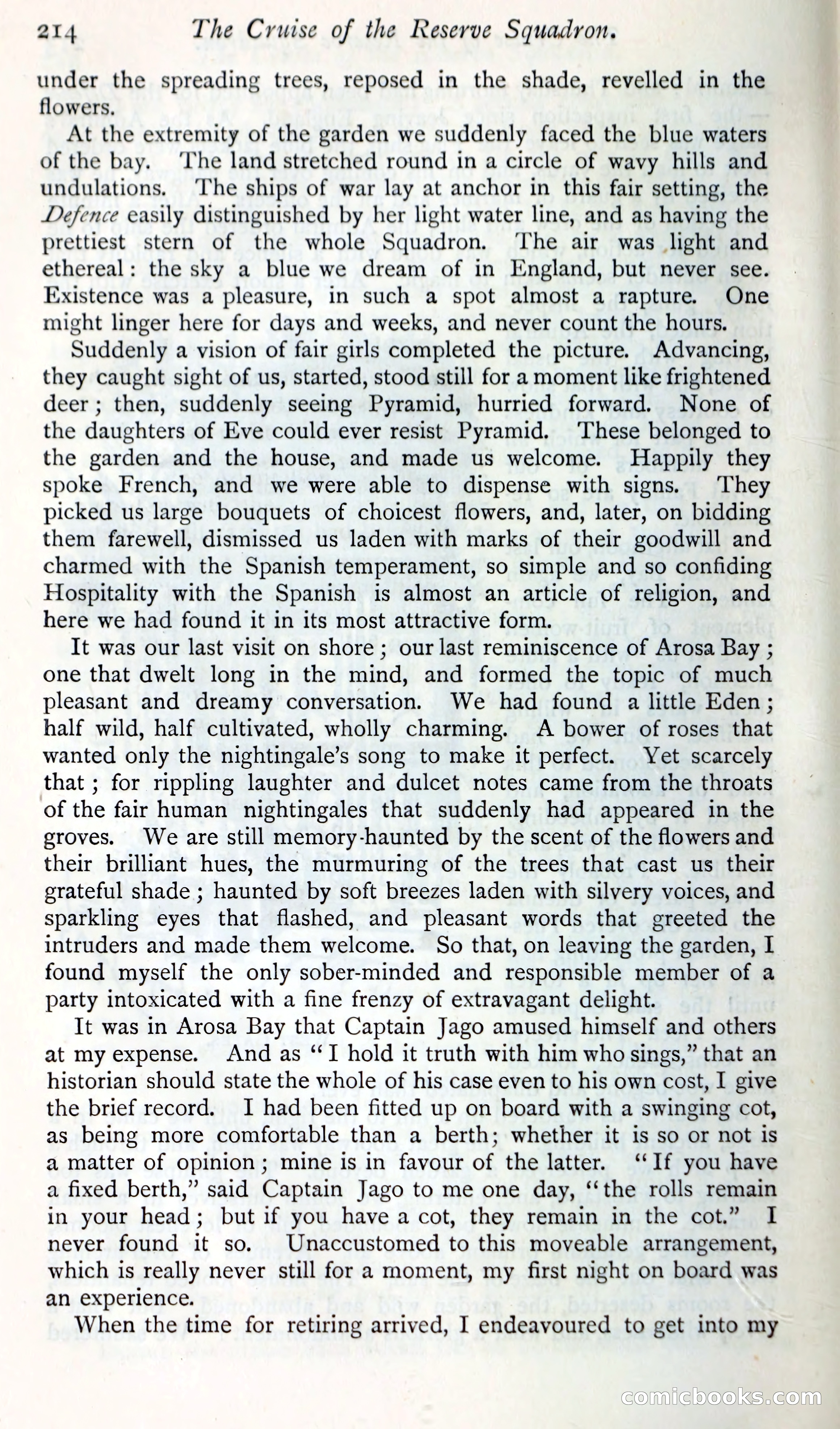
A restored page from Pulp Fiction, 1865. Page through the whole issue in the reader above.
📄 Transcribed text from this page (OCR, searchable)
Machine-transcribed from the original scan — historical spelling and the odd misread are preserved.
214 The Cruise of the Reserve Squadron. under the spreading trees, reposed in the shade, revelled in the flowers, At the extremity of the garden we suddenly faced the blue waters of the bay. ‘The land stretched round in a circle of wavy hills and undulations. The ships of war lay at anchor in this fair setting, the Defence easily distinguished by her light water line, and as having the prettiest stern of the whole Squadron. ‘The air was light and ethereal: the sky a blue we dream of in England, but never see. Existence was a pleasure, in such a spot almost a rapture. One might linger here for days and weeks, and never count the hours. Suddenly a vision of fair girls completed the picture. Advancing, they caught sight of us, started, stood still for a moment like frightened deer ; then, suddenly seeing Pyramid, hurried forward. None of the daughters of Eve could ever resist Pyramid. ‘These belonged to the garden and the house, and made us welcome. Happily they spoke French, and we were able to dispense with signs. They picked us large bouquets of choicest flowers, and, later, on bidding them farewell, dismissed us laden with marks of their goodwill and charmed with the Spanish temperament, so simple and so confiding Hospitality with the Spanish is almost an article of religion, and here we had found it in its most attractive form. It was our last visit on shore; our last reminiscence of Arosa Bay ; one that dwelt long in the mind, and formed the topic of much pleasant and dreamy conversation. We had found a little Eden; half wild, half cultivated, wholly charming. A bower of roses that wanted only the nightingale’s song to make it perfect. Yet scarcely that ; for rippling laughter and dulcet notes came from the throats of the fair human nightingales that suddenly had appeared in the groves. We are still memory-haunted by the scent of the flowers and their brilliant hues, the murmuring of the trees that cast us their grateful shade ; haunted by soft breezes laden with silvery voices, and sparkling eyes that flashed, and pleasant words that greeted the intruders and made them welcome. So that, on leaving the garden, | found myself the only sober-minded and responsible member of a party intoxicated with a fine frenzy of extravagant delight. It was in Arosa Bay that Captain Jago amused himself and others at my expense. And as “J hold it truth with him who sings,” that an historian should state the whole of his case even to his own cost, I give the brief record. I had been fitted up on board with a swinging cot, as being more comfortable than a berth; whether it is so or not is a matter of opinion; mine is in favour of the latter. ‘If you have a fixed berth,” said Captain Jago to me one day, ‘‘the rolls remain in your head; but if you have a cot, they remain in the cot.” I never found it so. Unaccustomed to this moveable arrangement, which is really never still for a moment, my first night on board was an experience. When the time for retiring arrived, I endeavoured to get into my GomicbooksnGo m