
Pulp Fiction, 1865 · page 200 of 399
The Argosy — page 200: what you’re looking at
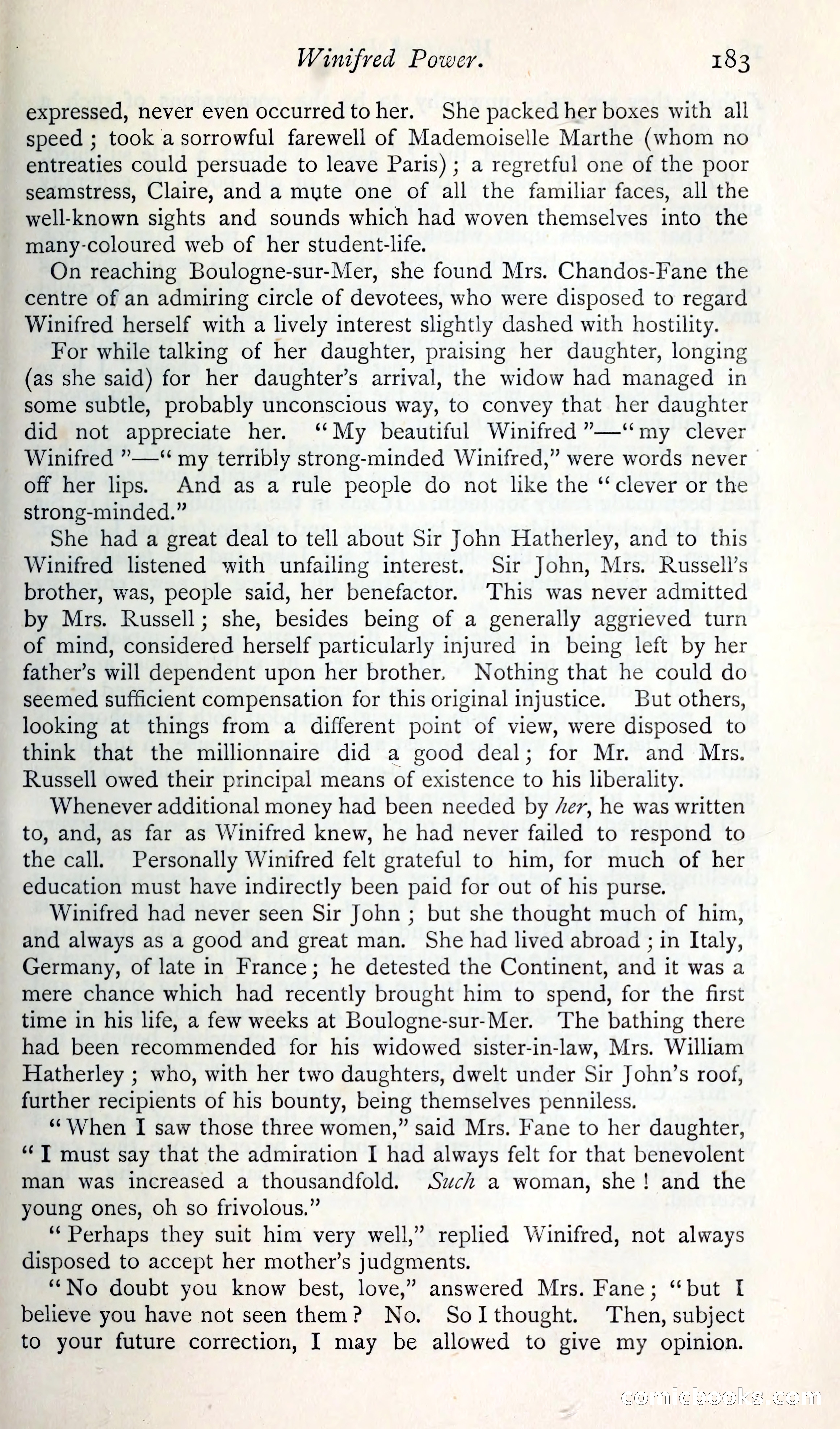
A restored page from Pulp Fiction, 1865. Page through the whole issue in the reader above.
📄 Transcribed text from this page (OCR, searchable)
Machine-transcribed from the original scan — historical spelling and the odd misread are preserved.
Winifred Power. 183 expressed, never even occurredtoher. She packed her boxes with all speed ; took a sorrowful farewell of Mademoiselle Marthe (whom no entreaties could persuade to leave Paris); a regretful one of the poor seamstress, Claire, and a mute one of all the familiar faces, all the well-known sights and sounds which had woven themselves into the many-coloured web of her student-life. On reaching Boulogne-sur-Mer, she found Mrs. Chandos-Fane the centre of an admiring circle of devotees, who were disposed to regard Winifred herself with a lively interest slightly dashed with hostility. For while talking of her daughter, praising her daughter, longing (as she said) for her daughter’s arrival, the widow had managed in some subtle, probably unconscious way, to convey that her daughter did not appreciate her. ‘‘My beautiful Winifred ”»—‘“‘my clever Winifred ”—“ my terribly strong-minded Winifred,” were words never off her lips. And as a rule people do not like the ‘‘ clever or the strong-minded.” She had a great deal to tell about Sir John Hatherley, and to this Winifred listened with unfailing interest. Sir John, Mrs. Russell’s brother, was, people said, her benefactor. ‘This was never admitted by Mrs. Russell; she, besides being of a generally aggrieved turn of mind, considered herself particularly injured in being left by her father’s will dependent upon her brother. Nothing that he could do seemed sufficient compensation for this original injustice. But others, looking at things from a different point of view, were disposed to think that the millionnaire did a good deal; for Mr. and Mrs. Russell owed their principal means of existence to his liberality. Whenever additional money had been needed by “er, he was written to, and, as far as Winifred knew, he had never failed to respond to the call. Personally Winifred felt grateful to him, for much of her education must have indirectly been paid for out of his purse. Winifred had never seen Sir John ; but she thought much of him, and always as a good and great man. She had lived abroad ; in Italy, Germany, of late in France; he detested the Continent, and it was a mere chance which had recently brought him to spend, for the first time in his life, a few weeks at Boulogne-sur-Mer. ‘The bathing there had been recommended for his widowed sister-in-law, Mrs. William Hatherley ; who, with her two daughters, dwelt under Sir John’s roof, further recipients of his bounty, being themselves penniless. “When I saw those three women,” said Mrs. Fane to her daughter, ‘I must say that the admiration I had always felt for that benevolent man was increased a thousandfold. Such a woman, she! and the young ones, oh so frivolous.” ‘Perhaps they suit him very well,” replied Winifred, not always disposed to accept her mother’s judgments. ““No doubt you know best, love,” answered Mrs. Fane; “but I believe you have not seen them? No. Solthought. Then, subject to your future correction, I may be allowed to give my opinion. Conniclooo! SS) (C(O)