
Pulp Fiction, 1865 · page 77 of 400
The Argosy — page 77: what you’re looking at
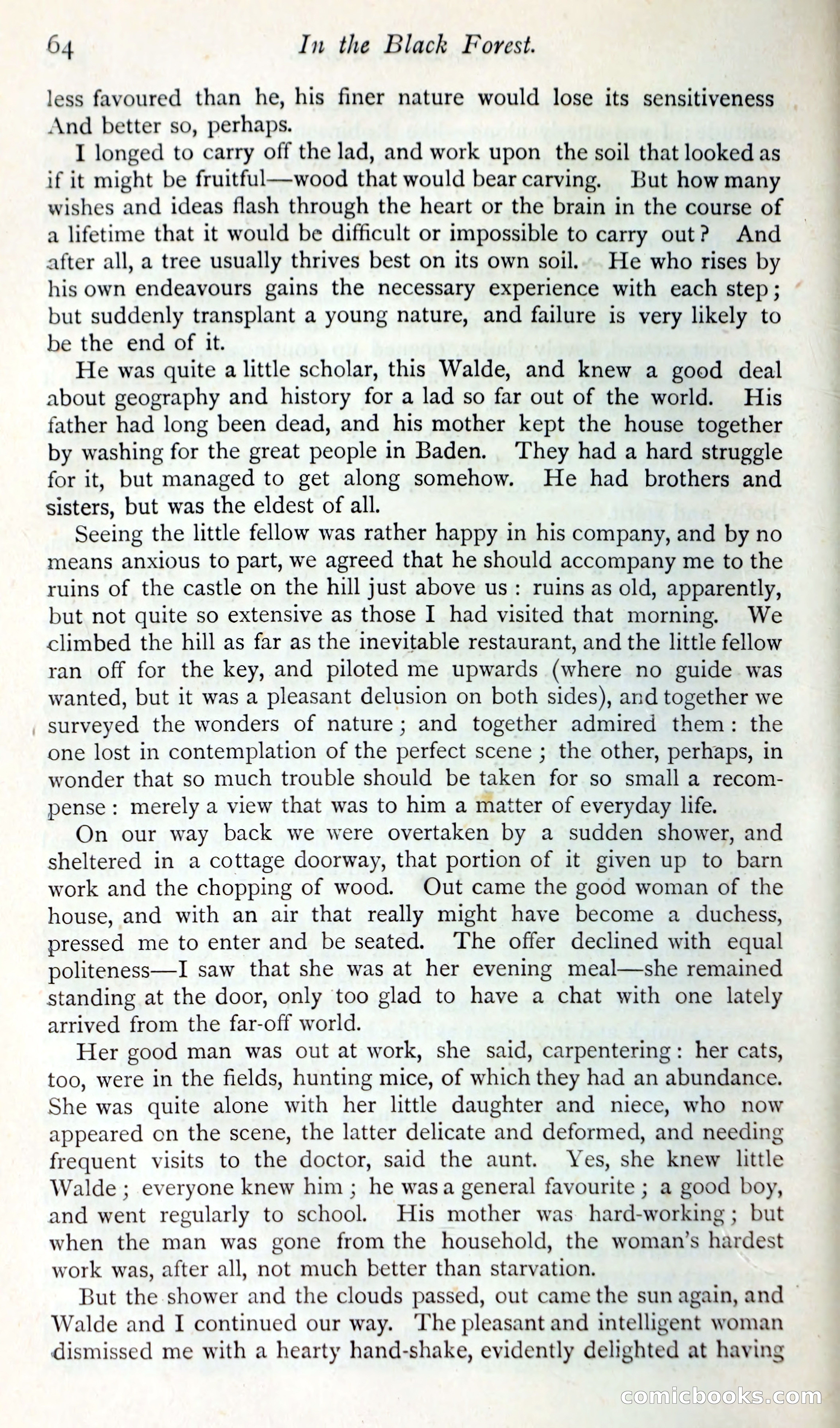
A restored page from Pulp Fiction, 1865. Page through the whole issue in the reader above.
📄 Transcribed text from this page (OCR, searchable)
Machine-transcribed from the original scan — historical spelling and the odd misread are preserved.
64 In the Black Forest. less favoured than he, his finer nature would lose its sensitiveness And better so, perhaps. I longed to carry off the lad, and work upon the soil that looked as if it might be fruitful—wood that would bearcarving. But how many wishes and ideas flash through the heart or the brain in the course of a lifetime that it would be difficult or impossible to carry out? And after all, a tree usually thrives best on its own soil... He who rises by his own endeavours gains the necessary experience with each step; — but suddenly transplant a young nature, and failure is very likely to be the end of it. He was quite a little scholar, this Walde, and knew a good deal about geography and history for a lad so far out of the world. His father had long been dead, and his mother kept the house together by washing for the great people in Baden. ‘They had a hard struggle for it, but managed to get along somehow. He had brothers and sisters, but was the eldest of all. Seeing the little fellow was rather happy in his company, and by no means anxious to part, we agreed that he should accompany me to the ruins of the castle on the hill just above us: ruins as old, apparently, but not quite so extensive as those I had visited that morning. We climbed the hill as far as the inevitable restaurant, and the little fellow ran off for the key, and piloted me upwards (where no guide was wanted, but it was a pleasant delusion on both sides), and together we _ surveyed the wonders of nature; and together admired them: the one lost in contemplation of the perfect scene ; the other, perhaps, in wonder that so much trouble should be taken for so small a recom- pense : merely a view that was to him a matter of everyday life. On our way back we were overtaken by a sudden shower, and sheltered in a cottage doorway, that portion of it given up to barn work and the chopping of wood. Out came the good woman of the house, and with an air that really might have become a duchess, pressed me to enter and be seated. ‘The offer declined with equal politeness—I saw that she was at her evening meal—she remained standing at the door, only too glad to have a chat with one lately arrived from the far-off world. Her good man was out at work, she said, carpentering: her cats, too, were in the fields, hunting mice, of which they had an abundance. She was quite alone with her little daughter and niece, who now appeared on the scene, the latter delicate and deformed, and needing frequent visits to the doctor, said the aunt. Yes, she knew little Walde ; everyone knew him ; he wasa general favourite ; a good boy, and went regularly to school. His mother was hard-working; but when the man was gone from the household, the woman’s hardest work was, after all, not much better than starvation. But the shower and the clouds passed, out came the sun again, and | Walde and I continued our way. The pleasant and intelligent woman dismissed me with a hearty hand-shake, evidently delighted at having ECOMMICLOCO!<S.(6O m , —