
Pulp Fiction, 1865 · page 58 of 400
The Argosy — page 58: what you’re looking at
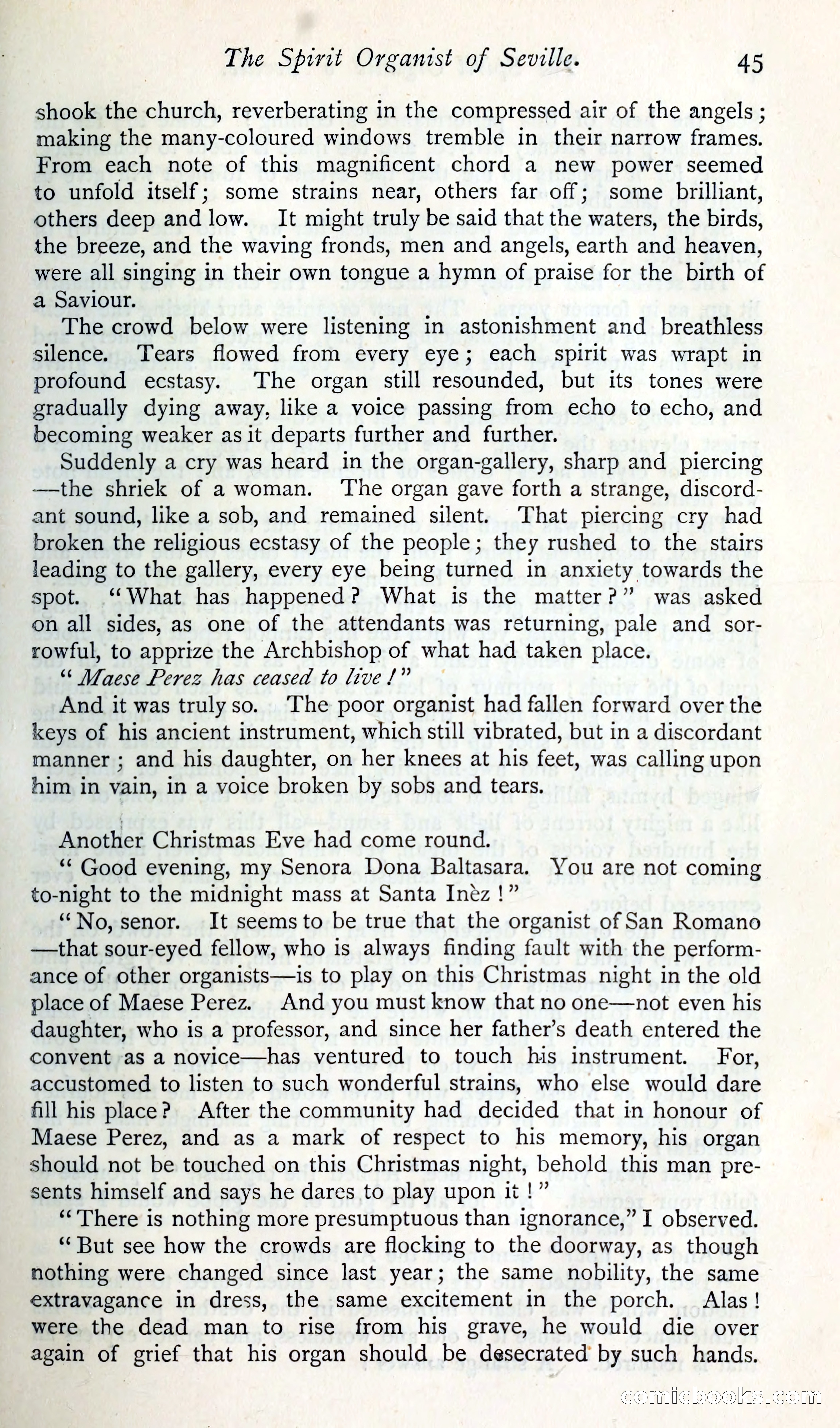
A restored page from Pulp Fiction, 1865. Page through the whole issue in the reader above.
📄 Transcribed text from this page (OCR, searchable)
Machine-transcribed from the original scan — historical spelling and the odd misread are preserved.
The Spirit Organist of Seville. 45 shook the church, reverberating in the compressed air of the angels ; making the many-coloured windows tremble in their narrow frames. From each note of this magnificent chord a new power seemed to unfold itself; some strains near, others far off; some brilliant, others deep and low. It might truly be said that the waters, the birds, the breeze, and the waving fronds, men and angels, earth and heaven, were all singing in their own tongue a hymn of praise for the birth of a Saviour. The crowd below were listening in astonishment and breathless silence. ‘Tears flowed from every eye; each spirit was wrapt in profound ecstasy. The organ still resounded, but its tones were gradually dying away, like a voice passing from echo to echo, and becoming weaker as it departs further and further. Suddenly a cry was heard in the organ-gallery, sharp and piercing —the shriek of a woman. ‘The organ gave forth a strange, discord- ant sound, like a sob, and remained silent. ‘That piercing cry had broken the religious ecstasy of the people; they rushed to the stairs leading to the gallery, every eye being turned in anxiety towards the spot. ‘‘What has happened? What is the matter?” was asked on all sides, as one of the attendants was returning, pale and sor- rowful, to apprize the Archbishop of what had taken place. “© Maese Perez has ceased to live /” And it was trulyso. The poor organist had fallen forward over the keys of his ancient instrument, which still vibrated, but in a discordant manner ; and his daughter, on her knees at his feet, was calling upon him in vain, in a voice broken by sobs and tears. Another Christmas Eve had come round. “ Good evening, my Senora Dona Baltasara. You are not coming to-night to the midnight mass at Santa Inez !” ‘‘No, senor. It seemsto be true that the organist of San Romano —that sour-eyed fellow, who is always finding fault with the perform- ance of other organists—is to play on this Christmas night in the old place of Maese Perez. And you must know that no one—not even his daughter, who is a professor, and since her father’s death entered the convent as a novice—has ventured to touch his instrument. For, accustomed to listen to such wonderful strains, who else would dare fill his place? After the community had decided that in honour of Maese Perez, and as a mark of respect to his memory, his organ should not be touched on this Christmas night, behold this man pre- sents himself and says he dares to play upon it!” ‘There is nothing more presumptuous than ignorance,” I observed. ‘But see how the crowds are flocking to the doorway, as though nothing were changed since last year; the same nobility, the same extravagance in dress, the same excitement in the porch. Alas! were the dead man to rise from his grave, he would die over again of grief that his organ should be desecrated by such hands. conniclbooolks (C(O)