
Pulp Fiction, 1865 · page 391 of 400
The Argosy — page 391: what you’re looking at
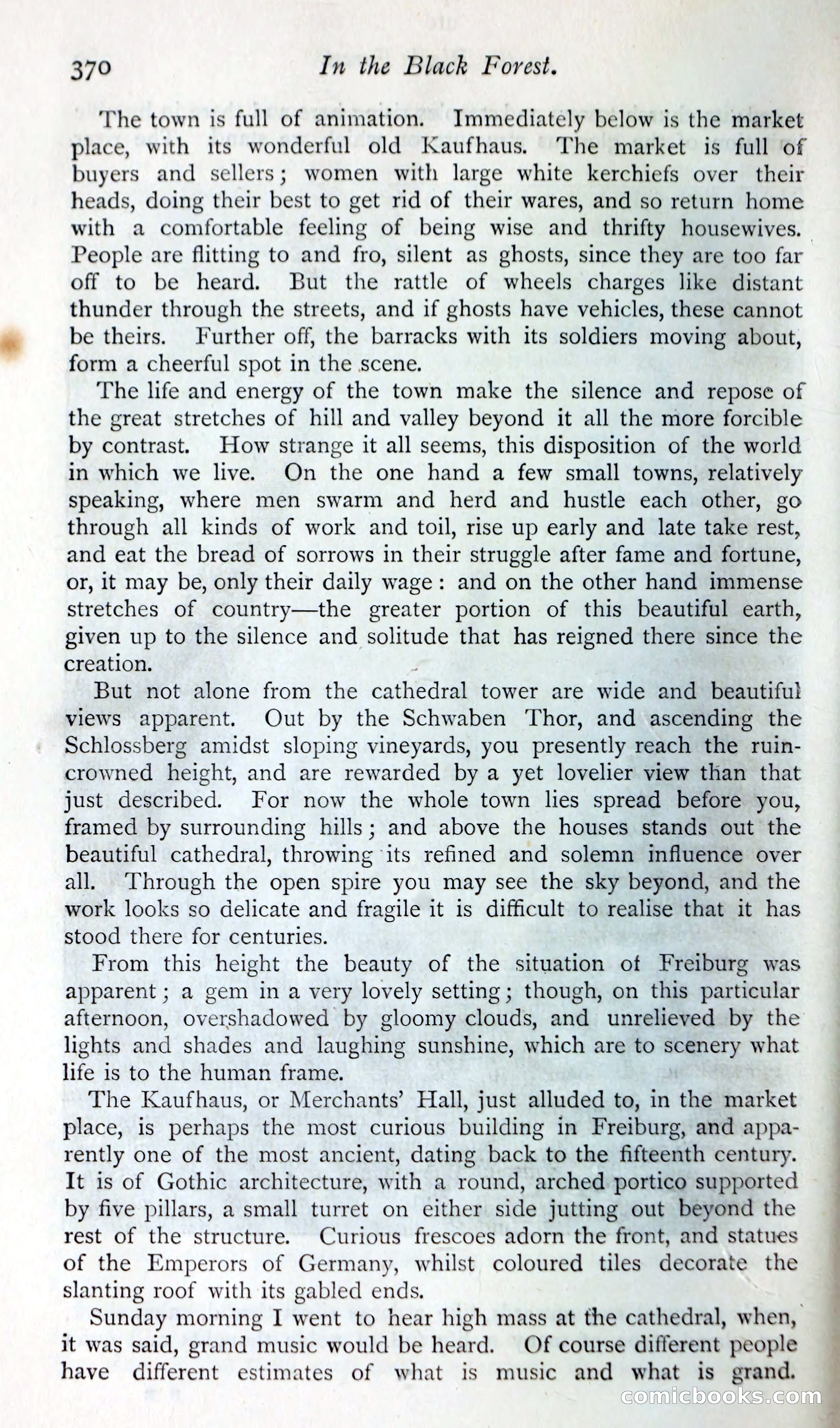
A restored page from Pulp Fiction, 1865. Page through the whole issue in the reader above.
📄 Transcribed text from this page (OCR, searchable)
Machine-transcribed from the original scan — historical spelling and the odd misread are preserved.
370 In the Black Forest. The town is full of animation. Immediately below is the market place, with its wonderful old Kaufhaus. The market is full of buyers and sellers; women with large white kerchiefs over their heads, doing their best to get rid of their wares, and so return home with a comfortable feeling of being wise and thrifty housewives. People are flitting to and fro, silent as ghosts, since they are too far off to be heard. But the rattle of wheels charges like distant thunder through the streets, and if ghosts have vehicles, these cannot be theirs. Further off, the barracks with its soldiers moving about, form a cheerful spot in the scene. The life and energy of the town make the silence and repose of the great stretches of hill and valley beyond it all the more forcible by contrast. How strange it all seems, this disposition of the world in which we live. On the one hand a few small towns, relatively speaking, where men swarm and herd and hustle each other, go through all kinds of work and toil, rise up early and late take rest, and eat the bread of sorrows in their struggle after fame and fortune, or, it may be, only their daily wage: and on the other hand immense stretches of country—the greater portion of this beautiful earth, given up to the silence and solitude that has reigned there since the creation. . But not alone from the cathedral tower are wide and beautiful views apparent. Out by the Schwaben ‘Thor, and ascending the Schlossberg amidst sloping vineyards, you presently reach the ruin- crowned height, and are rewarded by a yet lovelier view than that just described. For now the whole town lies spread before you, framed by surrounding hills; and above the houses stands out the beautiful cathedral, throwing its refined and solemn influence over all. ‘Through the open spire you may see the sky beyond, and the work looks so delicate and fragile it is difficult to realise that it has stood there for centuries. From this height the beauty of the situation of Freiburg was apparent ; a gem in a very lovely setting; though, on this particular afternoon, overshadowed by gloomy clouds, and unrelieved by the lights and shades and laughing sunshine, which are to scenery what life is to the human frame. The Kaufhaus, or Merchants’ Hall, just alluded to, in the market place, is perhaps the most curious building in Freiburg, and appa- rently one of the most ancient, dating back to the fifteenth century. It is of Gothic architecture, with a round, arched portico supported by five pillars, a small turret on either side jutting out beyond the rest of the structure. Curious frescoes adorn the front, and statues of the Emperors of Germany, whilst coloured tiles decorate the slanting roof with its gabled ends. Sunday morning I went to hear high mass at the cathedral, when, it was said, grand music would be heard. Of course different people have different estimates of what is music and what is grand. COMMENOO KS EO)