
Pulp Fiction, 1865 · page 389 of 400
The Argosy — page 389: what you’re looking at
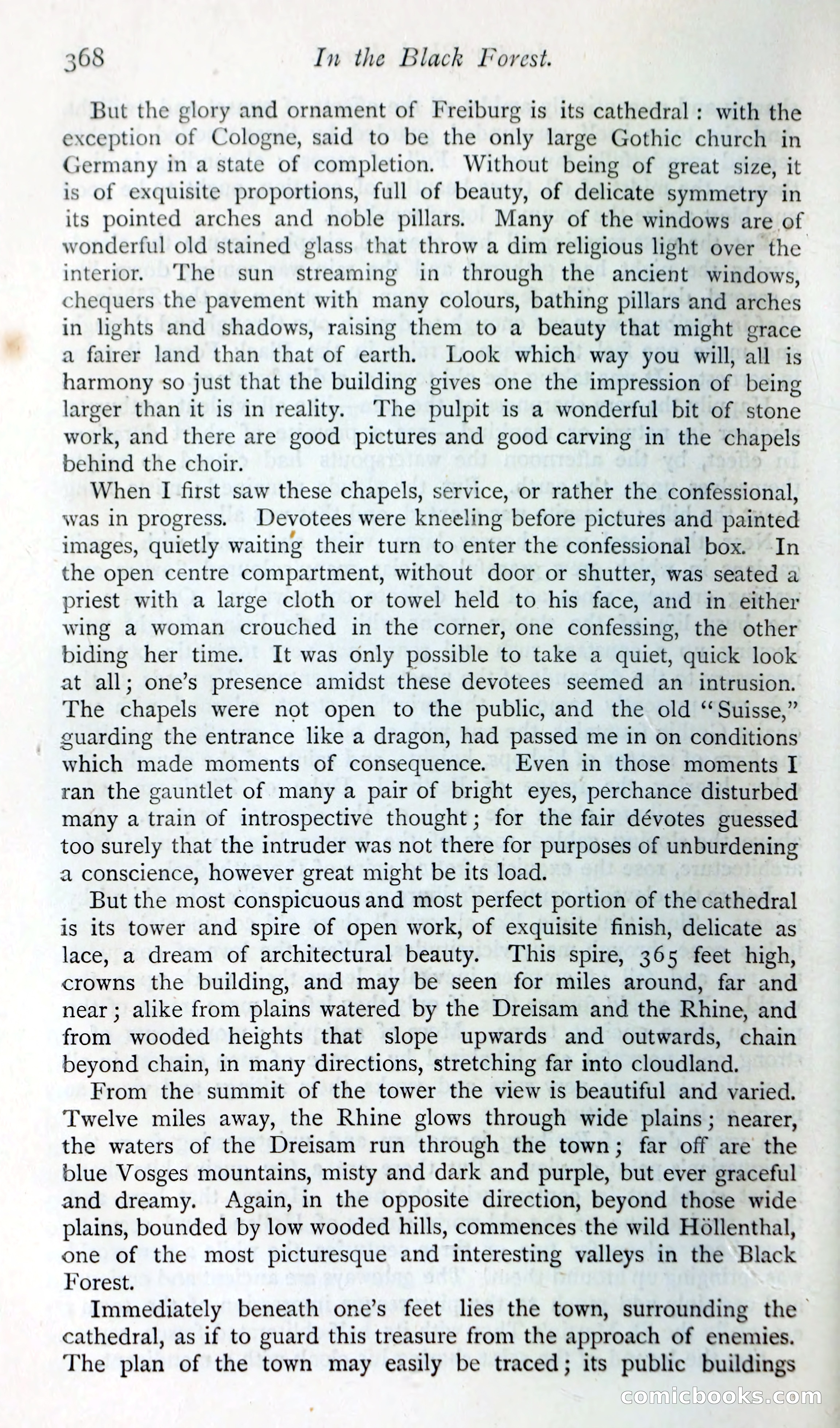
A restored page from Pulp Fiction, 1865. Page through the whole issue in the reader above.
📄 Transcribed text from this page (OCR, searchable)
Machine-transcribed from the original scan — historical spelling and the odd misread are preserved.
368 In the Black Forest. But the glory and ornament of Freiburg is its cathedral: with the exception of Cologne, said to be the only large Gothic church in Germany In a state of completion. Without being of great size, it is of exquisite proportions, full of beauty, of delicate symmetry in its pointed arches and noble pillars. Many of the windows are of wonderful old stained glass that throw a dim religious light over the interior. ‘The sun streaming in through the ancient windows, chequers the pavement with many colours, bathing pillars and arches in lights and shadows, raising them to a beauty that might grace a fairer land than that of earth. Look which way you will, all is harmony so just that the building gives one the impression of being larger than it is in reality. The pulpit is a wonderful bit of stone work, and there are good pictures and good carving in the chapels behind the chor. When I first saw these chapels, service, or rather the confessional, was in progress. Devotees were kneeling before pictures and paifited images, quietly waiting their turn to enter the confessional box. In the open centre compartment, without door or shutter, was seated a priest with a large cloth or towel held to his face, and in either wing a woman crouched in the corner, one confessing, the other biding her time. It was only possible to take a quiet, quick look at all; one’s presence amidst these devotees seemed an intrusion. The chapels were not open to the public, and the old “Suisse,” guarding the entrance like a dragon, had passed me in on conditions which made moments of consequence. Even in those moments I ran the gauntlet of many a pair of bright eyes, perchance disturbed many a train of introspective thought; for the fair dévotes guessed too surely that the intruder was not there for purposes of unburdening a conscience, however great might be its load. But the most conspicuous and most perfect portion of the cathedral is its tower and spire of open work, of exquisite finish, delicate as lace, a dream of architectural beauty. This spire, 365 feet high, crowns the building, and may be seen for miles around, far and near; alike from plains watered by the Dreisam and the Rhine, and from wooded heights that slope upwards and outwards, chain beyond chain, in many directions, stretching far into cloudland. From the summit of the tower the view is beautiful and varied. Twelve miles away, the Rhine glows through wide plains; nearer, the waters of the Dreisam run through the town; far off are the blue Vosges mountains, misty and dark and purple, but ever graceful and dreamy. Again, in the opposite direction, beyond those wide plains, bounded by low wooded hills, commences the wild Hoéllenthal, one of the most picturesque and interesting valleys in the Black Forest. Immediately beneath one’s feet lies the town, surrounding the cathedral, as if to guard this treasure from the approach of enemies. The plan of the town may easily be traced; its public buildings ECOMMICLOCO)<Sn(© m