
Pulp Fiction, 1865 · page 380 of 400
The Argosy — page 380: what you’re looking at
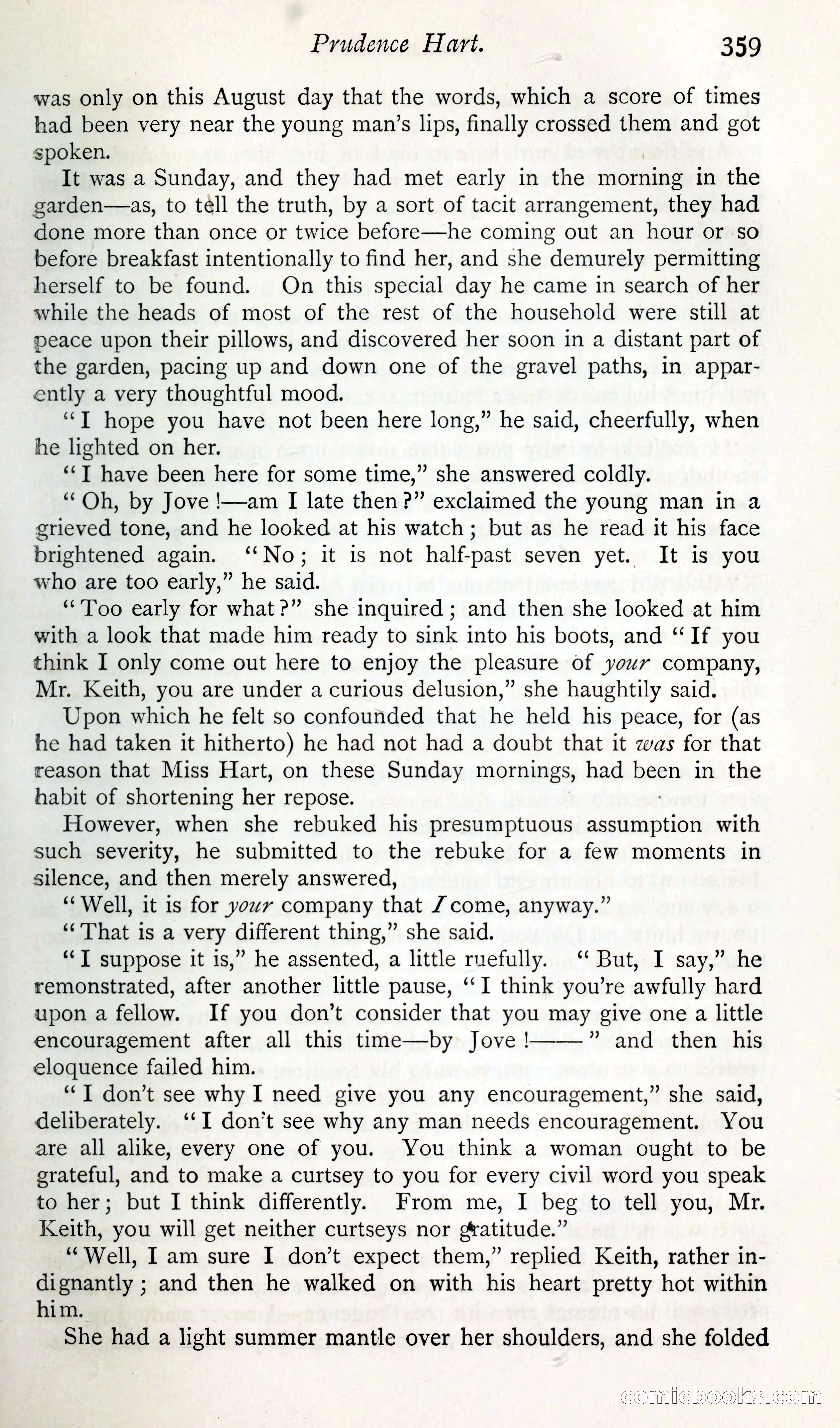
A restored page from Pulp Fiction, 1865. Page through the whole issue in the reader above.
📄 Transcribed text from this page (OCR, searchable)
Machine-transcribed from the original scan — historical spelling and the odd misread are preserved.
Prudence Hart. 359 was only on this August day that the words, which a score of times had been very near the young man’s lips, finally crossed them and got spoken. It was a Sunday, and they had met early in the morning in the garden—as, to téll the truth, by a sort of tacit arrangement, they had done more than once or twice before—he coming out an hour or so before breakfast intentionally to find her, and she demurely permitting herself to be found. On this special day he came in search of her while the heads of most of the rest of the household were still at peace upon their pillows, and discovered her soon in a distant part of the garden, pacing up and down one of the gravel paths, in appar- ently a very thoughtful mood. ‘“‘T hope you have not been here long,” he said, cheerfully, when he lighted on her. ‘“‘T have been here for some time,” she answered coldly. ‘““Oh, by Jove !—am I late then ?” exclaimed the young man in a grieved tone, and he looked at his watch; but as he read it his face brightened again. ‘‘No; it is not half-past seven yet. It is you who are too early,” he said. “Too early for what ?” she inquired ; and then she looked at him with a look that made him ready to sink into his boots, and “If you think I only come out here to enjoy the pleasure of your company, Mr. Keith, you are under a curious delusion,” she haughtily said. Upon which he felt so confounded that he held his peace, for (as he had taken it hitherto) he had not had a doubt that it zas for that reason that Miss Hart, on these Sunday mornings, had neem in the habit of shortening her repose. However, when she rebuked his presumptuous scatilniatid with such severity, he submitted to the rebuke for a few moments in silence, and then merely answered, “Well, it is for your company that J come, anyway.” “That is a very different thing,” she said. “‘T suppose it is,” he assented, a little ruefully. ‘ But, I say,” he remonstrated, after another little pause, ‘‘I think you’re awfully hard upon a fellow. If you don’t consider that you may give one a little encouragement after all this time—by Jove !——” and then his eloquence failed him. “TI don’t see why I need give you any encouragement,” she said, deliberately. ‘‘I don’t see why any man needs encouragement. You are all alike, every one of you. You think a woman ought to be srateful, and to make a curtsey to you for every civil word you speak to her; but I think differently. From me, I beg to tell you, Mr. Keith, you will get neither curtseys nor gratitude.” “Well, Iam sure I don’t expect them,” replied Keith, rather in- dignantly ; and then he walked on with his heart pretty hot within him. She had a hight summer mantle over her shoulders, and she folded conmicooolks (C(O)