
Pulp Fiction, 1865 · page 278 of 400
The Argosy — page 278: what you’re looking at
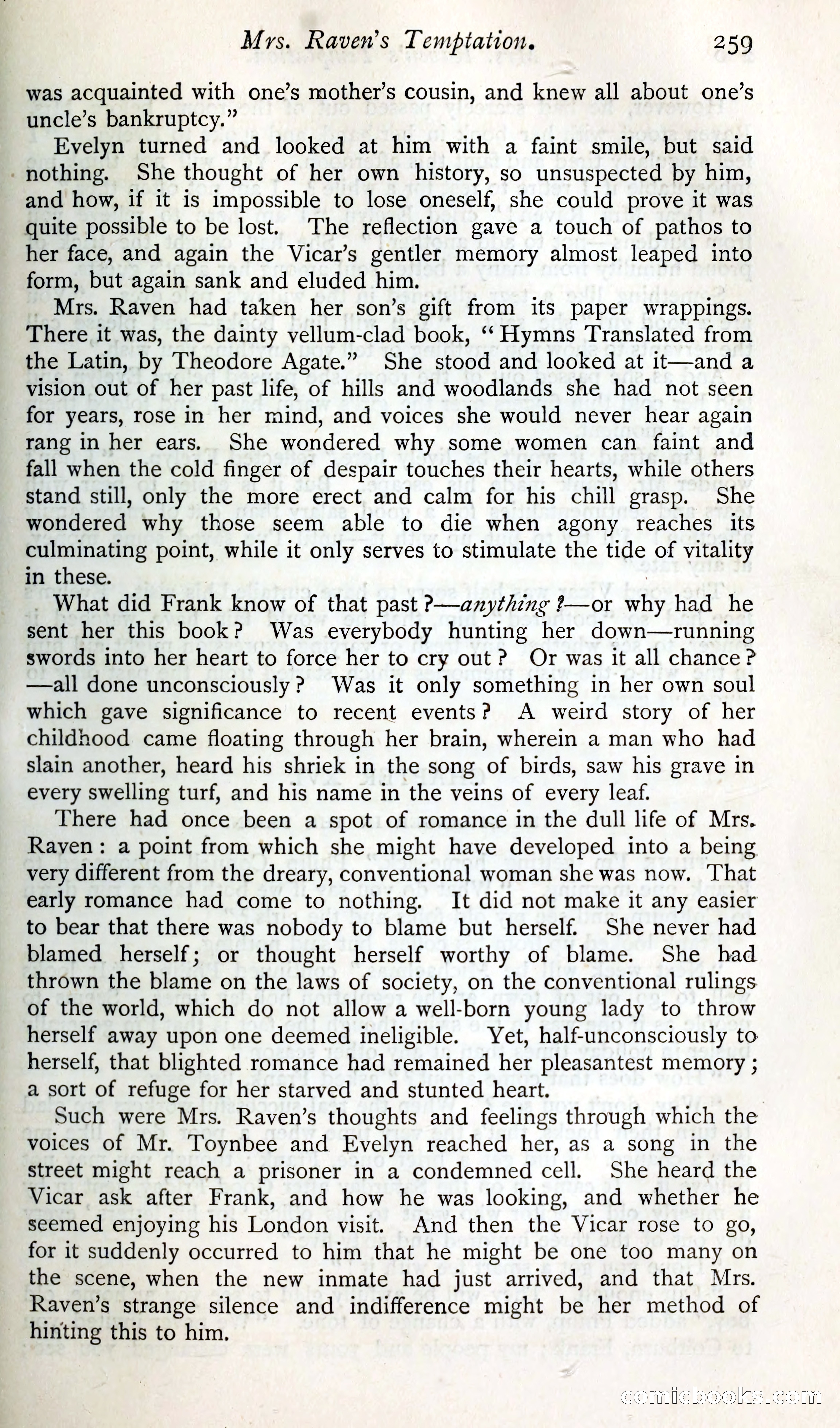
A restored page from Pulp Fiction, 1865. Page through the whole issue in the reader above.
📄 Transcribed text from this page (OCR, searchable)
Machine-transcribed from the original scan — historical spelling and the odd misread are preserved.
Mrs. Raven's Temptation. 259 was acquainted with one’s mother’s cousin, and knew all about one’s uncle’s bankruptcy.” Evelyn turned and looked at him with a faint smile, but said nothing. She thought of her own history, so unsuspected by him, and how, if it is impossible to lose oneself, she could prove it was quite possible to be lost. The reflection gave a touch of pathos to her face, and again the Vicar’s gentler memory almost leaped into form, but again sank and eluded him. _ Mrs. Raven had taken her son’s gift from its paper wrappings. There it was, the dainty vellum-clad book, ‘“‘ Hymns Translated from the Latin, by Theodore Agate.” She stood and looked at it—and a vision out of her past life, of hills and woodlands she had not seen for years, rose in her mind, and voices she would never hear again rang in her ears. She wondered why some women can faint and fall when the cold finger of despair touches their hearts, while others stand still, only the more erect and calm for his chill grasp. She wondered why those seem able to die when agony reaches its culminating point, while it only serves to stimulate the tide of vitality in these. _ What did Frank know of that past P—azything 2—or ba had he sent her this book? Was everybody hunting her down—running swords into her heart to force her to cry out ? Or was it all chance? —all done unconsciously ? Was it only something in her own soul which gave significance to recent events? A weird story of her childhood came floating through her brain, wherein a man who had slain another, heard his shriek in the song of birds, saw his grave in every swelling turf, and his name in the veins of every leaf. There had once been a spot of romance in the dull life of Mrs. Raven: a point from which she might have developed into a being very different from the dreary, conventional woman she was now. That early romance had come to nothing. It did not make it any easier to bear that there was nobody to blame but herself. She never had blamed herself; or thought herself worthy of blame. She had thrown the blame on the laws of society, on the conventional rulings of the world, which do not allow a well-born young lady to throw herself away upon one deemed ineligible. Yet, half-unconsciously to herself, that blighted romance had remained her pleasantest memory ; a sort of refuge for her starved and stunted heart. Such were Mrs. Raven’s thoughts and feelings through which the voices of Mr. Toynbee and Evelyn reached her, as a song in the street might reach a prisoner in a condemned cell. She heard the Vicar ask after Frank, and how he was looking, and whether he seemed enjoying his London visit. And then the Vicar rose to go, for it suddenly occurred to him that he might be one too many on the scene, when the new inmate had just arrived, and that Mrs. Raven’s strange silence and indifference might be her method of _ hinting this to him. CoOnniclooolks (SO)