
Pulp Fiction, 1865 · page 275 of 400
The Argosy — page 275: what you’re looking at
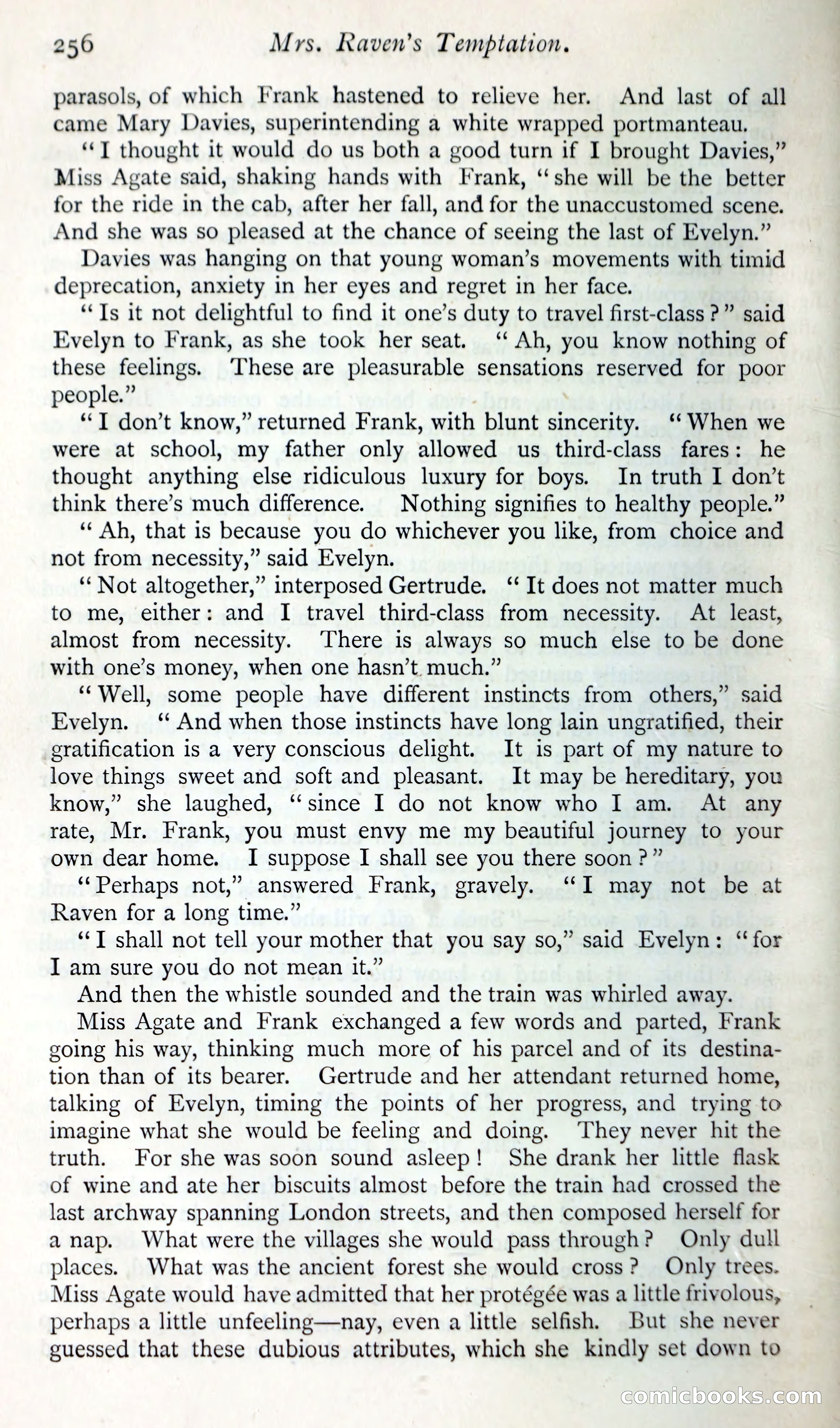
A restored page from Pulp Fiction, 1865. Page through the whole issue in the reader above.
📄 Transcribed text from this page (OCR, searchable)
Machine-transcribed from the original scan — historical spelling and the odd misread are preserved.
256 Mrs. Kaven’s Temptation. parasols, of which Frank hastened to relieve her. And last of all came Mary Davies, superintending a white wrapped portmanteau. ‘‘T thought it would do us both a good turn if I brought Davies,” Miss Agate said, shaking hands with Frank, ‘she will be the better for the ride in the cab, after her fall, and for the unaccustomed scene. And she was so pleased at the chance of seeing the last of Evelyn.” Davies was hanging on that young woman’s movements with timid deprecation, anxiety in her eyes and regret in her face. “Ts it not delightful to find it one’s duty to travel first-class ?” said Evelyn to Frank, as she took her seat. ‘‘ Ah, you know nothing of these feelings. ‘These are pleasurable sensations reserved for poor people.” ““T don’t know,” returned Frank, with blunt sincerity. ‘When we were at school, my father only allowed us third-class fares: he thought anything else ridiculous luxury for boys. In truth I don’t think there’s much difference. Nothing signifies to healthy people.” ‘‘ Ah, that is because you do whichever you like, from choice and not from necessity,” said Evelyn. ‘Not altogether,” interposed Gertrude. ‘‘ It does not matter much to me, either: and I travel third-class from necessity. At least, almost from necessity. ‘There is always so much else to be done with one’s money, when one hasn’t. much.” ‘Well, some people have different instincts from others,” said Evelyn. ‘‘ And when those instincts have long lain ungratified, their eratification is a very conscious delight. It is part of my nature to love things sweet and soft and pleasant. It may be hereditary, you know,” she laughed, ‘‘since I do not know who I am. At any rate, Mr. Frank, you must envy me my beautiful journey to your own dear home. I suppose I shall see you there soon ?” ‘‘Perhaps not,” answered Frank, gravely. “I may not be at Raven for a long time.” ‘“‘T shall not tell your mother that you say so,” said Evelyn: ‘for I am sure you do not mean it.” And then the whistle sounded and the train was whirled away. Miss Agate and Frank exchanged a few words and parted, Frank going his way, thinking much more of his parcel and of its destina- tion than of its bearer. Gertrude and her attendant returned home, talking of Evelyn, timing the points of her progress, and trying to imagine what she would be feeling and doing. They never hit the truth. For she was soon sound asleep! She drank her little flask of wine and ate her biscuits almost before the train had crossed the last archway spanning London streets, and then composed herself for a nap. What were the villages she would pass through? Only dull places. What was the ancient forest she would cross? Only trees. Miss Agate would have admitted that her protégée was a little frivolous, perhaps a little unfeeling—nay, even a little selfish. But she never guessed that these dubious attributes, which she kindly set down to Gomichooks, co