
Pulp Fiction, 1865 · page 268 of 400
The Argosy — page 268: what you’re looking at
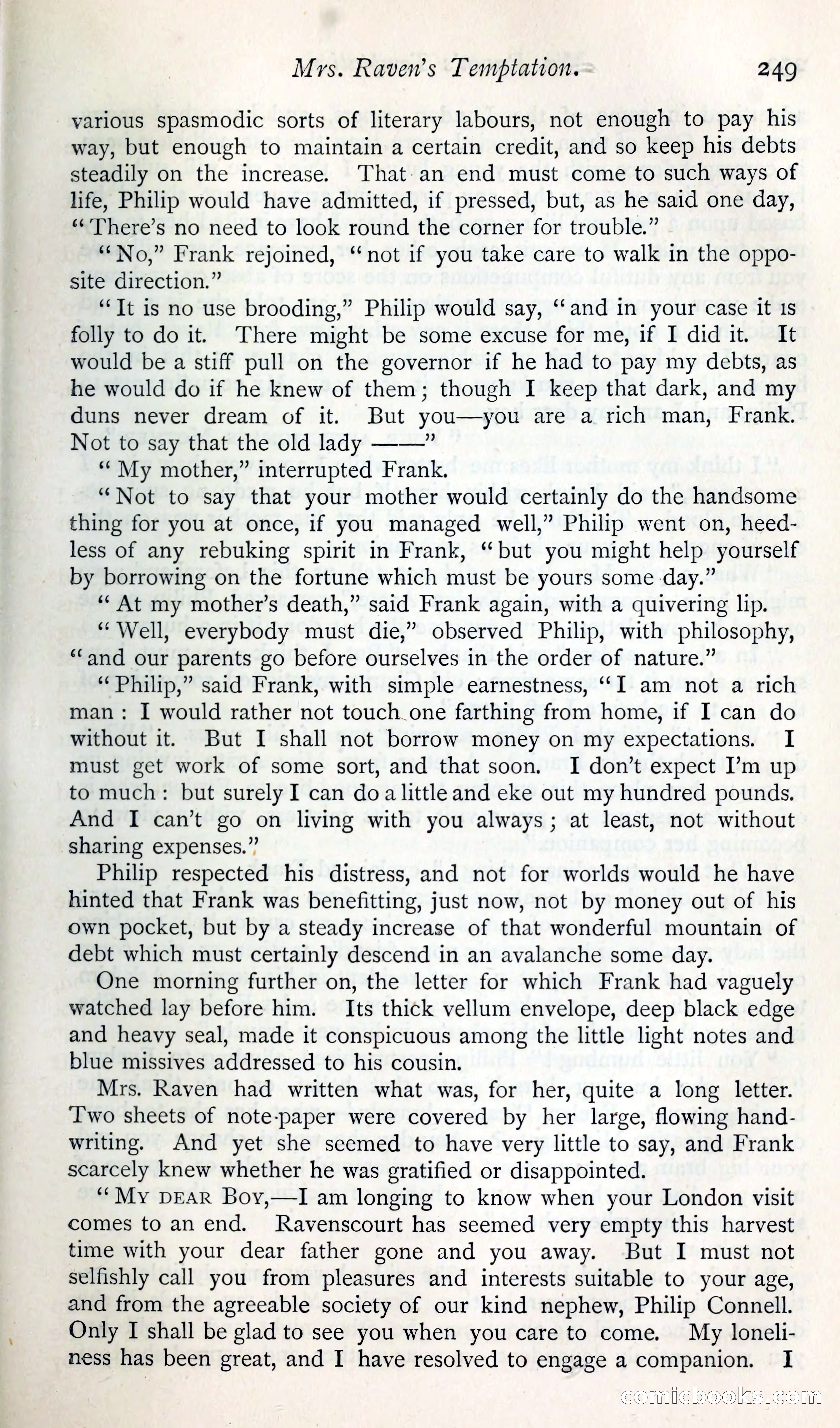
A restored page from Pulp Fiction, 1865. Page through the whole issue in the reader above.
📄 Transcribed text from this page (OCR, searchable)
Machine-transcribed from the original scan — historical spelling and the odd misread are preserved.
Mrs. Raven’s Temptation. 249 various spasmodic sorts of literary labours, not enough to pay his way, but enough to maintain a certain credit, and so keep his debts steadily on the increase. That. an end must come to such ways of life, Philip would have admitted, if pressed, but, as he said one day, ‘““’There’s no need to look round the corner for trouble.” “No,” Frank rejoined, “not if you take care to walk in the oppo- site direction.” “It is no use brooding,” Philip would say, “and in your case it 1s folly to do it. There might be some excuse for me, if I did it. It would be a stiff pull on the governor if he had to pay my debts, as he would do if he knew of them; though I keep that dark, and my duns never dream of it. But you—you are a rich man, Frank. Not to say that the old lady —-——” “My mother,” interrupted Frank. “Not to say that your mother would certainly do the handsome thing for you at once, if you managed well,” Philip went on, heed- less of any rebuking spirit in Frank, ‘but you might help yourself by borrowing on the fortune which must be yours some day.” ‘*“ At my mother’s death,” said Frank again, with a quivering lip. “Well, everybody must die,” observed Philip, with philosophy, ‘‘and our parents go before ourselves in the order of nature.” “Philip,” said Frank, with simple earnestness, ‘‘I am not a rich man: I would rather not touch_one farthing from home, if I can do without it. But I shall not borrow money on my expectations. I must get work of some sort, and that soon. I don’t expect I’m up to much: but surely I can doa little and eke out my hundred pounds. And I can’t go on living with you always; at least, not without sharing expenses.” Philip respected his distress, and not for worlds would he have hinted that Frank was benefitting, just now, not by money out of his own pocket, but by a steady increase of that wonderful mountain of debt which must certainly descend in an avalanche some day. One morning further on, the letter for which Frank had vaguely watched lay before him. Its thick vellum envelope, deep black edge and heavy seal, made it conspicuous among the little light notes and blue missives addressed to his cousin. Mrs. Raven had written what was, for her, quite a long letter. Two sheets of note-paper were covered by her large, flowing hand- writing. And yet she seemed to have very little to say, and Frank scarcely knew whether he was gratified or disappointed. ““My DEAR Boy,—I am longing to know when your London visit comes to an end. Ravenscourt has seemed very empty this harvest time with your dear father gone and you away. But I must not selfishly call you from pleasures and interests suitable to your age, and from the agreeable society of our kind nephew, Philip Connell. Only I shall be glad to see you when you care to come. My loneli- ness has been great, and I have resolved to engage a companion. I CONMMICOOOKS.C©