
Pulp Fiction, 1865 · page 250 of 400
The Argosy — page 250: what you’re looking at
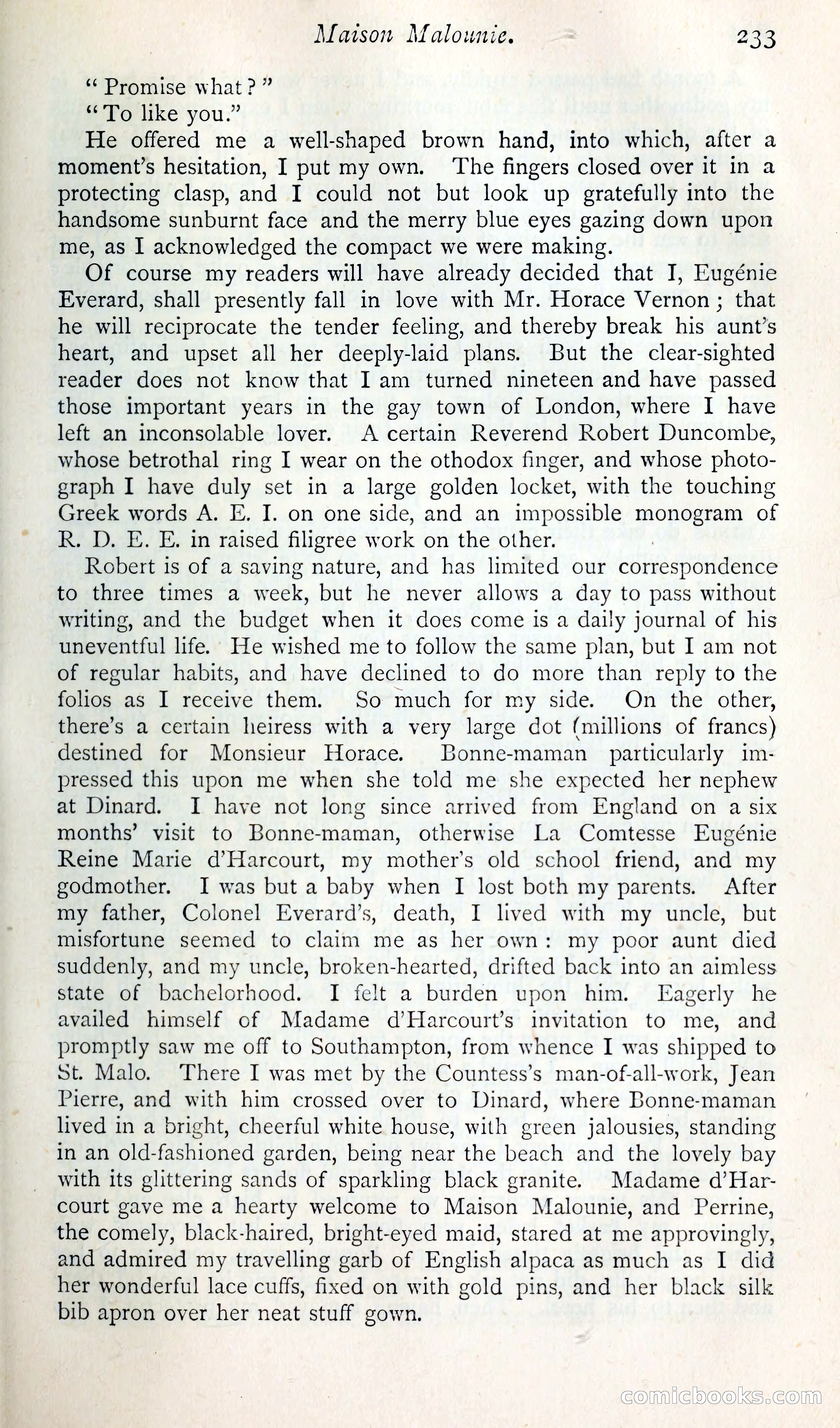
A restored page from Pulp Fiction, 1865. Page through the whole issue in the reader above.
📄 Transcribed text from this page (OCR, searchable)
Machine-transcribed from the original scan — historical spelling and the odd misread are preserved.
Matson Malounie. 233 ** Promise what ? ” To like you.” He offered me a well-shaped brown hand, into which, after a moment’s hesitation, I put my own. The fingers closed over it in a protecting clasp, and I could not but look up gratefully into the handsome sunburnt face and the merry blue eyes gazing down upon me, as I acknowledged the compact we were making. Of course my readers will have already decided that I, Eugénie Everard, shall presently fall in love with Mr. Horace Vernon ; that he will reciprocate the tender feeling, and thereby break his aunt’s heart, and upset all her deeply-laid plans. But the clear-sighted reader does not know that I am turned nineteen and have passed those important years in the gay town of London, where I have left an inconsolable lover. A certain Reverend Robert Duncombe, whose betrothal ring I wear on the othodox finger, and whose photo- graph I have duly set in a large golden locket, with the touching Greek words A. E. I. on one side, and an impossible monogram of R. D. E. E. in raised filigree work on the other. Robert is of a saving nature, and has limited our correspondence to three times a week, but he never allows a day to pass without writing, and the budget when it does come is a daily journal of his uneventful life. He wished me to follow the same plan, but I am not of regular habits, and have declined to do more than reply to the folios as I receive them. So much for my side. On the other, there’s a certain heiress with a very large dot (millions of francs) destined for Monsieur Horace. Bonne-maman particularly im- pressed this upon me when she told me she expected her nephew at Dinard. I have not long since arrived from England on a six months’ visit to Bonne-maman, otherwise La Comtesse Eugénie Reine Marie d’Harcourt, my mother’s old school friend, and my godmother. I was but a baby when I lost both my parents. After my father, Colonel Everard’s, death, I lived with my uncle, but misfortune seemed to claim me as her own: my poor aunt died suddenly, and my uncle, broken-hearted, drifted back into an aimless state of bachelorhood. I felt a burden upon him. Eagerly he availed himself of Madame d’Harcourt’s invitation to me, and promptly saw me off to Southampton, from whence I was shipped to ot. Malo. There I was met by the Countess’s man-of-all-work, Jean Pierre, and with him crossed over to Dinard, where Bonne-maman lived in a bright, cheerful white house, with green jalousies, standing in an old-fashioned garden, being near the beach and the lovely bay with its glittering sands of sparkling black granite. Madame d’Har- court gave me a hearty welcome to Maison Malounie, and Perrine, the comely, black-haired, bright-eyed maid, stared at me approvingly, and admired my travelling garb of English alpaca as much as I did her wonderful lace cuffs, fixed on with gold pins, and her black silk bib apron over her neat stuff gown. COM ) vjiOO|KS.CO