
Pulp Fiction, 1865 · page 235 of 400
The Argosy — page 235: what you’re looking at
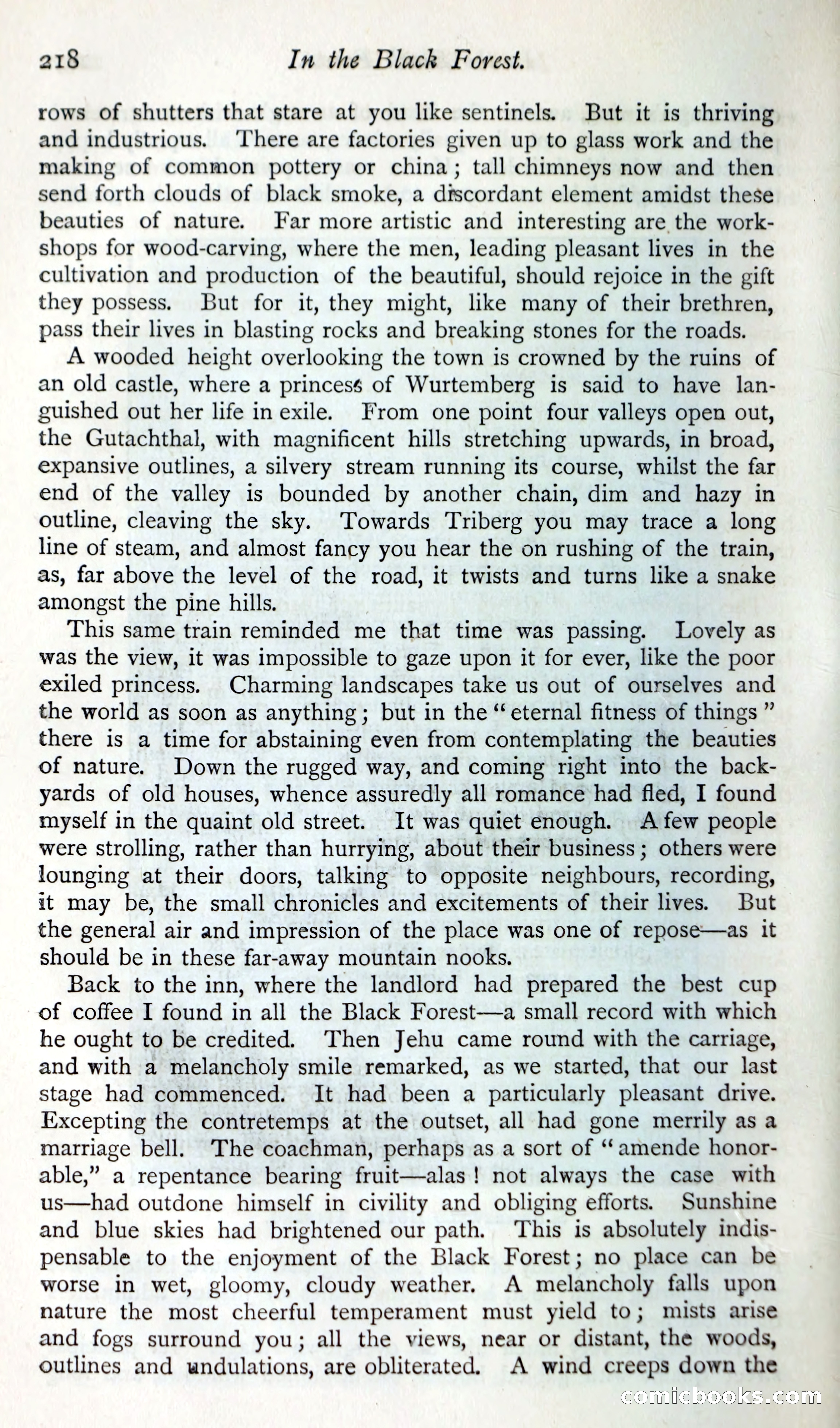
A restored page from Pulp Fiction, 1865. Page through the whole issue in the reader above.
📄 Transcribed text from this page (OCR, searchable)
Machine-transcribed from the original scan — historical spelling and the odd misread are preserved.
218 In the Black Forest. rows of shutters that stare at you like sentinels. But it is thriving and industrious. ‘There are factories given up to glass work and the making of common pottery or china; tall chimneys now and then send forth clouds of black smoke, a dtscordant element amidst these beauties of nature. Far more artistic and interesting are the work- shops for wood-carving, where the men, leading pleasant lives in the cultivation and production of the beautiful, should rejoice in the gift they possess. But for it, they might, like many of their brethren, pass their lives in blasting rocks and breaking stones for the roads. A wooded height overlooking the town is crowned by the ruins of an old castle, where a princes§ of Wurtemberg is said to have lan- guished out her life in exile. From one point four valleys open out, the Gutachthal, with magnificent hills stretching upwards, in broad, expansive outlines, a silvery stream running its course, whilst the far end of the valley is bounded by another chain, dim and hazy in Outline, cleaving the sky. Towards Triberg you may trace a long line of steam, and almost fancy you hear the on rushing of the train, as, far above the level of the road, it twists and turns like a snake amongst the pine hills. This same train reminded me that time was passing. Lovely as was the view, it was impossible to gaze upon it for ever, like the poor exiled princess. Charming landscapes take us out of ourselves and the world as soon as anything; but in the “eternal fitness of things ” there is a time for abstaining even from contemplating the beauties of nature. Down the rugged way, and coming right into the back- yards of old houses, whence assuredly all romance had fled, I found myself in the quaint old street. It was quiet enough. A few people were strolling, rather than hurrying, about their business; others were lounging at their doors, talking to opposite neighbours, recording, it may be, the small chronicles and excitements of their lives. But the general air and impression of the place was one of repose—as it should be in these far-away mountain nooks. Back to the inn, where the landlord had prepared the best cup of coffee I found in all the Black Forest—a small record with which he ought to be credited. ‘Then Jehu came round with the carriage, and with a melancholy smile remarked, as we started, that our last stage had commenced. It had been a particularly pleasant drive. Excepting the contretemps at the outset, all had gone merrily as a marriage bell. The coachman, perhaps as a sort of ‘‘amende honor- able,” a repentance bearing fruit—alas! not always the case with us—had outdone himself in civility and obliging efforts. Sunshine and blue skies had brightened our path. This is absolutely indis- pensable to the enjoyment of the Black Forest; no place can be worse in wet, gloomy, cloudy weather. A melancholy falls upon nature the most cheerful temperament must yield to; mists arise and fogs surround you; all the views, near or distant, the woods, outlines and undulations, are obliterated. A wind creeps down the CONMICELNCKO KS, (E0) m