
Pulp Fiction, 1865 · page 231 of 400
The Argosy — page 231: what you’re looking at
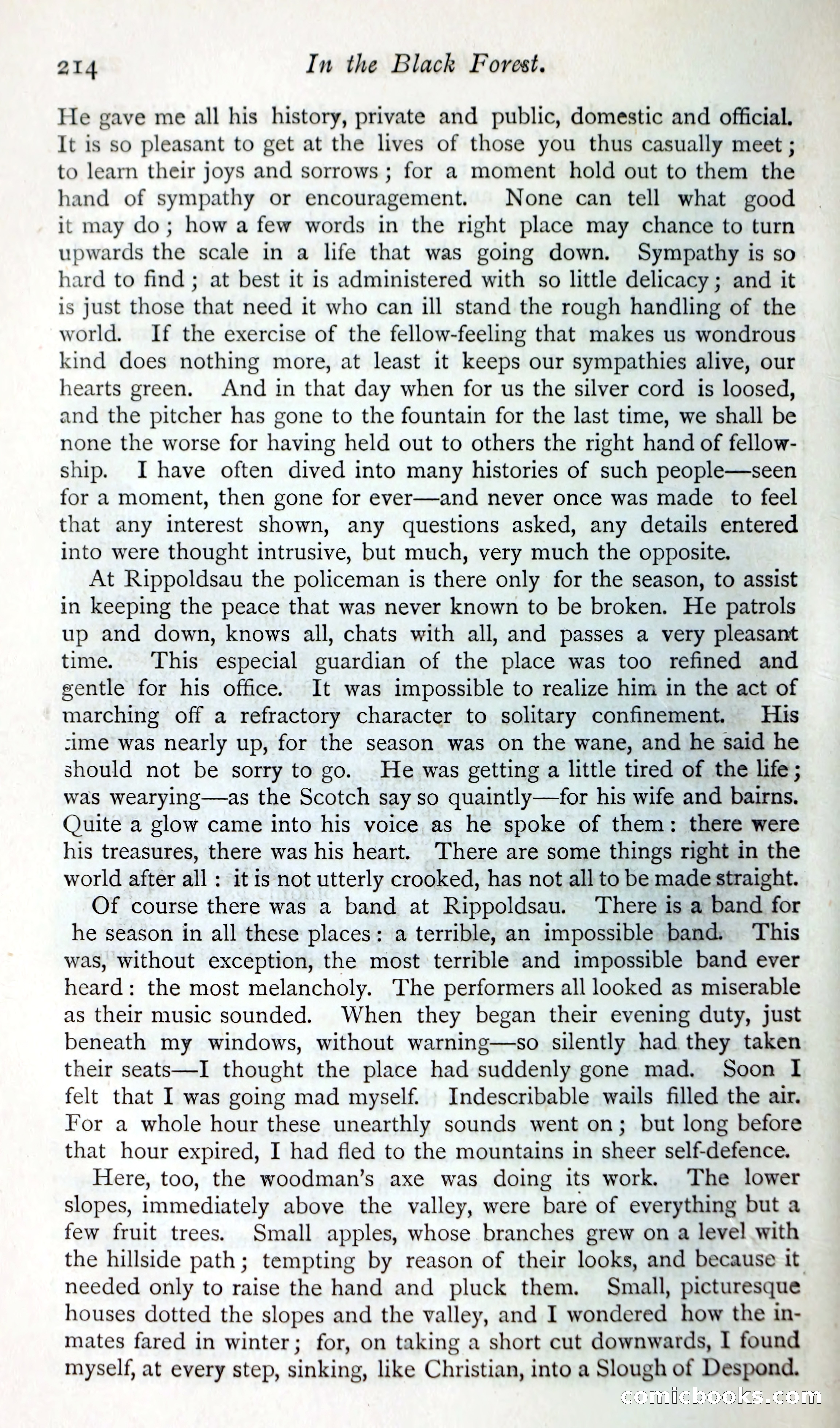
A restored page from Pulp Fiction, 1865. Page through the whole issue in the reader above.
📄 Transcribed text from this page (OCR, searchable)
Machine-transcribed from the original scan — historical spelling and the odd misread are preserved.
214 In the Black Forest. He gave me all his history, private and public, domestic and official. It is so pleasant to get at the lives of those you thus casually meet ; to learn their joys and sorrows ; for a moment hold out to them the hand of sympathy or encouragement. None can tell what good it may do; how a few words in the right place may chance to turn upwards the scale in a life that was going down. Sympathy is so hard to find ; at best it is administered with so little delicacy ; and it is just those that need it who can ill stand the rough handling of the world. If the exercise of the fellow-feeling that makes us wondrous kind does nothing more, at least it keeps our sympathies alive, our hearts green. And in that day when for us the silver cord is loosed, and the pitcher has gone to the fountain for the last time, we shall be none the worse for having held out to others the right hand of fellow- ship. I have often dived into many histories of such people—seen for a moment, then gone for ever—and never once was made to feel that any interest shown, any questions asked, any details entered into were thought intrusive, but much, very much the opposite. At Rippoldsau the policeman is there only for the season, to assist in keeping the peace that was never known to be broken. He patrols up and down, knows all, chats with all, and passes a very pleasant time. This especial guardian of the place was too refined and gentle for his office. It was impossible to realize him in the act of marching off a refractory character to solitary confinement. His “ime was nearly up, for the season was on the wane, and he said he should not be sorry to go. He was getting a little tired of the life; was wearying—as the Scotch say so quaintly—for his wife and bairns. Quite a glow came into his voice as he spoke of them: there were his treasures, there was his heart. There are some things right in the world after all : it is not utterly crooked, has not all to be made straight. Of course there was a band at Rippoldsau. There is a band for he season in all these places: a terrible, an impossible band. ‘This was, without exception, the most terrible and impossible band ever heard: the most melancholy. The performers all looked as miserable as their music sounded. When they began their evening duty, just beneath my windows, without warning—so silently had they taken their seats—I thought the place had suddenly gone mad. Soon I felt that I was going mad myself. Indescribable wails filled the air. For a whole hour these unearthly sounds went on; but long before that hour expired, I had fled to the mountains in sheer self-defence. Here, too, the woodman’s axe was doing its work. The lower slopes, immediately above the valley, were bare of everything but a few fruit trees. Small apples, whose branches grew on a level with the hillside path; tempting by reason of their looks, and because it needed only to raise the hand and pluck them. Small, picturesque houses dotted the slopes and the valley, and I wondered how the in- mates fared in winter; for, on taking a short cut downwards, I found myself, at every step, sinking, like Christian, into a Slough of Despond. Gomichookssco