
Pulp Fiction, 1865 · page 227 of 400
The Argosy — page 227: what you’re looking at
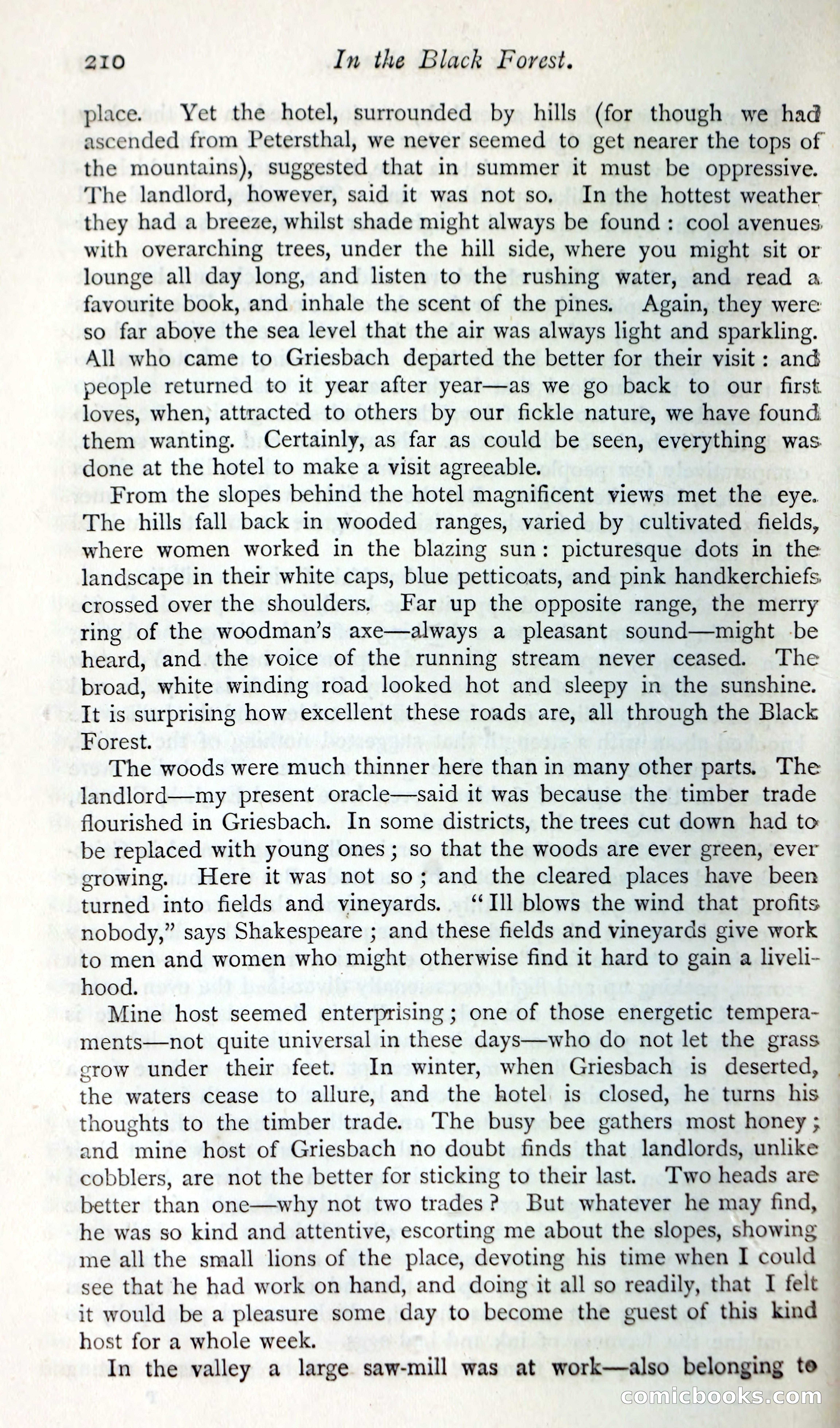
A restored page from Pulp Fiction, 1865. Page through the whole issue in the reader above.
📄 Transcribed text from this page (OCR, searchable)
Machine-transcribed from the original scan — historical spelling and the odd misread are preserved.
210 In the Black Forest. place. Yet the hotel, surrounded by hills (for though we had ascended from Petersthal, we never seemed to get nearer the tops of the mountains), suggested that in summer it must be oppressive. The landlord, however, said it was not so. In the hottest weather they had a breeze, whilst shade might always be found: cool avenues, with overarching trees, under the hill side, where you might sit or lounge all day long, and listen to the rushing water, and read a favourite book, and inhale the scent of the pines. Again, they were so far above the sea level that the air was always light and sparkling. All who came to Griesbach departed the better for their visit: and people returned to it year after year—as we go back to our first. loves, when, attracted to others by our fickle nature, we have found them wanting. Certainly, as far as could be seen, everything was. done at the hotel to make a visit agreeable. From the slopes behind the hotel magnificent views met the eye. The hills fall back in wooded ranges, varied by cultivated fields, where women worked in the blazing sun: picturesque dots in the landscape in their white caps, blue petticoats, and pink handkerchiefs crossed over the shoulders. Far up the opposite range, the merry ring of the woodman’s axe—always a pleasant sound—might -be heard, and the voice of the running stream never ceased. ‘The broad, white winding road looked hot and sleepy in the sunshine. It is surprising how excellent these roads are, all through the Black Forest. The woods were much thinner here than in many other parts. The landlord—my present oracle—said it was because the timber trade flourished in Griesbach. In some districts, the trees cut down had to be replaced with young ones ; so that the woods are ever green, ever erowing. Here it was not so; and the cleared places have been turned into fields and vineyards. ‘Ill blows the wind that profits nobody,” says Shakespeare ; and these fields and vineyards give work to men and women who might otherwise find it hard to gain a liveli- hood. Mine host seemed enterprising ; one of those energetic tempera- ments—not quite universal in these days—who do not let the grass crow under their feet. In winter, when Griesbach is deserted, the waters cease to allure, and the hotel is closed, he turns his thoughts to the timber trade. The busy bee gathers most honey ; and mine host of Griesbach no doubt finds that landlords, unlike cobblers, are not the better for sticking to their last. ‘Two heads are better than one—why not two trades? But whatever he may find, he was so kind and attentive, escorting me about the slopes, showing me all the small lions of the place, devoting his time when I could see that he had work on hand, and doing it all so readily, that I felt it would be a pleasure some day to become the guest of this kind host for a whole week. In the valley a large saw-mill was at work—also belonging te — Gomiecbooks;com