
Pulp Fiction, 1865 · page 219 of 400
The Argosy — page 219: what you’re looking at
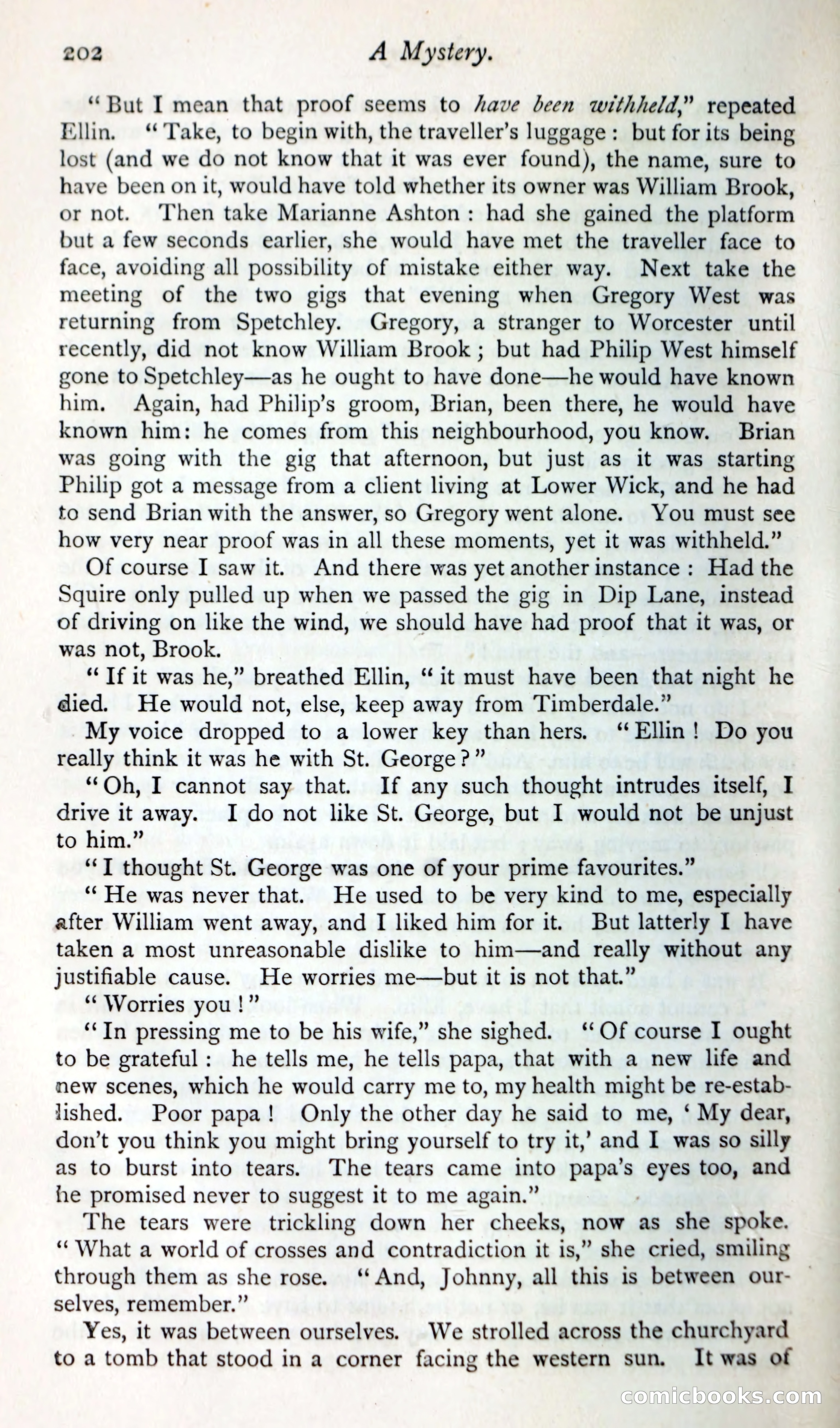
A restored page from Pulp Fiction, 1865. Page through the whole issue in the reader above.
📄 Transcribed text from this page (OCR, searchable)
Machine-transcribed from the original scan — historical spelling and the odd misread are preserved.
202 A Mystery. “But I mean that proof seems to have been withheld,” repeated Ellin. ‘Take, to begin with, the traveller’s luggage: but for its being lost (and we do not know that it was ever found), the name, sure to have been on it, would have told whether its owner was William Brook, or not. Then take Marianne Ashton: had she gained the platform — but a few seconds earlier, she would have met the traveller face to face, avoiding all possibility of mistake either way. Next take the meeting of the two gigs that evening when Gregory West was returning from Spetchley. Gregory, a stranger to Worcester until recently, did not know William Brook; but had Philip West himself gone to Spetchley—as he ought to have done—he would have known him. Again, had Philip’s groom, Brian, been there, he would have known him: he comes from this neighbourhood, you know. Brian was going with the gig that afternoon, but just as it was starting Philip got a message from a client living at Lower Wick, and he had to send Brian with the answer, so Gregory went alone. You must see how very near proof was in all these moments, yet it was withheld.” Of course I saw it. And there was yet another instance: Had the Squire only pulled up when we passed the gig in Dip Lane, instead of driving on like the wind, we should have had proof that it was, or was not, Brook. ‘Tf it was he,” breathed Ellin, “it must have been that night he died. He would not, else, keep away from Timberdale.” My voice dropped to a lower key thanhers. “Ellin! Do you really think it was he with St. George?” “Oh, I cannot say that. If any such thought intrudes itself, I drive it away. I do not like St. George, but I would not be unjust to him.” ‘“T thought St. George was one of your prime favourites.” ‘He was never that. He used to be very kind to me, especially after William went away, and I liked him for it. But latterly I have taken a most unreasonable dislike to him—and really without any justifiable cause. He worries me—but it is not that.” ‘“ Worries you!” ‘In pressing me to be his wife,” she sighed. ‘‘Of course I ought to be grateful: he tells me, he tells papa, that with a new life and new scenes, which he would carry me to, my health might be re-estab- lished. Poor papa! Only the other day he said to me, ‘ My dear, don’t you think you might bring yourself to try it,’ and I was so silly as to burst into tears. The tears came into Pena eyes too, and he promised never to suggest it to me again.” The tears were trickling down her cheeks, now as she spoke. ‘What a world of crosses and contradiction it is,” she cried, smiling through them as she rose. ‘And, Johnny, all this is between our- | selves, remember.” Yes, it was between ourselves. We strolled across the churchyard to a tomb that stood in a corner facing the western sun. It was of Gomicbooks:Go