
Pulp Fiction, 1865 · page 217 of 400
The Argosy — page 217: what you’re looking at
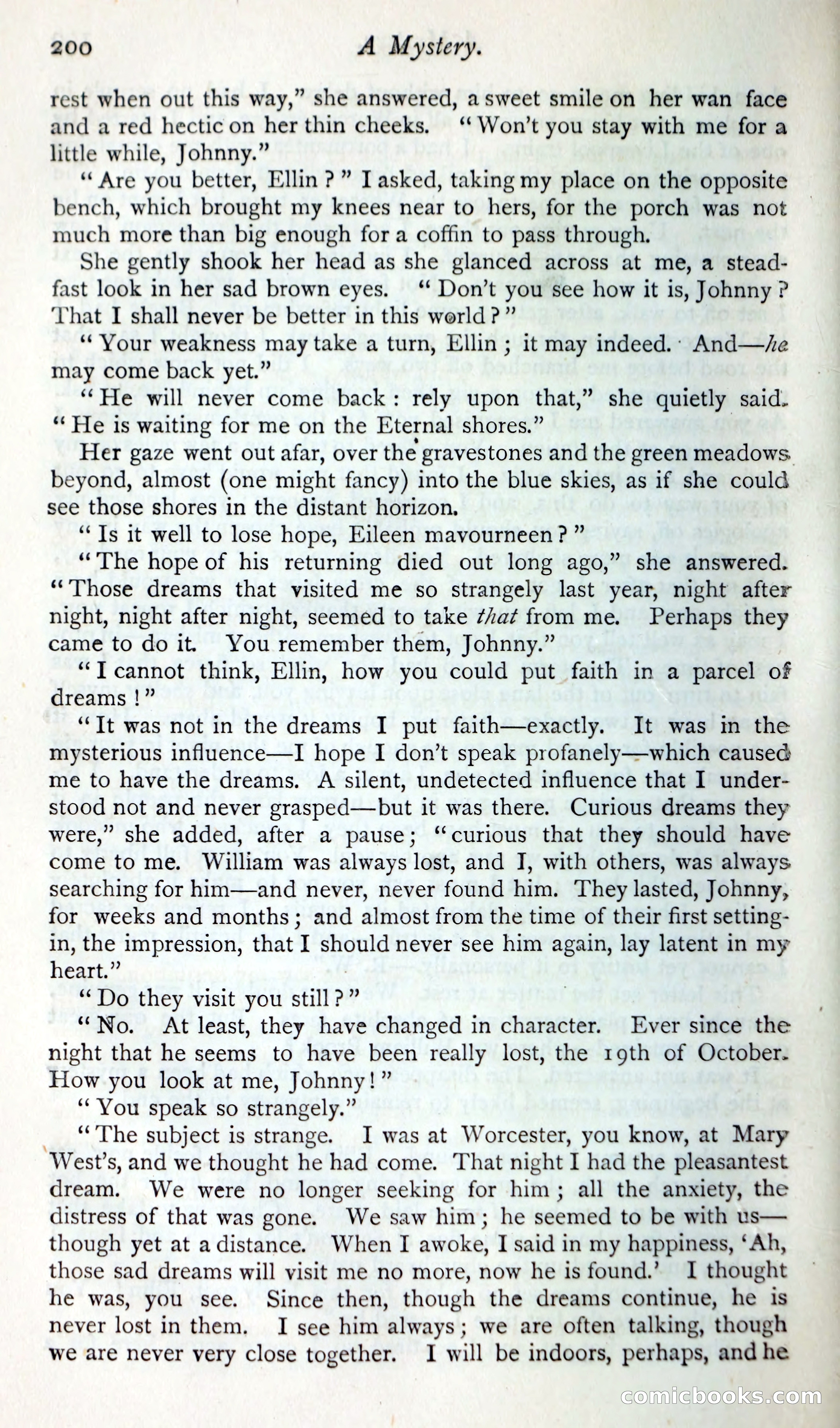
A restored page from Pulp Fiction, 1865. Page through the whole issue in the reader above.
📄 Transcribed text from this page (OCR, searchable)
Machine-transcribed from the original scan — historical spelling and the odd misread are preserved.
200 A Mystery. rest when out this way,” she answered, asweet smile on her wan face and a red hectic on her thin cheeks. ‘‘ Won’t you stay with me for a little while, Johnny.” ‘“ Are you better, Ellin ?” Iasked, taking my place on the opposite bench, which brought my knees near to hers, for the porch was not much more than big enough for a coffin to pass through. She gently shook her head as she glanced across at me, a stead- fast look in her sad brown eyes. ‘‘ Don’t you see how it is, Johnny ?P ‘That I shall never be better in this world ?” “Your weakness may take a turn, Ellin; it may indeed. And—/e may come back yet.” “He will never come back: rely upon that,” she quietly said. “He is waiting for me on the Eternal shores.” | Her gaze went out afar, over the gravestones and the green meadows. beyond, almost (one might fancy) into the blue skies, as if she could see those shores in the distant horizon, ‘““Ts it well to lose hope, Eileen mavourneen ? ” “The hope of his returning died out long ago,” she answered. “Those dreams that visited me so strangely last year, night after night, night after night, seemed to take ¢ia¢ from me. Perhaps they came to do it. You remember them, Johnny.” “T cannot think, Ellin, how you could put faith in a parcel of dreams !” “Tt was not in the dreams I put faith—exactly. It was in the mysterious influence—I hope I don’t speak profanely—which caused me to have the dreams. A silent, undetected influence that I under- stood not and never grasped—but it was there. Curious dreams they were,” she added, after a pause; “curious that they should have come to me. William was always lost, and J, with others, was always searching for him—and never, never found him. They lasted, Johnny, for weeks and months; and almost from the time of their first setting- in, the impression, that I should never see him again, lay latent in my heart. r “Do they visit you still ? ‘ded “No. At least, they have changed in character. Ever since the night that he seems to have been really lost, the 19th of October. How you look at me, Johnny! 7 ‘You speak so strangely.” “The subject is strange. JI was at Worcester, you know, at Mary ‘West’s, and we thought he had come. That night I had the pleasantest dream. We were no longer seeking for hits all the anxiety, the distress of that was gone. We saw him; he seemed to be with us— though yet at adistance. When I awoke, I said in my happiness, ‘Ah, those sad dreams will visit me no more, now he is found.’ I thought he was, you see. Since then, though the dreams continue, he is never lost in them. I see him always; we are often talking, though we are never very close together. I will be indoors, perhaps, and he EORNIE KOOKS AEC) m