
Pulp Fiction, 1865 · page 210 of 400
The Argosy — page 210: what you’re looking at
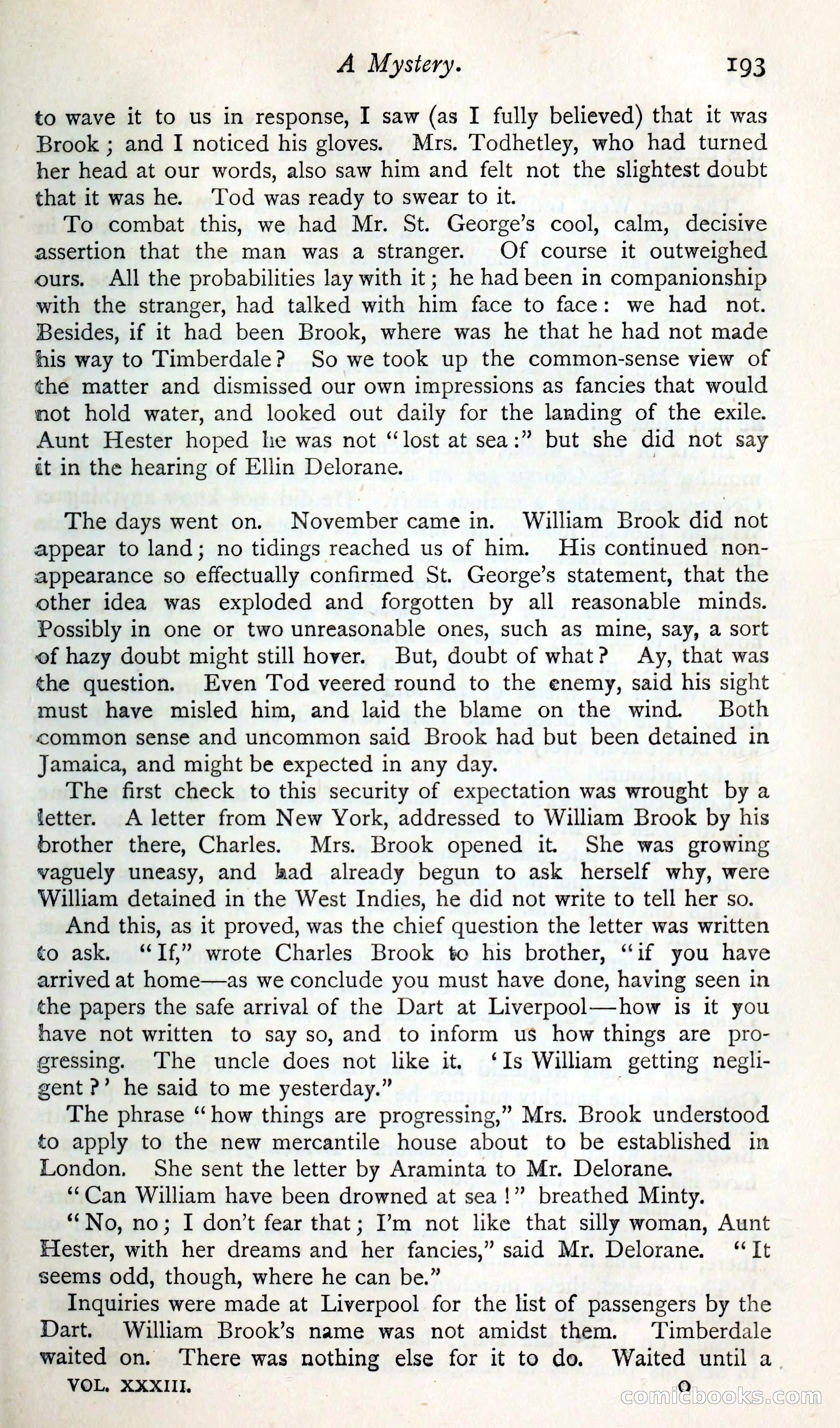
A restored page from Pulp Fiction, 1865. Page through the whole issue in the reader above.
📄 Transcribed text from this page (OCR, searchable)
Machine-transcribed from the original scan — historical spelling and the odd misread are preserved.
A Mystery. 193 to wave it to us in response, I saw (as I fully believed) that it was Brook ; and I noticed his gloves. Mrs. Todhetley, who had turned her head at our words, also saw him and felt not the slightest doubt that it was he. ‘Tod was ready to swear to it. To combat this, we had Mr. St. George’s cool, calm, decisive assertion that the man was a stranger. Of course it outweighed ours. All the probabilities lay with it; he had been in companionship with the stranger, had talked with him face to face: we had not. Besides, if it had been Brook, where was he that he had not made his way to Timberdale? So we took up the common-sense view of the matter and dismissed our own impressions as fancies that would mot hold water, and looked out daily for the landing of the exile. Aunt Hester hoped he was not ‘lost at sea:” but she did not say it in the hearing of Ellin Delorane. | The days went on. November came in. William Brook did not appear to land; no tidings reached us of him. His continued non- appearance so effectually confirmed St. George’s statement, that the other idea was exploded and forgotten by all reasonable minds. Possibly in one or two unreasonable ones, such as mine, say, a sort of hazy doubt might still hover. But, doubt of what? Ay, that was the question. Even Tod veered round to the enemy, said his sight must have misled him, and laid the blame on the wind. Both common sense and uncommon said Brook had but been detained in Jamaica, and might be expected in any day. The first check to this security of expectation was wrought by a letter. A letter from New York, addressed to William Brook by his brother there, Charles. Mrs. Brook opened it. She was growing vaguely uneasy, and lad already begun to ask herself why, were William detained in the West Indies, he did not write to tell her so. And this, as it proved, was the chief question the letter was written ¢o ask. “If,” wrote Charles Brook to his brother, ‘if you have arrived at home—as we conclude you must have done, having seen in the papers the safe arrival of the Dart at Liverpool—how is it you have not written to say so, and to inform us how things are pro- gressing. ‘The uncle does not like it. ‘Is William getting negli- gent P’ he said to me yesterday.” ! The phrase “ how things are progressing,” Mrs. Brook understood to apply to the new mercantile house about to be established in London. She sent the letter by Araminta to Mr. Delorane. “Can William have been drowned at sea!” breathed Minty. *“No, no; I don’t fear that; I’m not like that silly woman, Aunt Hester, with her dreams and her fancies,” said Mr. Delorane. “It seems odd, though, where he can be.” Inquiries were made at Liverpool for the list of passengers by the Dart. William Brook’s name was not amidst them. ‘Timberdale waited on. ‘There was nothing else for it to do. Waited until a VOL. XXXIII. | | a COM jiOO|KS.CO