
Pulp Fiction, 1865 · page 199 of 400
The Argosy — page 199: what you’re looking at
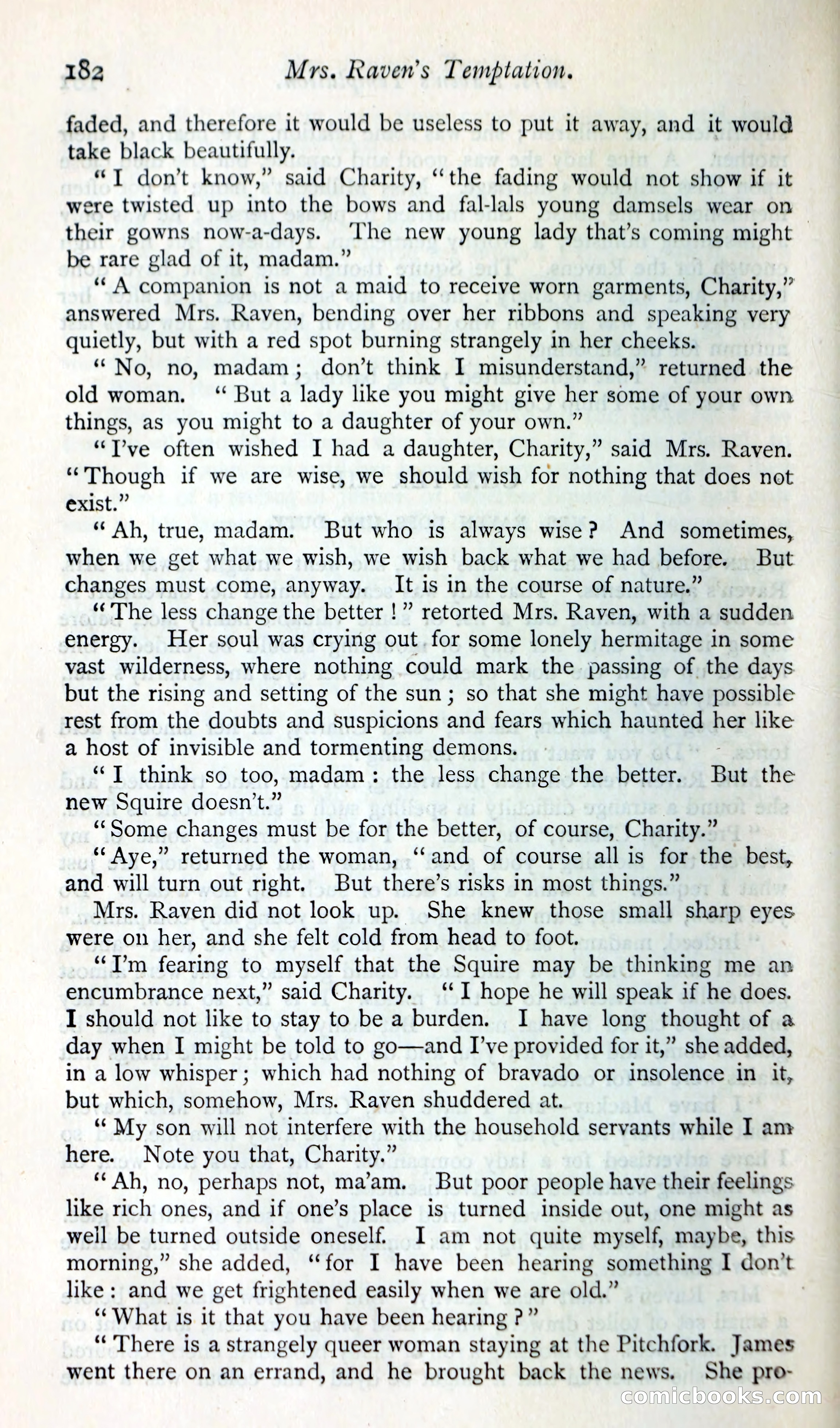
A restored page from Pulp Fiction, 1865. Page through the whole issue in the reader above.
📄 Transcribed text from this page (OCR, searchable)
Machine-transcribed from the original scan — historical spelling and the odd misread are preserved.
182 Mrs. Raven’s Temptation. faded, and therefore it would be useless to put it away, and it would take black beautifully. | “T don’t know,” said Charity, “the fading would not show if it were twisted up into the bows and fal-lals young damsels wear on their gowns now-a-days. The new young lady that’s coming might — be rare glad of it, madam.” ‘‘A companion is not a maid to receive worn garments, Charity,” answered Mrs. Raven, bending over her ribbons and speaking very quietly, but with a red spot burning strangely in her cheeks. ‘No, no, madam; don’t think I misunderstand,” returned the old woman. ‘ But a lady like you might give her some of your own things, as you might to a daughter of your own.” “ve often wished I had a daughter, Charity,” said Mrs. Raven. “Though if we are wise, we should wish for nothing that does not exist.” ‘Ah, true, madam. But who is always wise? And sometimes, when we get what we wish, we wish back what we had before. But changes must come, anyway. It 1s in the course of nature.” ‘‘'The less change the better!” retorted Mrs. Raven, with a sudden energy. Her soul was crying out. for some lonely hermitage in some vast wilderness, where nothing could mark the passing of the days but the rising and setting of the sun; so that she might have possible rest from the doubts and suspicions and fears which haunted her like a host of invisible and tormenting demons. “T think so too, madam: the less change the better. But the new Squire doesn’t.” ‘‘Some changes must be for the better, of course, Charity.” ‘ Aye,” returned the woman, “and of course all is for the best, and will turn out right. But there’s risks in most things.” Mrs. Raven did not look up. She knew those small sharp eyes were on her, and she felt cold from head to foot. “T’m fearing to myself that the Squire may be thinking me an encumbrance next,” said Charity. ‘‘I hope he will speak if he does. I should not like to stay to be a burden. I have long thought of a day when I might be told to go—and I’ve provided for it,” she added, in a low whisper; which had nothing of bravado or insolence in it, but which, somehow, Mrs. Raven shuddered at. ‘My son will not interfere with the household servants while I am here. Note you that, Charity.” ‘Ah, no, perhaps not, ma’am. But poor people have their feelings like rich ones, and if one’s place is turned inside out, one might as well be turned outside oneself. I am not quite myself, maybe, this morning,” she added, “for I have been hearing something I don’t like: and we get frightened easily when we are old.” ‘What is it that you have been hearing ?” “There is a strangely queer woman staying at the Pitchfork. James went there on an errand, and he brought back the news. She pro- CONMIELNCO KS (EC) m