
Pulp Fiction, 1865 · page 173 of 400
The Argosy — page 173: what you’re looking at
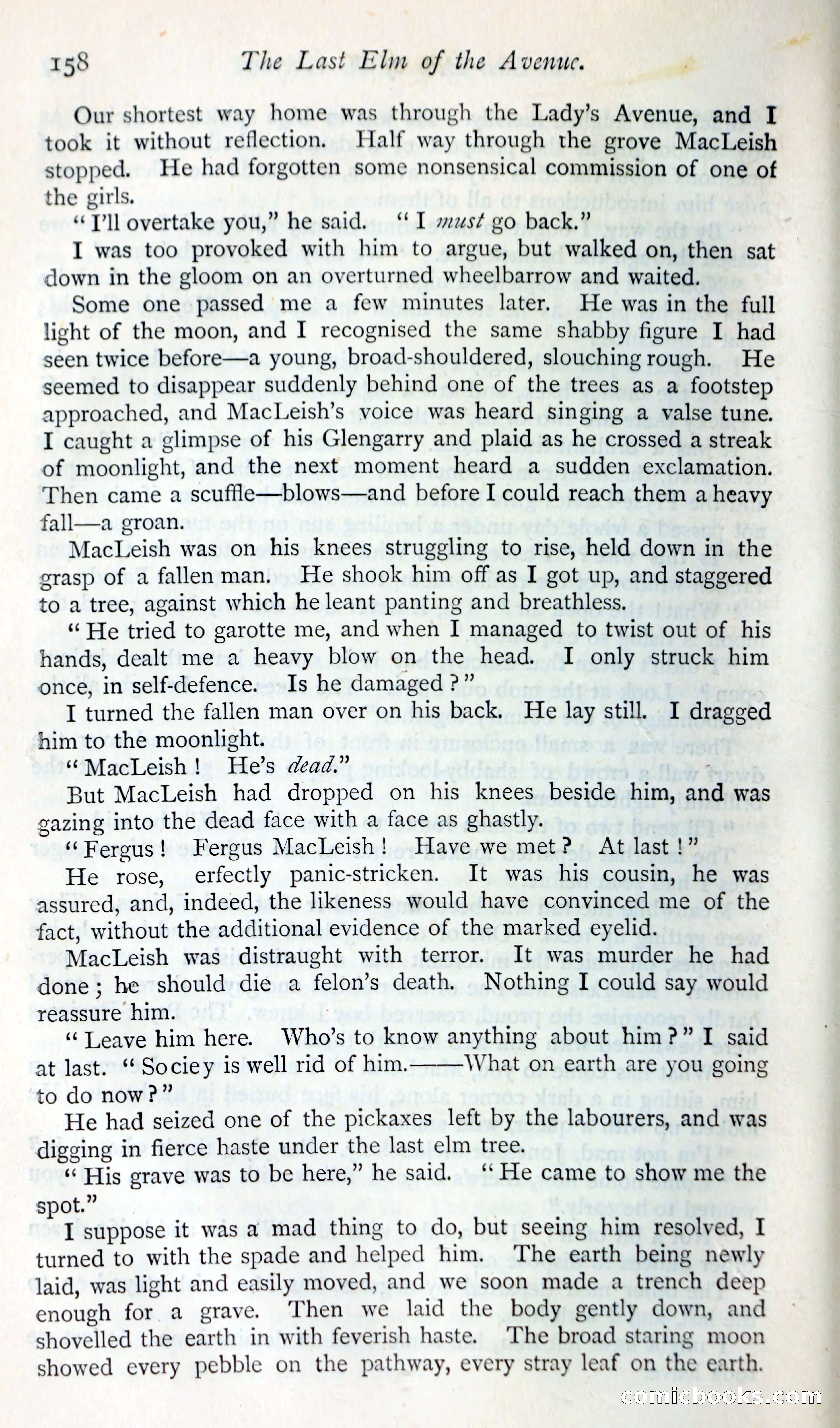
A restored page from Pulp Fiction, 1865. Page through the whole issue in the reader above.
📄 Transcribed text from this page (OCR, searchable)
Machine-transcribed from the original scan — historical spelling and the odd misread are preserved.
158 The Last Elm of the Avenue. Our shortest way home was through the Lady’s Avenue, and I took it without reflection. Half way through the grove MacLeish stopped. He had forgotten some nonsensical commission of one of the girls. ‘T’ll overtake you,” he said. ‘I sust go back.” I was too provoked with him to argue, but walked on, then sat down in the gloom on an overturned wheelbarrow and waited. Some one passed me a few minutes later. He was in the full light of the moon, and I recognised the same shabby figure I had seen twice before—a young, broad-shouldered, slouching rough. He seemed to disappear suddenly behind one of the trees as a footstep approached, and MacLeish’s voice was heard singing a valse tune. I caught a glimpse of his Glengarry and plaid as he crossed a streak of moonlight, and the next moment heard a sudden exclamation. Then came a scuffle—blows—and before I could reach them a heavy fall—a groan. MacLeish was on his knees struggling to rise, held down in the grasp of a fallenman. He shook him off as I got up, and staggered to a tree, against which he leant panting and breathless. “ He tried to garotte me, and when I managed to twist out of his hands, dealt me a heavy blow on the head. I only struck him once, in self-defence. Is he damaged ?” I turned the fallen man over on his back. He lay still. I dragged him to the moonlight. | ‘¢MacLeish ! He’ s dead,” But MacLeish had dropped on his knees beside him, aa was gazing into the dead face with a face as ghastly. ‘Fergus! Fergus MacLeish! Have we met? At last!” He rose, erfectly panic-stricken. It was his cousin, he was assured, and, indeed, the likeness would have convinced me of the fact, without the additional evidence of the marked eyelid. MacLeish was distraught with terror. It was murder he had done; he should die a felon’s death. Nothing I could say would reassure him. ‘Leave him here. Who’ s to know anything about him?” [I said at last. ‘“ Sociey is well rid of him.——What on earth are you going to do now?” He had seized one of the pickaxes left by the labourers, and was digging in fierce haste under the last elm tree. “His grave was to be here,” he said. “He came to show me the spot.” <7 suppose it was a mad thing to do, but seeing him resolved, I turned to with the spade and helped him. ‘The oan being newly laid, was light and easily moved, and we soon made a fone 5 deep enough for a grave. Then we laid the body gently down, and shovelled the earth in with feverish haste. The broad staring moon showed every pebble on the pathway, every stray leaf on the earth. CORMNICLIOOKS (E©)