
Pulp Fiction, 1865 · page 161 of 400
The Argosy — page 161: what you’re looking at
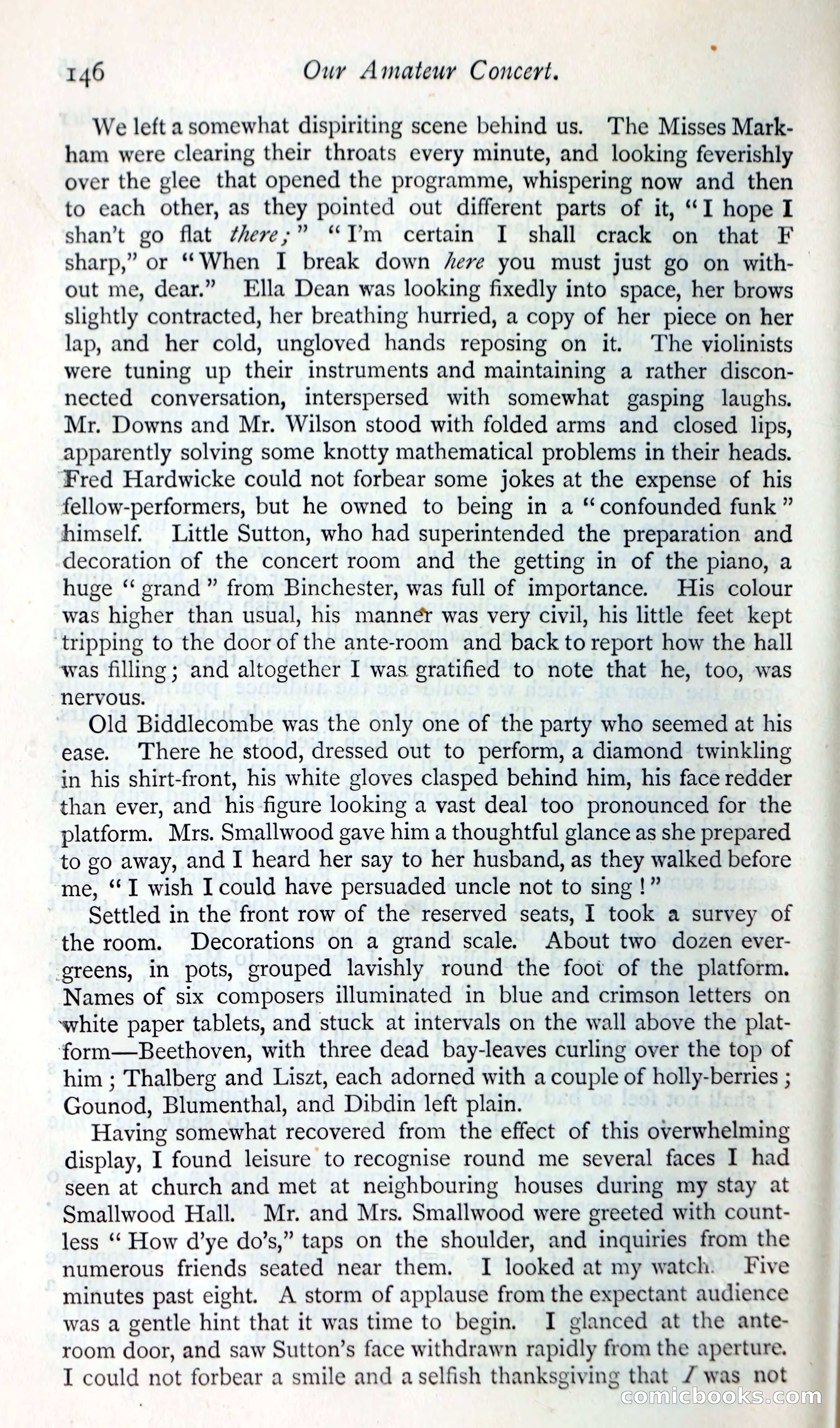
A restored page from Pulp Fiction, 1865. Page through the whole issue in the reader above.
📄 Transcribed text from this page (OCR, searchable)
Machine-transcribed from the original scan — historical spelling and the odd misread are preserved.
146 Our Amateur Concert. We left asomewhat dispiriting scene behind us. The Misses Mark- ham were clearing their throats every minute, and looking feverishly over the glee that opened the programme, whispering now and then to each other, as they pointed out different parts of it, “I hope I shan’t go flat ¢heve;” “Im certain I shall crack on that F sharp,” or ‘When I break down eve you must just go on with- out me, dear.” Ella Dean was looking fixedly into space, her brows slightly contracted, her breathing hurried, a copy of her piece on her lap, and her cold, ungloved hands reposing on it. The violinists were tuning up their instruments and maintaining a rather discon- nected conversation, interspersed with somewhat gasping laughs. Mr. Downs and Mr. Wilson stood with folded arms and closed lips, apparently solving some knotty mathematical problems in their heads. Fred Hardwicke could not forbear some jokes at the expense of his fellow-performers, but he owned to being in a “confounded funk ” himself. Little Sutton, who had superintended the preparation and decoration of the concert room and the getting in of the piano, a huge “ grand” from Binchester, was full of importance. His colour was higher than usual, his mannér was very civil, his little feet kept tripping to the door of the ante-room and back to report how the hall was filling; and altogether I was gratified to note that he, too, was nervous. Old Biddlecombe was the only one of the party who seemed at his ease. There he stood, dressed out to perform, a diamond twinkling in his shirt-front, his white gloves clasped behind him, his face redder than ever, and his figure looking a vast deal too pronounced for the platform. Mrs. Smallwood gave him a thoughtful glance as she prepared to go away, and I heard her say to her husband, as they walked before me, “I wish Icould have persuaded uncle not to sing !” Settled in the front row of the reserved seats, I took a survey of the room. Decorations on a grand scale. About two dozen ever- greens, in pots, grouped lavishly round the foot of the platform. Names of six composers illuminated in blue and crimson letters on white paper tablets, and stuck at intervals on the wall above the plat- form—Beethoven, with three dead bay-leaves curling over the top of him ; Thalberg and Liszt, each adorned with a couple of holly-berries ; Gounod, Blumenthal, and Dibdin left plain. Having somewhat recovered from the effect of this overwhelming display, I found leisure to recognise round me several faces I had seen at church and met at neighbouring houses during my stay at Smallwood Hall. Mr. and Mrs. Smallwood were greeted with count- less ““ How d’ye do’s,” taps on the shoulder, and inquiries from the numerous friends seated near them. I looked at my watch. Five minutes past eight. A storm of applause from the expectant audience was a gentle hint that it was time to begin. I glanced at the ante- room door, and saw Sutton’s face withdrawn rapidly from the aperture. I cowl? not forbear a smile and aselfish thanksgiving that / was not Comic ooo) <S,(C()