
Pulp Fiction, 1865 · page 156 of 400
The Argosy — page 156: what you’re looking at
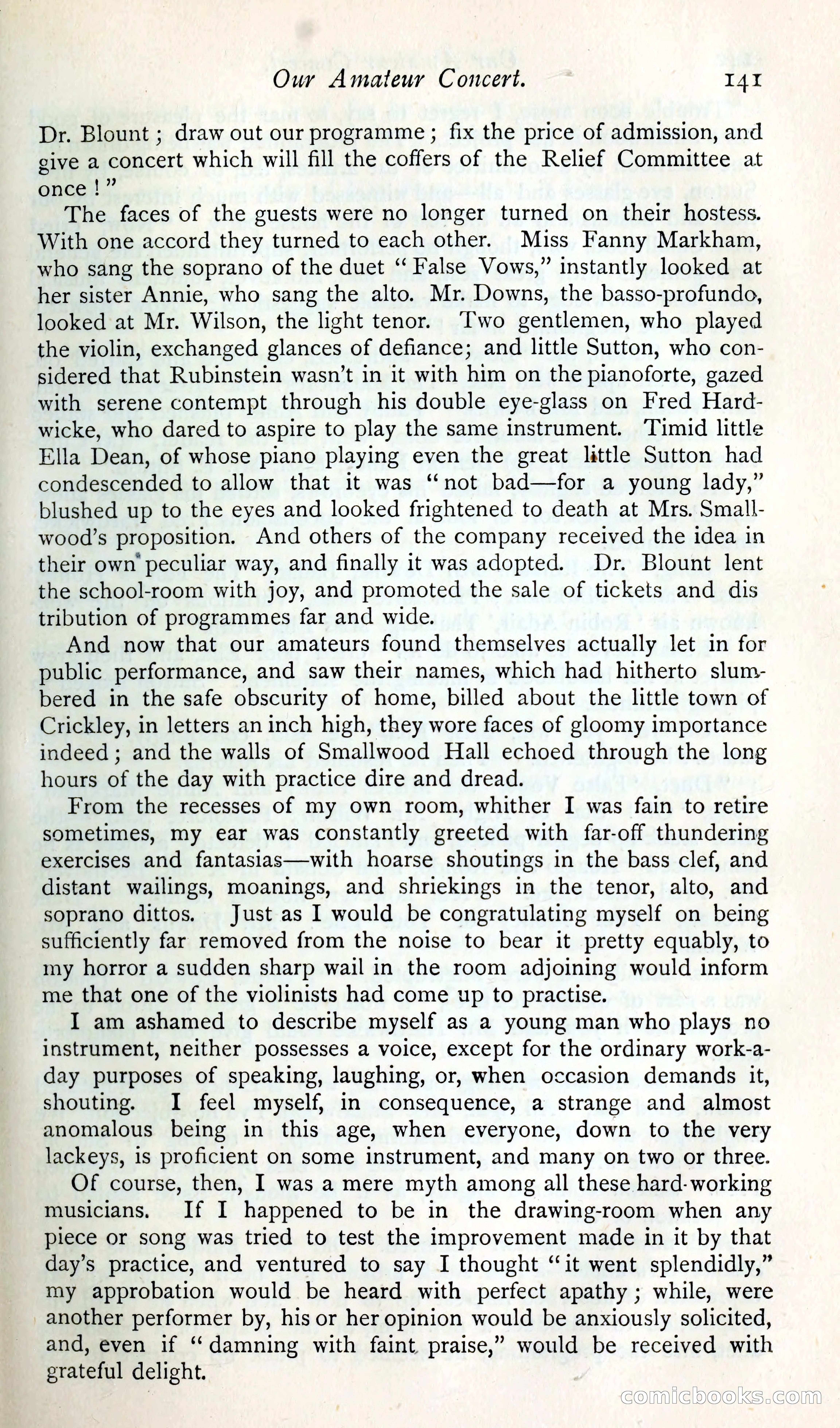
A restored page from Pulp Fiction, 1865. Page through the whole issue in the reader above.
📄 Transcribed text from this page (OCR, searchable)
Machine-transcribed from the original scan — historical spelling and the odd misread are preserved.
Our Amateur Concert. I4I Dr. Blount ; draw out our programme; fix the price of admission, and give a concert which will fill the coffers of the Relief Committee at once!” The faces of the guests were no longer turned on their hostess. With one accord they turned to each other. Miss Fanny Markham, who sang the soprano of the duet ‘‘ False Vows,” instantly looked at her sister Annie, who sang the alto. Mr. Downs, the basso-profundo, looked at Mr. Wilson, the light tenor. ‘Two gentlemen, who played the violin, exchanged glances of defiance; and little Sutton, who con- sidered that Rubinstein wasn’t in it with him on the pianoforte, gazed with serene contempt through his double eye-glass on Fred Hard- wicke, who dared to aspire to play the same instrument. ‘Timid little Ella Dean, of whose piano playing even the great little Sutton had condescended to allow that it was “not bad—for a young lady,” blushed up to the eyes and looked frightened to death at Mrs. Small- wood’s proposition. And others of the company received the idea in their own’ peculiar way, and finally it was adopted. Dr. Blount lent the school-room with joy, and promoted the sale of tickets and dis tribution of programmes far and wide. And now that our amateurs found themselves actually let in for public performance, and saw their names, which had hitherto slum- bered in the safe obscurity of home, billed about the little town of Crickley, in letters an inch high, they wore faces of gloomy importance indeed ; and the walls of Smallwood Hall echoed through the long hours of the day with practice dire and dread. From the recesses of my own room, whither I was fain to retire sometimes, my ear was constantly greeted with far-off thundering exercises and fantasias—with hoarse shoutings in the bass clef, and distant wailings, moanings, and shriekings in the tenor, alto, and soprano dittos. Just as I would be congratulating myself on being sufficiently far removed from the noise to bear it pretty equably, to my horror a sudden sharp wail in the room adjoining would inform me that one of the violinists had come up to practise. I am ashamed to describe myself as a young man who plays no instrument, neither possesses a voice, except for the ordinary work-a- day purposes of speaking, laughing, or, when occasion demands it, shouting. I feel myself, in consequence, a strange and almost anomalous being in this age, when everyone, down to the very lackeys, 1s proficient on some instrument, and many on two or three. Of course, then, I was a mere myth among all these hard-working musicians. If I happened to be in the drawing-room when any plece or song was tried to test the improvement made in it by that day’s practice, and ventured to say I thought ‘it went splendidly,” my approbation would be heard with perfect apathy ; while, were another performer by, his or her opinion would be anxiously solicited, and, even if “damning with faint praise,” would be received with grateful delight. COMICOOOKS.C©