
Pulp Fiction, 1865 · page 142 of 400
The Argosy — page 142: what you’re looking at
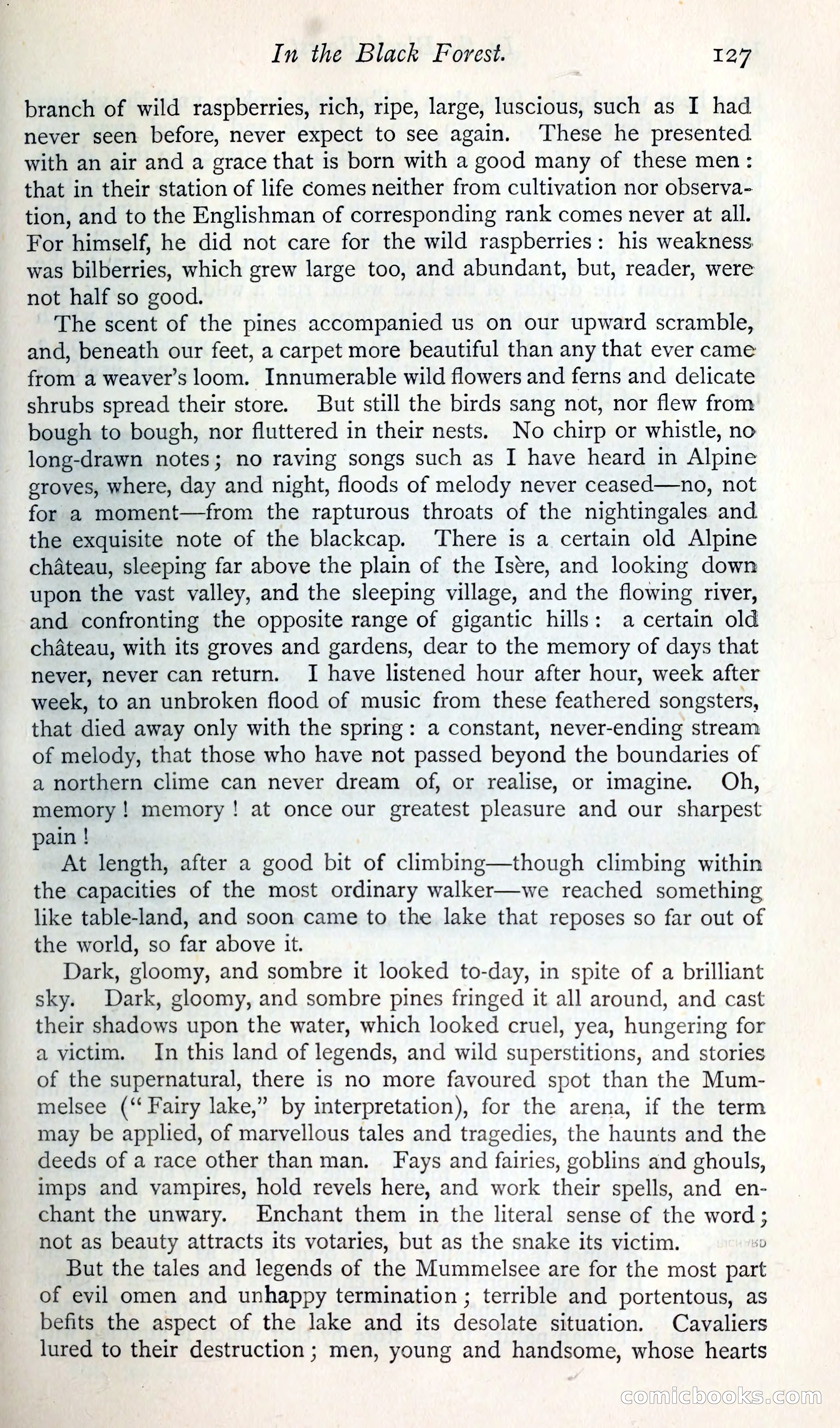
A restored page from Pulp Fiction, 1865. Page through the whole issue in the reader above.
📄 Transcribed text from this page (OCR, searchable)
Machine-transcribed from the original scan — historical spelling and the odd misread are preserved.
In the Black Forest. 129 branch of wild raspberries, rich, ripe, large, luscious, such as I had never seen before, never expect to see again. ‘These he presented. with an air and a grace that is born with a good many of these men: that in their station of life comes neither from cultivation nor observa- tion, and to the Englishman of corresponding rank comes never at all. For himself, he did not care for the wild raspberries: his weakness was bilberries, which grew large too, and abundant, but, reader, were not half so good. The scent of the pines accompanied us on our upward scramble, and, beneath our feet, a carpet more beautiful than any that ever came from a weaver’s loom. Innumerable wild flowers and ferns and delicate shrubs spread their store. But still the birds sang not, nor flew from bough to bough, nor fluttered in their nests. No chirp or whistle, no long-drawn notes; no raving songs such as I have heard in Alpine groves, where, day and night, floods of melody never ceased—no, not for a moment—from the rapturous throats of the nightingales and the exquisite note of the blackcap. ‘There is a certain old Alpine chateau, sleeping far above the plain of the Isere, and looking down upon the vast valley, and the sleeping village, and the flowing river, and confronting the opposite range of gigantic hills: a certain old chateau, with its groves and gardens, dear to the memory of days that never, never can return. I have listened hour after hour, week after week, to an unbroken flood of music from these feathered songsters, that died away only with the spring: a constant, never-ending stream of melody, that those who have not passed beyond the boundaries of a northern clime can never dream of, or realise, or imagine. Oh, memory! memory! at once our greatest pleasure and our sharpest pain ! At length, after a good bit of climbing—though climbing within the capacities of the most ordinary walker—we reached something like table-land, and soon came to the lake that reposes so far out of the world, so far above it. Dark, gloomy, and sombre it looked to-day, in spite of a brilliant sky. Dark, gloomy, and sombre pines fringed it all around, and cast their shadows upon the water, which looked cruel, yea, hungering for a victim. In this land of legends, and wild superstitions, and stories of the supernatural, there is no more favoured spot than the Mum- melsee (“Fairy lake,” by interpretation), for the arena, if the term may be applied, of marvellous tales and tragedies, the haunts and the deeds of a race other thanman. Fays and fairies, goblins and ghouls, imps and vampires, hold revels here, and work their spells, and en- chant the unwary. Enchant them in the literal sense of the word; not as beauty attracts its votaries, but as the snake its victim. 60 But the tales and legends of the Mummelsee are for the most part of evil omen and unhappy termination ; terrible and portentous, as befits the aspect of the lake and its desolate situation. Cavaliers lured to their destruction; men, young and handsome, whose hearts CoOnniclooolks (SO) mn