
Pulp Fiction, 1865 · page 140 of 400
The Argosy — page 140: what you’re looking at
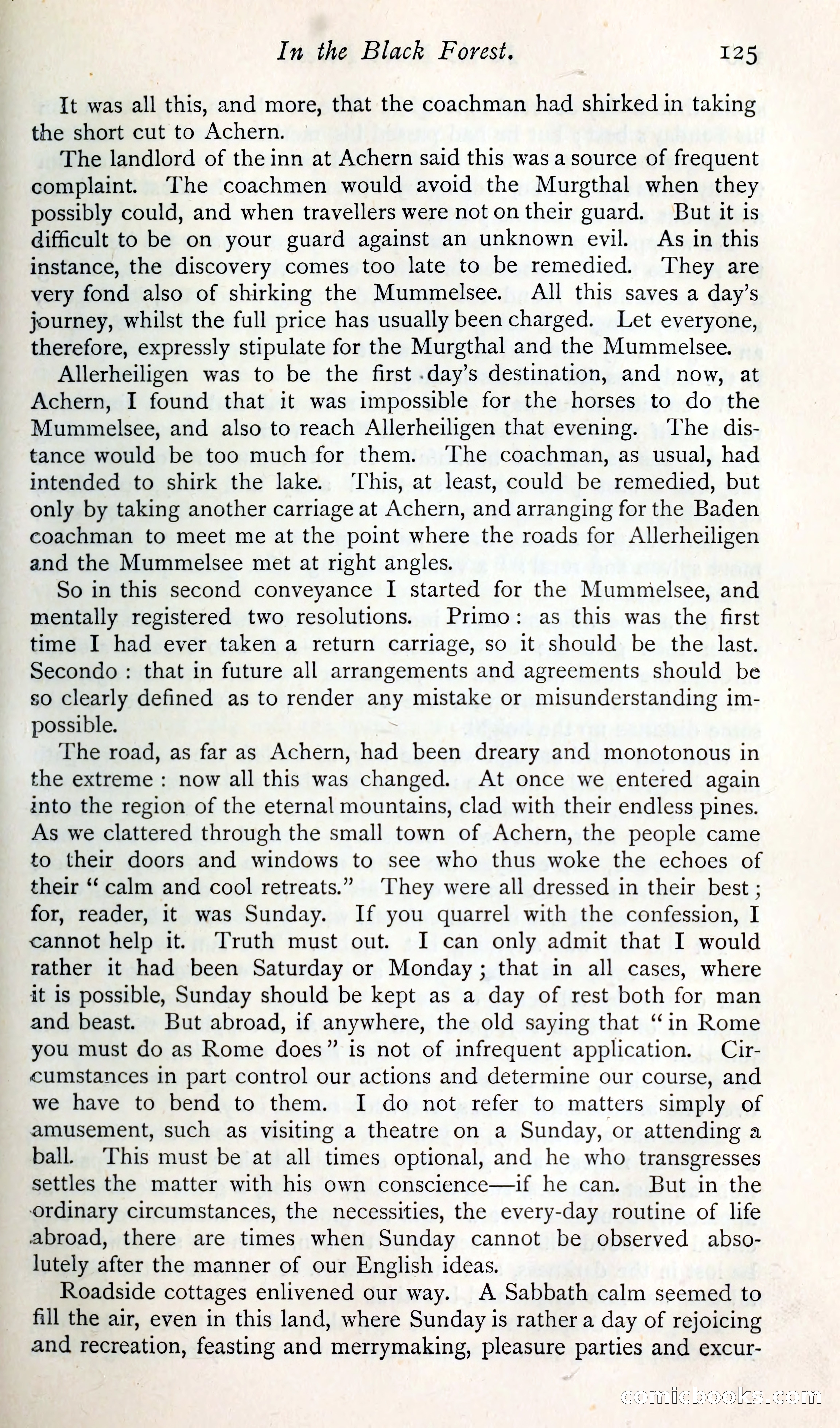
A restored page from Pulp Fiction, 1865. Page through the whole issue in the reader above.
📄 Transcribed text from this page (OCR, searchable)
Machine-transcribed from the original scan — historical spelling and the odd misread are preserved.
In the Black Forest. 125 It was all this, and more, that the coachman had shirked in taking the short cut to Achern. The landlord of the inn at Achern said this was a source of frequent complaint. The coachmen would avoid the Murgthal when they possibly could, and when travellers were not on their guard. But it is difficult to be on your guard against an unknown evil. As in this instance, the discovery comes too late to be remedied. ‘They are very fond also of shirking the Mummelsee. All this saves a day’s journey, whilst the full price has usually been charged. Let everyone, therefore, expressly stipulate for the Murgthal and the Mummelsee. Allerheiligen was to be the first .day’s destination, and now, at Achern, I found that it was impossible for the horses to do the Mummelsee, and also to reach Allerheiligen that evening. ‘The dis- tance would be too much for them. ‘The coachman, as usual, had intended to shirk the lake. ‘This, at least, could be remedied, but only by taking another carriage at Achern, and arranging for the Baden coachman to meet me at the point where the roads for Allerheiligen and the Mummelsee met at right angles. So in this second conveyance I started for the Mummelsee, and mentally registered two resolutions. Primo: as this was the first time I had ever taken a return carriage, so it should be the last. Secondo : that in future all arrangements and agreements should be so clearly defined as to render any mistake or misunderstanding im- possible. The road, as far as Achern, had been dreary and monotonous in the extreme : now all this was changed. At once we entered again into the region of the eternal mountains, clad with their endless pines. As we clattered through the small town of Achern, the people came to their doors and windows to see who thus woke the echoes of their ‘‘ calm and cool retreats.” They were all dressed in their best ; for, reader, it was Sunday. If you quarrel with the confession, I cannot help it. Truth must out. I can only admit that I would rather it had been Saturday or Monday ; that in all cases, where it is possible, Sunday should be kept as a day of rest both for man and beast. But abroad, if anywhere, the old saying that “in Rome you must do as Rome does” is not of infrequent application. Cir- cumstances in part control our actions and determine our course, and we have to bend to them. I do not refer to matters simply of amusement, such as visiting a theatre on a Sunday, or attending a ball. ‘This must be at all times optional, and he who transgresses settles the matter with his own conscience—if he can. But in the ordinary circumstances, the necessities, the every-day routine of life abroad, there are times when Sunday cannot be observed abso- lutely after the manner of our English ideas. Roadside cottages enlivened our way. A Sabbath calm seemed to fill the air, even in this land, where Sunday is rather a day of rejoicing and recreation, feasting and merrymaking, pleasure parties and excur- CoOnniclooolks (S(O)