
Pulp Fiction, 1865 · page 110 of 400
The Argosy — page 110: what you’re looking at
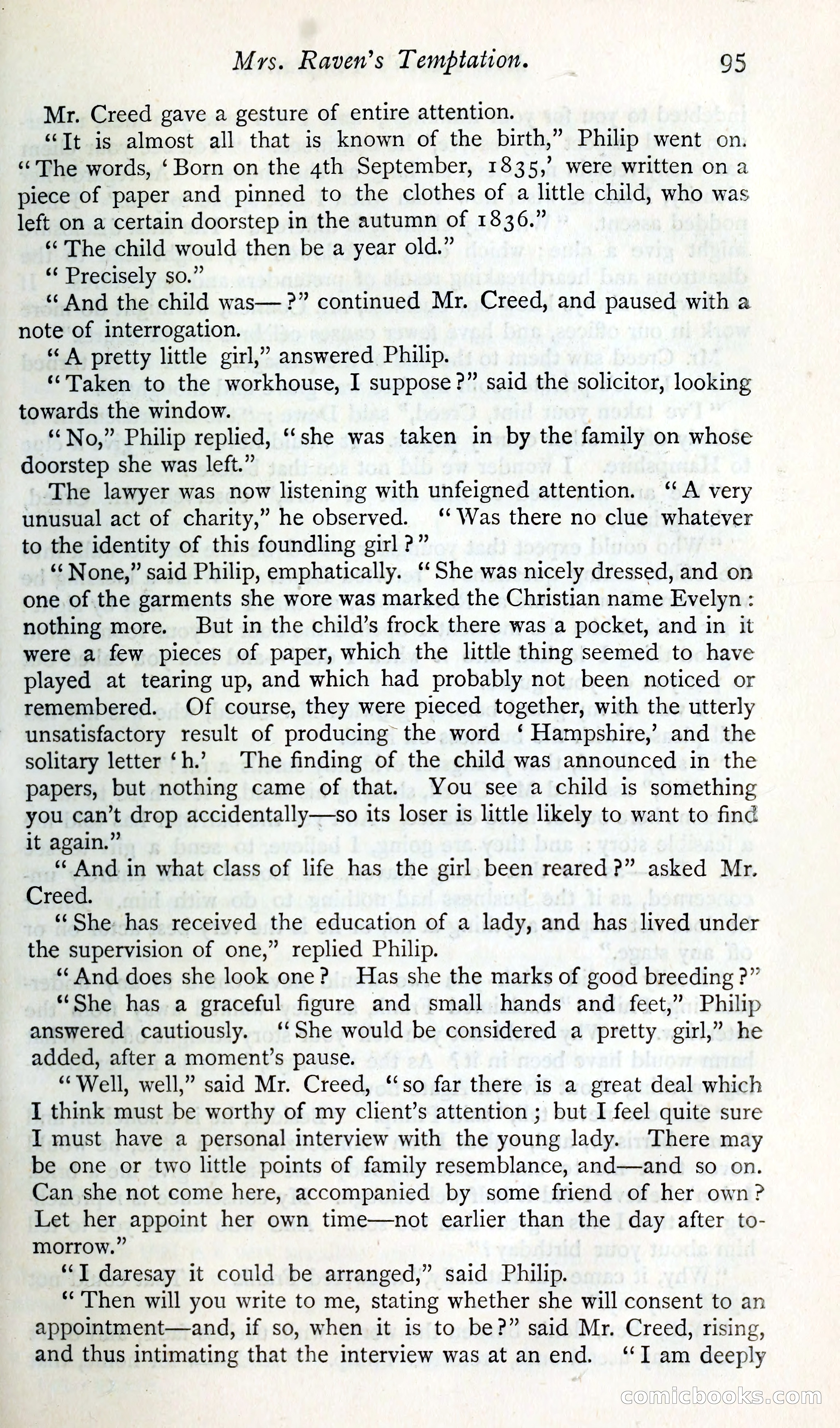
A restored page from Pulp Fiction, 1865. Page through the whole issue in the reader above.
📄 Transcribed text from this page (OCR, searchable)
Machine-transcribed from the original scan — historical spelling and the odd misread are preserved.
Mrs. Raven’s Temptation. Q5 Mr. Creed gave a gesture of entire attention. “Tt is almost all that is known of the birth,” Philip went on. ‘The words, ‘Born on the 4th September, 1835,’ were written on a piece of paper and pinned to the clothes of a little child, who was left on a certain doorstep in the autumn of 1836.” “The child would then be a year old.” ** Precisely so.” “And the child was—?” continued Mr. Creed, and paused with a note of interrogation. “ A pretty little girl,” answered Philip. ‘‘Taken to the workhouse, I suppose ?” said the solicitor, looking towards the window. “No,” Philip replied, ‘‘she was taken in by the family on whose doorstep she was left.” | ‘The lawyer was now listening with unfeigned attention. ‘A very unusual act of charity,” he observed. ‘‘ Was there no clue whatever to the identity of this foundling girl ?” “None,” said Philip, emphatically. ‘‘She was nicely dressed, and on one of the garments she wore was marked the Christian name Evelyn : nothing more. But in the child’s frock there was a pocket, and in it were a few pieces of paper, which the little thing seemed to have played at tearing up, and which had probably not been noticed or remembered. Of course, they were pieced together, with the utterly unsatisfactory result of producing the word ‘ Hampshire,’ and the solitary letter ‘h.’ The finding of the child was announced in the papers, but nothing came of that. You see a child is something you can’t drop accidentally—so its loser is little likely to want to find it again.” ‘ And in what class of life has the girl been reared?” asked Mr. Creed. *¢ She has received the education of a lady, and has lived under the supervision of one,” replied Philip. ‘And does she look one? Has she the marks of good breeding ?” ‘She has a graceful figure and small hands and feet,” Philip answered cautiously. ‘‘She would be considered a pretty girl,” he added, after a moment’s pause. “Well, well,” said Mr. Creed, ‘‘so far there is a great deal which I think must be worthy of my client’s attention ; but I feel quite sure I must have a personal interview with the young lady. ‘There may be one or two little points of family resemblance, and—and so on. Can she not come here, accompanied by some friend of her own? Let her appoint her own time—not earlier than the day after to- morrow.” ““Y daresay it could be arranged,” said Philip. ‘Then will you write to me, stating whether she will consent to an appointment—and, if so, when it is to be?” said Mr. Creed, rising, and thus intimating that the interview was at anend. ‘I am deeply CoOnniclooolks (CO)