
Pulp Fiction, 1865 · page 107 of 400
The Argosy — page 107: what you’re looking at
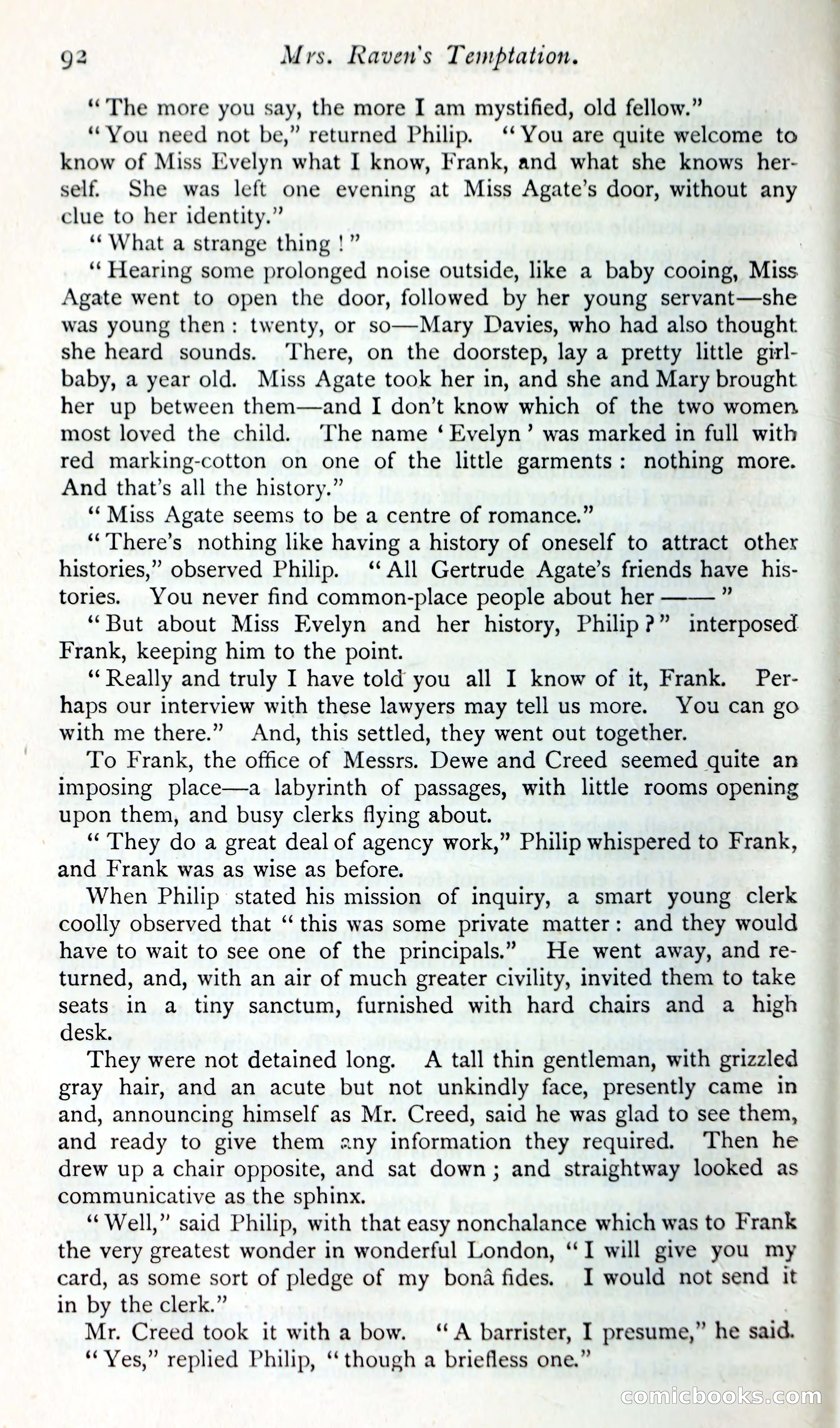
A restored page from Pulp Fiction, 1865. Page through the whole issue in the reader above.
📄 Transcribed text from this page (OCR, searchable)
Machine-transcribed from the original scan — historical spelling and the odd misread are preserved.
Q2 Mrs. Raven's Temptation. “The more you say, the more I am mystified, old fellow.” ‘You need not be,” returned Philip. ‘‘ You are quite welcome to know of Miss Evelyn what I know, Frank, and what she knows her- self. She was left one evening at Miss Agate’s door, without any clue to her identity.” ‘“What a strange thing !” , ‘‘ Hearing some prolonged noise outside, like a baby cooing, Miss Agate went to open the door, followed by her young servant—she was young then: twenty, or so—Mary Davies, who had also thought she heard sounds. ‘There, on the doorstep, lay a pretty little girl- baby, a year old. Miss Agate took her in, and she and Mary brought her up between them—and I don’t know which of the two women most loved the child. The name ‘ Evelyn’ was marked in full with red marking-cotton on one of the little garments: nothing more. And that’s all the history.” ‘““Miss Agate seems to be a centre of romance.” ‘“‘’There’s nothing like having a history of oneself to attract other histories,” observed Philip. ‘All Gertrude Agate’s friends have his- tories. You never find common-place people about her —— ” ‘But about Miss Evelyn and her history, Philip?” interposed Frank, keeping him to the point. “Really and truly I have told you all I know of it, Frank. Per- haps our interview with these lawyers may tell us more. You can go with me there.” And, this settled, they went out together. To Frank, the office of Messrs. Dewe and Creed seemed quite an Imposing place—a labyrinth of passages, with little rooms opening upon them, and busy clerks flying about. “They do a great deal of agency work,” Philip whispered to Frank, and Frank was as wise as before. When Philip stated his mission of inquiry, a smart young clerk coolly observed that “‘ this was some private matter: and they would have to wait to see one of the principals.” He went away, and re- turned, and, with an air of much greater civility, invited them to take seats in a tiny sanctum, furnished with hard chairs and a high desk. They were not detained long. A tall thin gentleman, with grizzled gray hair, and an acute but not unkindly face, presently came in and, announcing himself as Mr. Creed, said he was glad to see them, and ready to give them any information they required. ‘Then he drew up a chair opposite, and sat down; and straightway looked as communicative as the sphinx. “Well,” said Philip, with that easy nonchalance which was to Frank the very greatest wonder in wonderful London, ‘I will give you my card, as some sort of pledge of my bona fides. I would not send it in by the clerk.” | Mr. Creed took it with a bow. ‘A barrister, I presume,” he said. “Yes,” replied Philip, “‘ though a briefless one.” CONMICLIOO_ KS. (€©)