
Pulp Fiction, 1865 · page 104 of 400
The Argosy — page 104: what you’re looking at
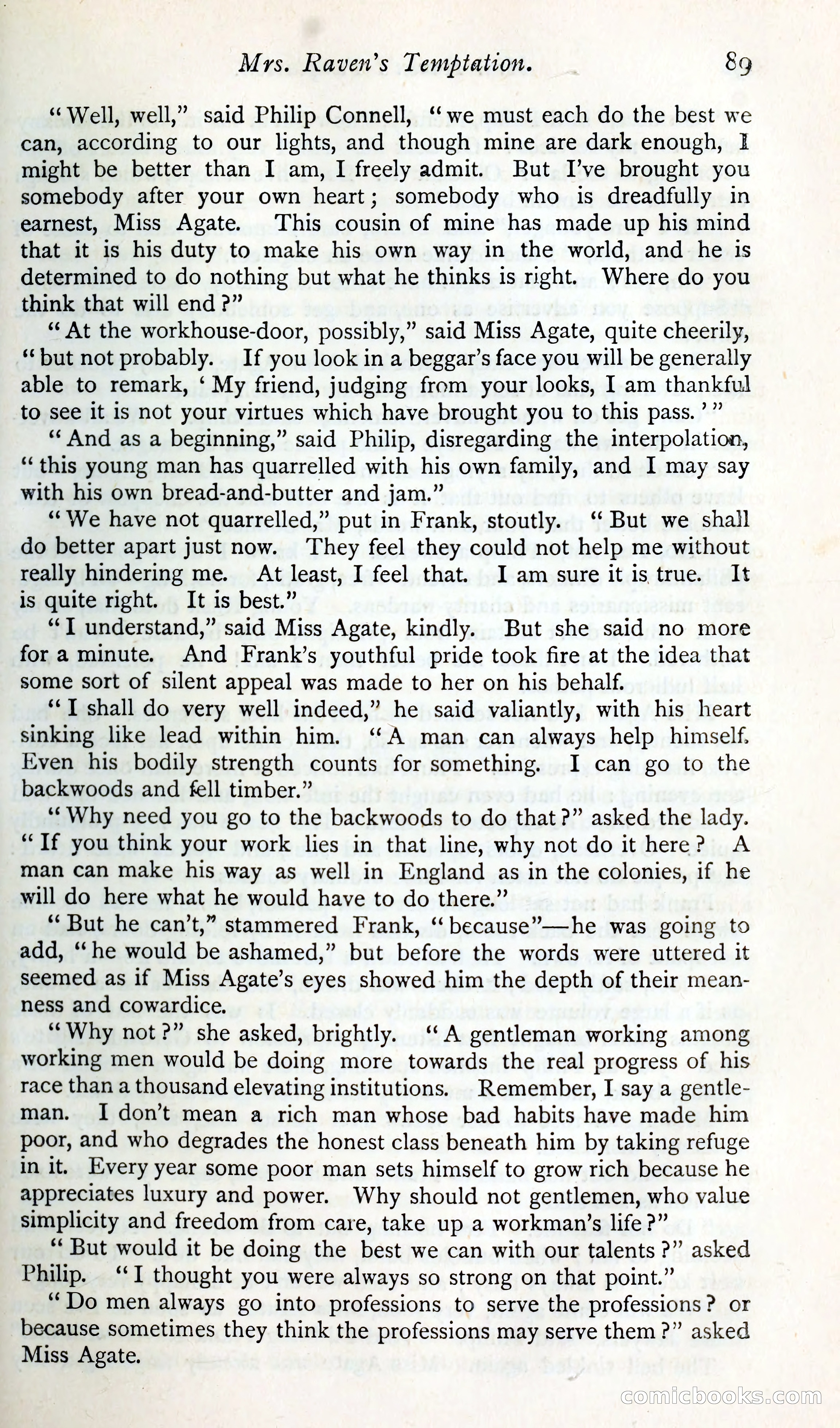
A restored page from Pulp Fiction, 1865. Page through the whole issue in the reader above.
📄 Transcribed text from this page (OCR, searchable)
Machine-transcribed from the original scan — historical spelling and the odd misread are preserved.
Mrs. Raven’s Temptation. &9 “Well, well,” said Philip Connell, ‘‘we must each do the best we can, according to our lights, and though mine are dark enough, I might be better than I am, I freely admit. But I’ve brought you somebody after your own heart; somebody who is dreadfully in earnest, Miss Agate. This cousin of mine has made up his mind that it is his duty to make his own way in the world, and he is determined to do nothing but what he thinks is right. Where do you think that will end ?” ‘At the workhouse-door, possibly,” said Miss Agate, quite cheerily, ‘but not probably. If you look in a beggar’s face you will be generally able to remark, ‘ My friend, judging from your looks, I am thankful to see it is not your virtues which have brought you to this pass.’” “And as a beginning,” said Philip, disregarding the interpolation, ‘this young man has quarrelled with his own family, and I may say with his own bread-and-butter and jam.” ‘““We have not quarrelled,” put in Frank, stoutly. ‘‘ But we shall do better apart just now. They feel they could not help me without really hindering me. At least, I feel that. Iam sure it istrue. It is quite right. It is best.” ‘““T understand,” said Miss Agate, kindly. But she said no more fora minute. And Frank’s youthful pride took fire at the idea that some sort of silent appeal was made to her on his behalf. ‘‘] shall do very well indeed,” he said valiantly, with his heart sinking like lead within him. ‘A man can always help himself. Even his bodily strength counts for something. I can go to the backwoods and fell timber.” ‘Why need you go to the backwoods to do that ?” asked the lady. “Tf you think your work lies in that line, why not do it here? A man can make his way as well in England as in the colonies, if he will do here what he would have to do there.” ‘But he can’t,” stammered Frank, ‘‘ because”—he was going to add, ‘‘he would be ashamed,” but before the words were uttered it seemed as if Miss Agate’s eyes showed him the depth of their mean- ness and cowardice. ‘“Why not?” she asked, brightly. ‘A gentleman working among working men would be doing more towards the real progress of his race than a thousand elevating institutions. Remember, I say a gentle- man. I don’t mean a rich man whose bad habits have made him poor, and who degrades the honest class beneath him by taking refuge in it. Every year some poor man sets himself to grow rich because he appreciates luxury and power. Why should not gentlemen, who value simplicity and freedom from care, take up a workman’s life ?” ‘“ But would it be doing the best we can with our talents ?” asked Philip. ‘I thought you were always so strong on that point.” ‘Do men always go into professions to serve the professions? or because sometimes they think the professions may serve them ?” asked Miss Agate. cConniclooolks (S(O)