
Pulp Fiction, 1865 · page 91 of 400
The Argosy — page 91: what you’re looking at
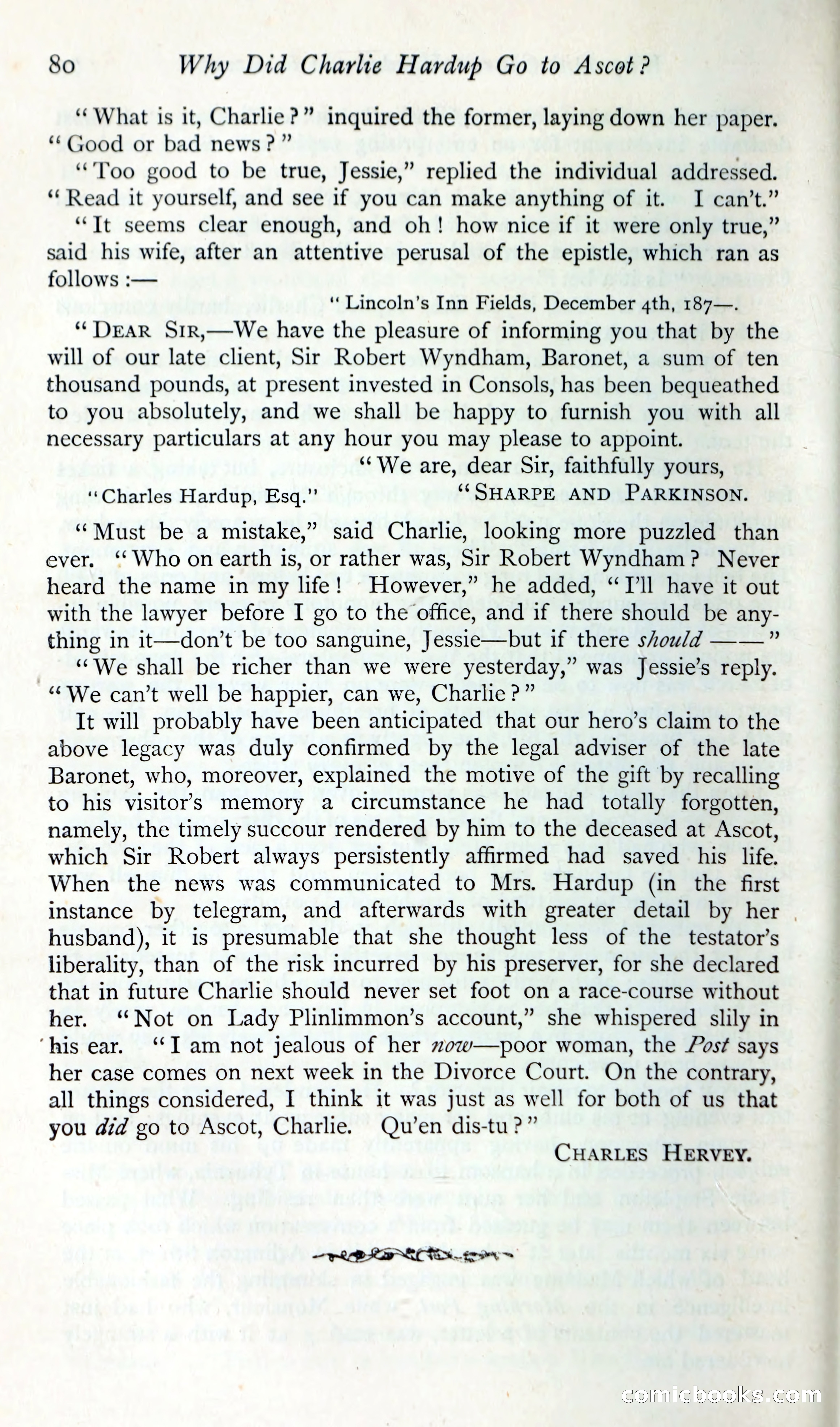
A restored page from Pulp Fiction, 1865. Page through the whole issue in the reader above.
📄 Transcribed text from this page (OCR, searchable)
Machine-transcribed from the original scan — historical spelling and the odd misread are preserved.
80 Why Did Charlie Hardup Go to Ascot? ‘What is it, Charlie?” inquired the former, laying down her paper. ‘Good or bad news ? ” “Too good to be true, Jessie,” replied the individual addressed. ‘Read it yourself, and see if you can make anything of it. I can’t.” “Tt seems clear enough, and oh! how nice if it were only true,” said his wife, after an attentive perusal of the epistle, which ran as follows :— ‘Lincoln’s Inn Fields, December 4th, 187—. “ DEAR SrR,—We have the pleasure of informing you that by the will of our late client, Sir Robert Wyndham, Baronet, a sum of ten thousand pounds, at present invested in Consols, has been bequeathed to you absolutely, and we shall be happy to furnish you with all necessary particulars at any hour you may please to appoint. ‘“‘We are, dear Sir, faithfully yours, ‘Charles Hardup, Esq.” ‘‘SHARPE AND PARKINSON. “Must be a mistake,” said Charlie, looking more puzzled than ever. ‘‘ Who on earth is, or rather was, Sir Robert Wyndham? Never heard the name in my life! However,” he added, “Tl have it out with the lawyer before I go to the office, and if there should be any- thing in it—don’t be too sanguine, Jessie—but if there should —_” ‘“We shall be richer than we were yesterday,” was Jessie’s reply. “We can’t well be happier, can we, Charlie ?” It will probably have been anticipated that our hero’s claim to the above legacy was duly confirmed by the legal adviser of the late Baronet, who, moreover, explained the motive of the gift by recalling to his visitor's memory a circumstance he had totally forgotten, namely, the timely succour rendered by him to the deceased at Ascot, which Sir Robert always persistently affirmed had saved his life. When the news was communicated to Mrs. Hardup (in the first instance by telegram, and afterwards with greater detail by her | husband), it is presumable that she thought less of the testator’s liberality, than of the risk incurred by his preserver, for she declared that in future Charlie should never set foot on a race-course without her. ‘Not on Lady Plinlimmon’s account,” she whispered slily in ‘his ear. ‘‘I am not jealous of her 70zw—poor woman, the /os?t says her case comes on next week in the Divorce Court. On the contrary, all things considered, I think it was just as well for both of us that you aid go to Ascot, Charlie. Qu’en dis-tu ?” CHARLES HERVEY. ECOPMICMOO;KS, EO)