
Pulp Fiction, 1865 · page 89 of 400
The Argosy — page 89: what you’re looking at
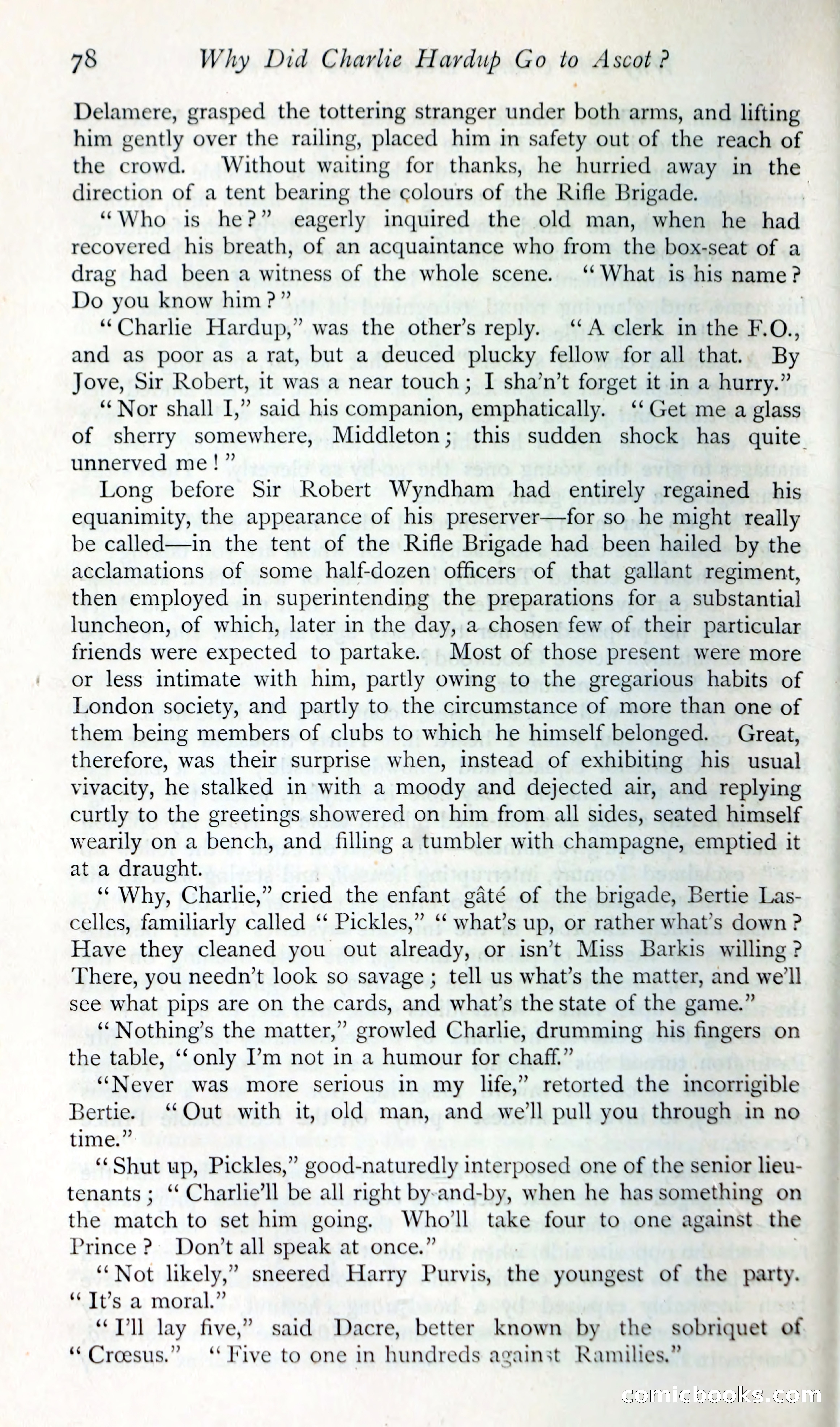
A restored page from Pulp Fiction, 1865. Page through the whole issue in the reader above.
📄 Transcribed text from this page (OCR, searchable)
Machine-transcribed from the original scan — historical spelling and the odd misread are preserved.
78 Why Did Charlie Hardup Go to Ascot? Delamere, grasped the tottering stranger under both arms, and lifting him gently over the railing, placed him in safety out of the reach of the crowd. Without waiting for thanks, he hurried away in the direction of a tent bearing the colours of the Rifle Brigade. ) “Who is he?” eagerly inquired the old man, when he had recovered his breath, of an acquaintance who from the box-seat of a drag had been a witness of the whole scene. ‘‘What is his name? Do you know him ?” : ‘““Charlie Hardup,” was the other’s reply. ‘A clerk in the F.O., and as poor as a rat, but a deuced plucky fellow for all that. By Jove, Sir Robert, it was a near touch; I sha’n’t forget it in a hurry.” ‘Nor shall I,” said his companion, emphatically. ‘‘Get me a glass of sherry somewhere, Middleton; this sudden shock has quite unnerved me!” Long before Sir Robert Wyndham had entirely regained his equanimity, the appearance of his preserver—for so he might really be called—ain the tent of the Rifle Brigade had been hailed by the acclamations of some half-dozen officers of that gallant regiment, then employed in superintending the preparations for a substantial luncheon, of which, later in the day, a chosen few of their particular friends were expected to partake. Most of those present were more or less intimate with him, partly owing to the gregarious habits of London society, and partly to the circumstance of more than one of them being members of clubs to which he himself belonged. Great, therefore, was their surprise when, instead of exhibiting his usual vivacity, he stalked in with a moody and dejected air, and replying curtly to the greetings showered on him from all sides, seated himself wearily on a bench, and filling a tumbler with champagne, emptied it at a draught. ‘Why, Charlie,” cried the enfant gaté of the brigade, Bertie Las- celles, familiarly called ‘‘ Pickles,” ‘ what? sup, or rather what’s down ? Have they cleaned you out already, or isn’t Miss Barkis willing ? There, you needn’t look so savage ; tell us what’s the matter, and we'll see what pips are on the cards, and what’s the state of the game.” ‘“‘Nothing’s the matter,” growled Charlie, drumming his fingers on the table, ‘only I’m not in a humour for chaff.” “Never was more serious in my life,” retorted the incorrigible Bertie. ‘Out with it, old man, and we'll pull you through in no time.” ‘‘Shut up, Pickles,” good-naturedly interposed one of the senior lieu- tenants; ‘ Charlie’ll be all right by-and-by, when he has something on the match to set him going. Who’ ll take four to one against the Prince ? Don’t all speak at once.’ ‘Not likely,” sneered Harry Purvis, the youngest of the party. “It’s a moral.” ‘“T’ll lay five,” said Dacre, better known by the sobriquet of ‘ Croesus.” ‘Five to one in hundreds against Ramilies,” EOPMICIOO; KS, EO)