
Pulp Fiction, 1865 · page 79 of 400
The Argosy — page 79: what you’re looking at
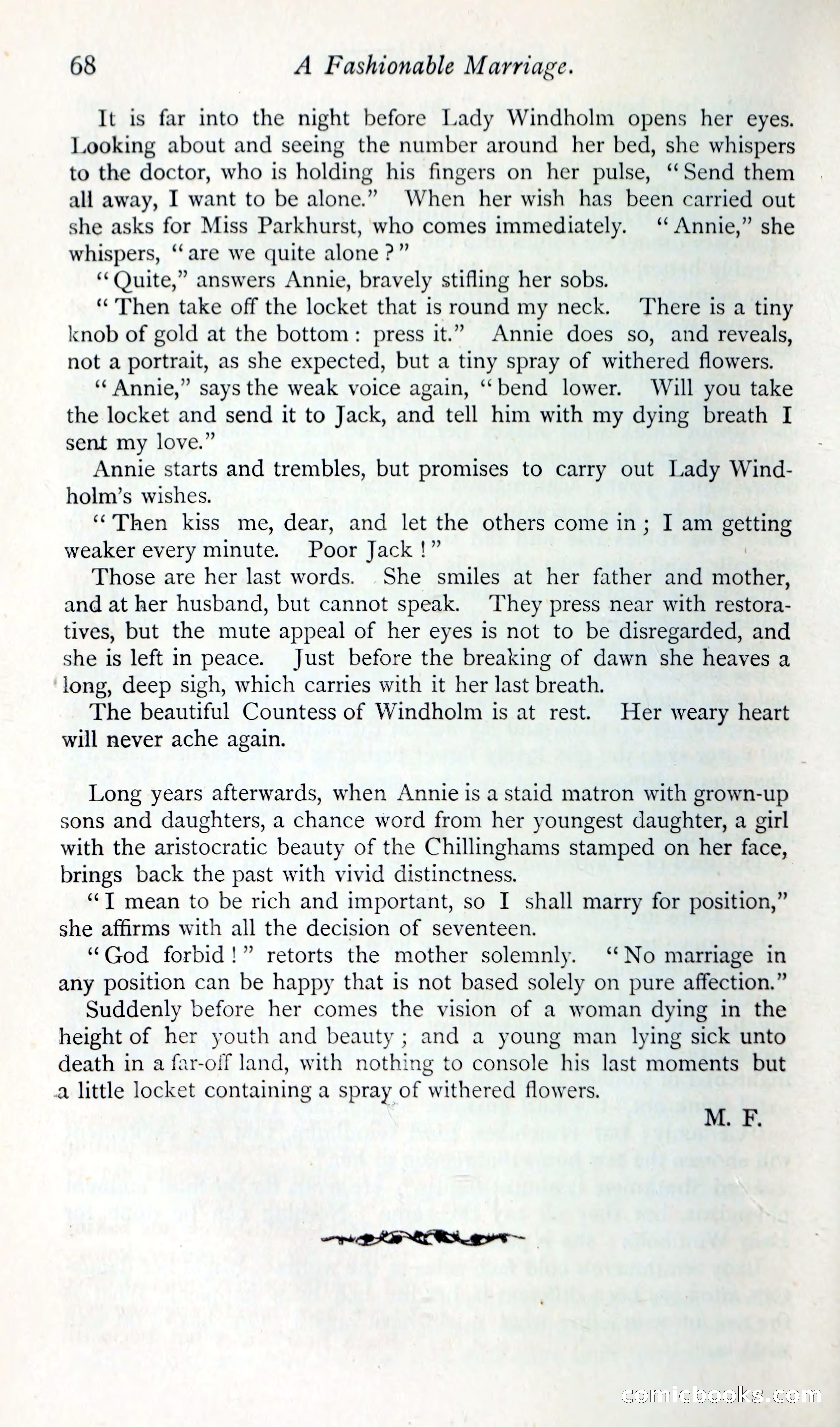
A restored page from Pulp Fiction, 1865. Page through the whole issue in the reader above.
📄 Transcribed text from this page (OCR, searchable)
Machine-transcribed from the original scan — historical spelling and the odd misread are preserved.
68 A Fashionable Marriage. It is far into the night before Lady Windholm opens her eyes. Looking about and seeing the number around her bed, she whispers to the doctor, who is holding his fingers on her pulse, ‘‘Send them all away, I want to be alone.” When her wish has been carried out she asks for Miss Parkhurst, who comes immediately. ‘‘ Annie,” she whispers, ‘fare we quite alone ?” “Quite,” answers Annie, bravely stifling her sobs. ‘Then take off the locket that is round my neck. ‘There is a tiny knob of gold at the bottom: press it.” Annie does so, and reveals, not a portrait, as she expected, but a tiny spray of withered flowers. ‘‘ Annie,” says the weak voice again, “‘bend lower. Will you take the locket and send it to Jack, and tell him with my dying breath [ sent my love.” Annie starts and trembles, but promises to carry out Lady Wind- holm’s wishes. ‘Then kiss me, dear, and let the others come in; I am getting weaker every minute. Poor Jack!” | Those are her last words. She smiles at her father and mother, and at her husband, but cannot speak. They press near with restora- tives, but the mute appeal of her eyes is not to be disregarded, and she is left in peace. Just before the breaking of dawn she heaves a ‘long, deep sigh, which carries with it her last breath. The beautiful Countess of Windholm is at rest. Her weary heart will never ache again. Long years afterwards, when Annie is a staid matron with grown-up sons and daughters, a chance word from her youngest daughter, a girl with the aristocratic beauty of the Chillinghams stamped on her face, brings back the past with vivid distinctness. ‘‘T mean to be rich and important, so I shall marry for position,” she affirms with all the decision of seventeen. “God forbid!” retorts the mother solemnly. ‘‘No marriage in any position can be happy that is not based solely on pure affection.” Suddenly before her comes the vision of a woman dying in the height of her youth and beauty ; and a young man lying sick unto death in a far-off land, with nothing to console his last moments but a little locket containing a spray of withered flowers. M. F. COPMICMDOO; KS, EO)