
Pulp Fiction, 1865 · page 330 of 400
The Argosy — page 330: what you’re looking at
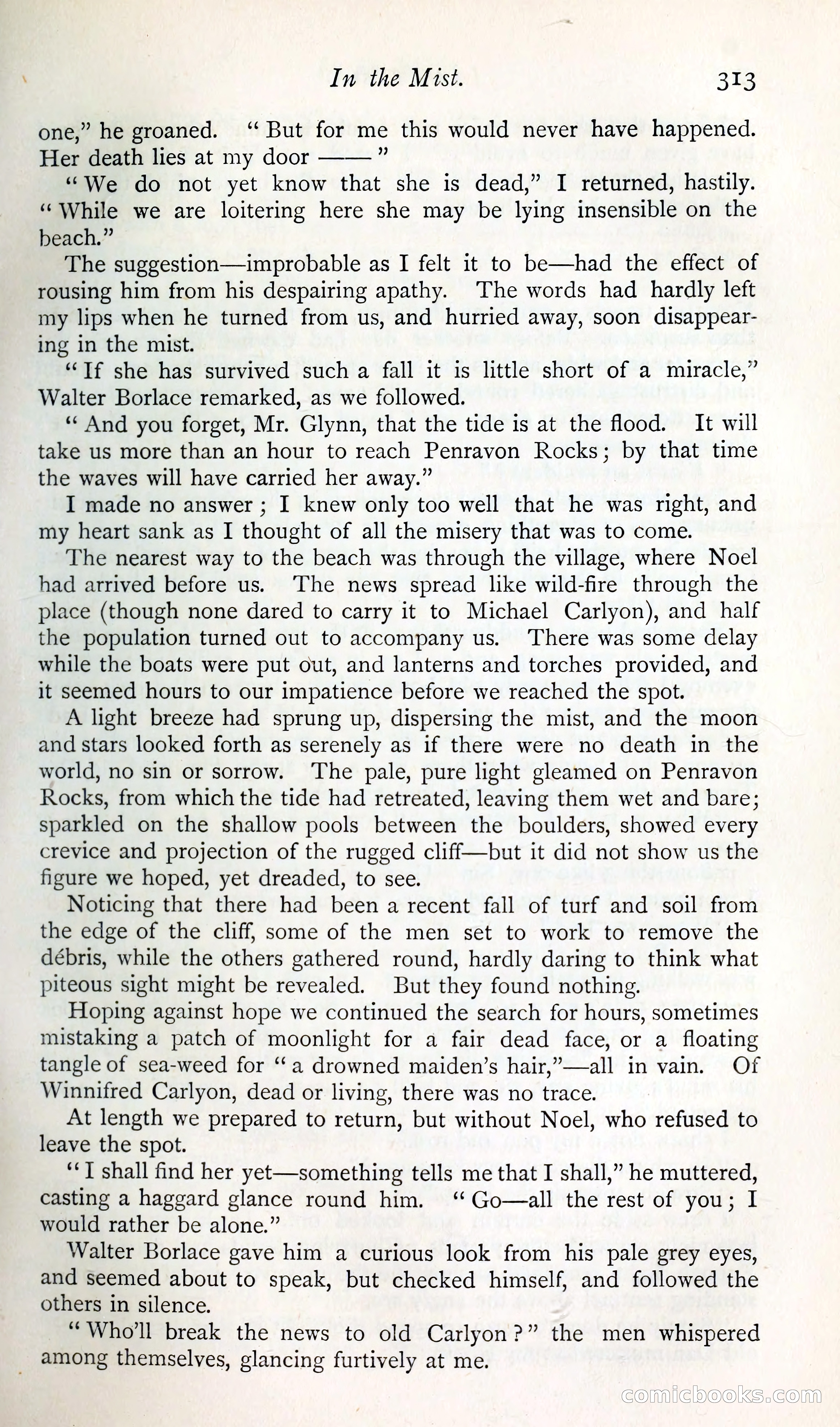
A restored page from Pulp Fiction, 1865. Page through the whole issue in the reader above.
📄 Transcribed text from this page (OCR, searchable)
Machine-transcribed from the original scan — historical spelling and the odd misread are preserved.
In the Mist. 313 one,” he groaned. ‘But for me this would never have happened. Her death lies at my door ——” “We do not yet know that she is dead,” I returned, hastily. ‘‘While we are loitering here she may be lying insensible on the beach.” The suggestion—improbable as I felt it to be—had the effect of rousing him from his despairing apathy. The words had hardly left my lips when he turned from us, and hurried away, soon disappear- ing in the mist. “Tf she has survived such a fall it is little short of a muracle,” Walter Borlace remarked, as we followed. ‘And you forget, Mr. Glynn, that the tide is at the flood. It will take us more than an hour to reach Penravon Rocks; by that time the waves will have carried her away.” I made no answer ; I knew only too well that he was right, and my heart sank as I thought of all the misery that was to come. The nearest way to the beach was through the village, where Noel had arrived before us. ‘The news spread like wild-fire through the place (though none dared to carry it to Michael Carlyon), and half the population turned out to accompany us. ‘There was some delay while the boats were put out, and lanterns and torches provided, and it seemed hours to our impatience before we reached the spot. A light breeze had sprung up, dispersing the mist, and the moon and stars looked forth as serenely as if there were no death in the world, no sin or sorrow. ‘The pale, pure light gleamed on Penravon Rocks, from which the tide had retreated, leaving them wet and bare; sparkled on the shallow pools between the boulders, showed every crevice and projection of the rugged cliff—but it did not show us the figure we hoped, yet dreaded, to see. Noticing that there had been a recent fall of turf and soil from the edge of the cliff, some of the men set to work to remove the débris, while the others gathered round, hardly daring to think what piteous sight might be revealed. But they found nothing. Hoping against hope we continued the search for hours, sometimes mistaking a patch of moonlight for a fair dead face, or a floating tangle of sea-weed for “‘a drowned maiden’s hair,”—all in vain. Of Winnifred Carlyon, dead or living, there was no trace. At length we prepared to return, but without Noel, who refused to leave the spot. ‘*] shall find her yet—something tells me that I shall,” he muttered, casting a haggard glance round him. ‘“ Go—all the rest of you; I would rather be alone.” Walter Borlace gave him a curious look from his pale grey eyes, and seemed about to speak, but checked himself, and followed the others in silence. “Who'll break the news to old Carlyon?” the men whispered _ among themselves, glancing furtively at me. ECORnNIClOOkKS (CO)