
Pulp Fiction, 1865 · page 313 of 400
The Argosy — page 313: what you’re looking at
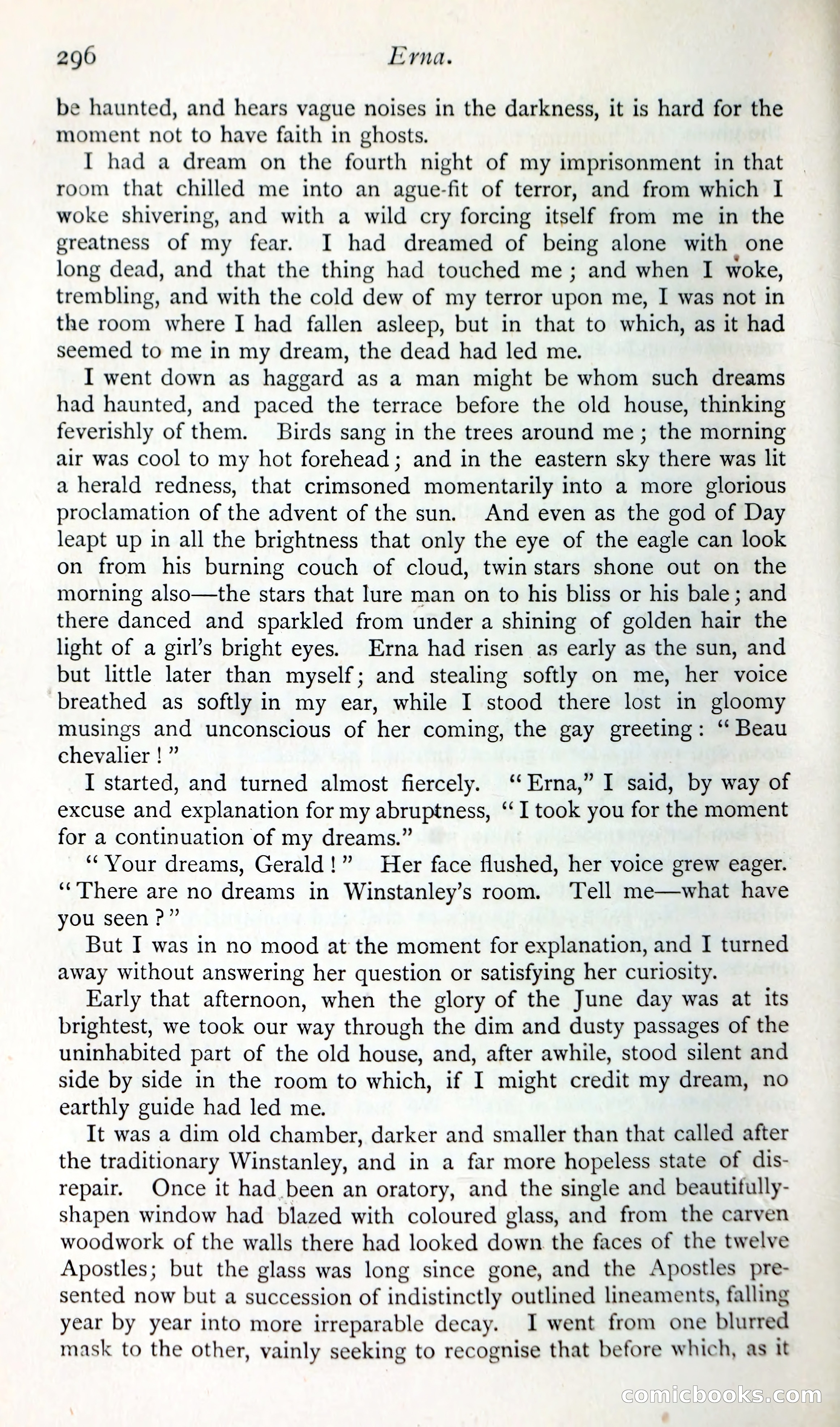
A restored page from Pulp Fiction, 1865. Page through the whole issue in the reader above.
📄 Transcribed text from this page (OCR, searchable)
Machine-transcribed from the original scan — historical spelling and the odd misread are preserved.
296 Erna. be haunted, and hears vague noises in the darkness, it is hard for the moment not to have faith in ghosts. I had a dream on the fourth night of my imprisonment in that room that chilled me into an ague-fit of terror, and from which I woke shivering, and with a wild cry forcing itself from me in the greatness of my fear. I had dreamed of being alone with one long dead, and that the thing had touched me; and when I woke, trembling, and with the cold dew of my terror upon me, I was not in the room where I had fallen asleep, but in that to which, as it had seemed to me in my dream, the dead had led me. I went down as haggard as a man might be whom such dreams had haunted, and paced the terrace before the old house, thinking feverishly of them. Birds sang in the trees around me; the morning air was cool to my hot forehead; and in the eastern sky there was lit a herald redness, that crimsoned momentarily into a more glorious proclamation of the advent of the sun. And even as the god of Day leapt up in all the brightness that only the eye of the eagle can look on from his burning couch of cloud, twin stars shone out on the morning also—the stars that lure man on to his bliss or his bale; and there danced and sparkled from under a shining of golden hair the light of a girl’s bright eyes. Erna had risen as early as the sun, and but little later than myself; and stealing softly on me, her voice breathed as softly in my ear, while I stood there lost in gloomy musings and unconscious of her coming, the gay greeting: “‘ Beau chevalier ! ” I started, and turned almost fiercely. ‘‘ Erna,” I said, by way of excuse and explanation for my abruptness, ‘‘I took you for the moment for a continuation of my dreams.” ‘Your dreams, Gerald!” Her face flushed, her voice grew eager. ‘There are no dreams in Winstanley’s room. Tell me—what have you seen ?” But I was in no mood at the moment for explanation, and I turned away without answering her question or satisfying her curiosity. Early that afternoon, when the glory of the June day was at its brightest, we took our way through the dim and dusty passages of the uninhabited part of the old house, and, after awhile, stood silent and side by side in the room to which, if I might credit my dream, no earthly guide had led me. It was a dim old chamber, darker and smaller than that called after the traditionary Winstanley, and in a far more hopeless state of dis- repair. Once it had been an oratory, and the single and beautifully- shapen window had blazed with coloured glass, and from the carven woodwork of the walls there had looked down the faces of the twelve Apostles; but the glass was long since gone, and the Apostles pre- sented now but a succession of indistinctly outlined lineaments, falling year by year into more irreparable decay. I went from one blurred mask to the other, vainly seeking to recognise that before which, as it ECOMICMDOO;KS, (EC)