
Pulp Fiction, 1865 · page 293 of 400
The Argosy — page 293: what you’re looking at
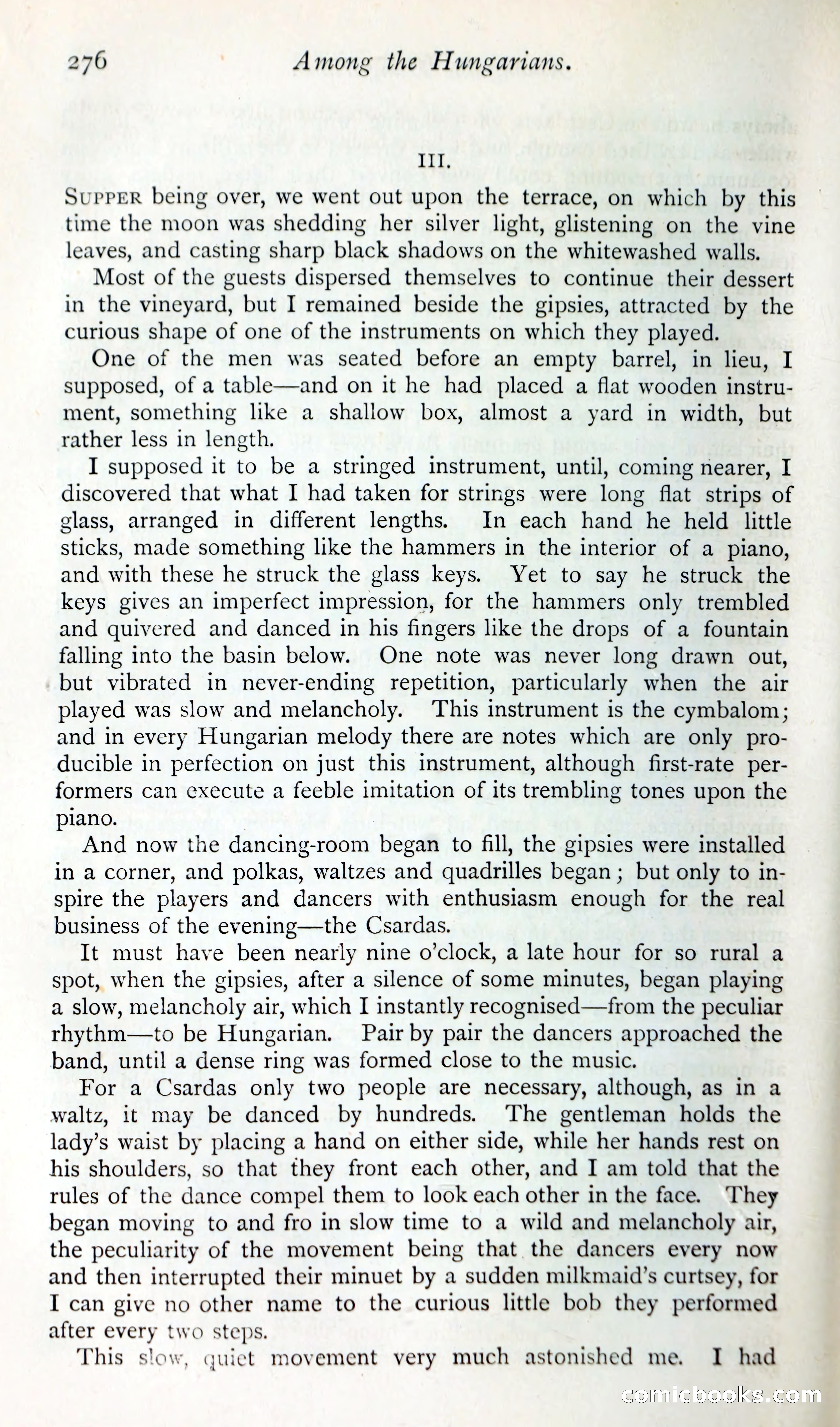
A restored page from Pulp Fiction, 1865. Page through the whole issue in the reader above.
📄 Transcribed text from this page (OCR, searchable)
Machine-transcribed from the original scan — historical spelling and the odd misread are preserved.
276 Among the Hungarians. Ill, SUPPER being over, we went out upon the terrace, on which by this time the moon was shedding her silver light, glistening on the vine leaves, and casting sharp black shadows on the whitewashed walls. Most of the guests dispersed themselves to continue their dessert in the vineyard, but I remained beside the gipsies, attracted by the curious shape of one of the instruments on which they played. One of the men was seated before an empty barrel, in lieu, I supposed, of a table—and on it he had placed a flat wooden instru- ment, something like a shallow box, almost a yard in width, but rather less in length. I supposed it to be a stringed instrument, until, coming nearer, I discovered that what I had taken for strings were long flat strips of glass, arranged in different lengths. In each hand he held little sticks, made something like the hammers in the interior of a piano, and with these he struck the glass keys. Yet to say he struck the keys gives an imperfect impression, for the hammers only trembled and quivered and danced in his fingers like the drops of a fountain falling into the basin below. One note was never long drawn out, but vibrated in never-ending repetition, particularly when the air played was slow and melancholy. ‘This instrument is the cymbalom; and in every Hungarian melody there are notes which are only pro- ducible in perfection on just this instrument, although first-rate per- formers can execute a feeble imitation of its trembling tones upon the piano. And now the dancing-room began to fill, the gipsies were installed in a corner, and polkas, waltzes and quadrilles began ; but only to in- spire the players and dancers with enthusiasm enough for the real business of the evening—the Csardas. It must have been nearly nine o’clock, a late hour for so rural a spot, when the gipsies, after a silence of some minutes, began playing a slow, melancholy air, which I instantly recognised—from the peculiar rhythm—to be Hungarian. Pair by pair the dancers approached the band, until a dense ring was formed close to the music. For a Csardas only two people are necessary, although, as in a waltz, it may be danced by hundreds. ‘The gentleman holds the lady’s waist by placing a hand on either side, while her hands rest on his shoulders, so that they front each other, and I am told that the rules of the dance compel them to look each other in the face. ‘They began moving to and fro in slow time to a wild and melancholy air, the peculiarity of the movement being that the dancers every now and then interrupted their minuet by a sudden milkmaid’s curtsey, for I can give no other name to the curious little bob they performed after every two steps. This slow, quiet movement very much astonished me. I had COMIC LOOKS, (E00)