
Pulp Fiction, 1865 · page 278 of 400
The Argosy — page 278: what you’re looking at
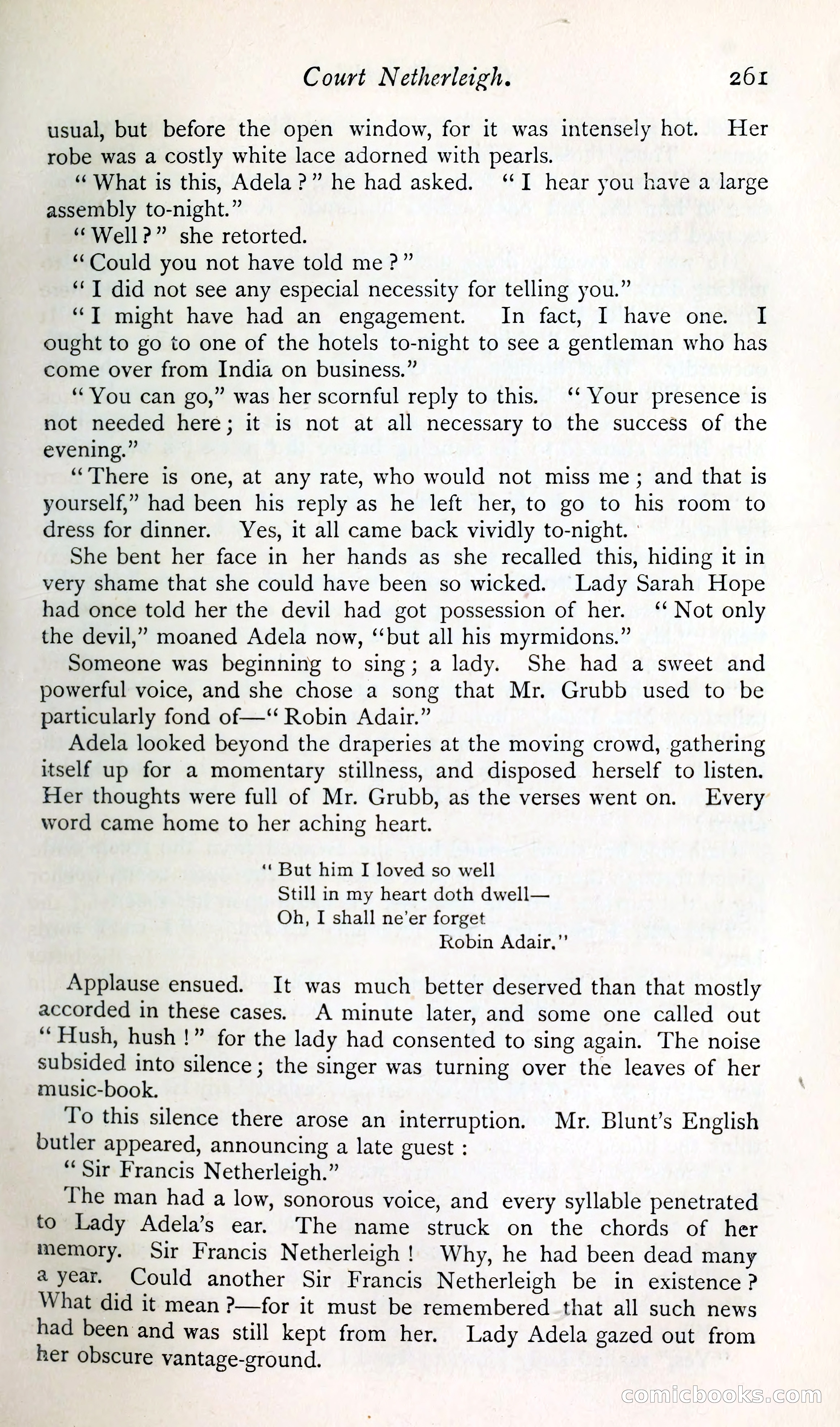
A restored page from Pulp Fiction, 1865. Page through the whole issue in the reader above.
📄 Transcribed text from this page (OCR, searchable)
Machine-transcribed from the original scan — historical spelling and the odd misread are preserved.
Court Netherleigh. 201 usual, but before the open window, for it was intensely hot. Her robe was a costly white lace adorned with pearls. ‘What is this, Adela?” he had asked. ‘I hear you have a large assembly to-night.” “Well?” she retorted. “Could you not have told me ?” ‘“‘ TI did not see any especial necessity for telling you.” “TI might have had an engagement. In fact, I have one. I ought to go to one of the hotels to-night to see a gentleman who has come over from India on business.” “You can go,” was her scornful reply to this. ‘‘ Your presence Is not needed here; it is not at all necessary to the success of the evening.” “There is one, at any rate, who would not miss me; and that is yourself,” had been his reply as he left her, to go to his room to dress for dinner. Yes, it all came back vividly to-night. ° She bent her face in her hands as she recalled this, hiding it in very shame that she could have been so wicked. Lady Sarah Hope had once told her the devil had got possession of her. ‘‘ Not only the devil,” moaned Adela now, ‘‘but all his myrmidons.” Someone was beginning to sing; a lady. She had a sweet and powerful voice, and she chose a song that Mr. Grubb used to be particularly fond of—‘‘ Robin Adair.” Adela looked beyond the draperies at the moving crowd, gathering itself up for a momentary stillness, and disposed herself to listen. Fer thoughts were full of Mr. Grubb, as the verses went on. Every word came home to her aching heart. ‘‘ But him I loved so well Still in my heart doth dwell— Oh, I shall ne’er forget Robin Adair,”’ Applause ensued. It was much better deserved than that mostly accorded in these cases. A minute later, and some one called out ‘Hush, hush!” for the lady had consented to sing again. The noise subsided into silence; the singer was turning over the leaves of her music-book. | To this silence there arose an interruption. Mr. Blunt’s English butler appeared, announcing a late guest : ‘Sir Francis Netherleigh.” The man had a low, sonorous voice, and every syllable penetrated to Lady Adela’s ear. The name struck on the chords of her memory. Sir Francis Netherleigh! Why, he had been dead many a year. Could another Sir Francis Netherleigh be in existence? What did it mean ?—for it must be remembered that all such news had been and was still kept from her. Lady Adela gazed out from her obscure vantage-ground. ECORnnicloooks (©)