
Pulp Fiction, 1865 · page 273 of 400
The Argosy — page 273: what you’re looking at
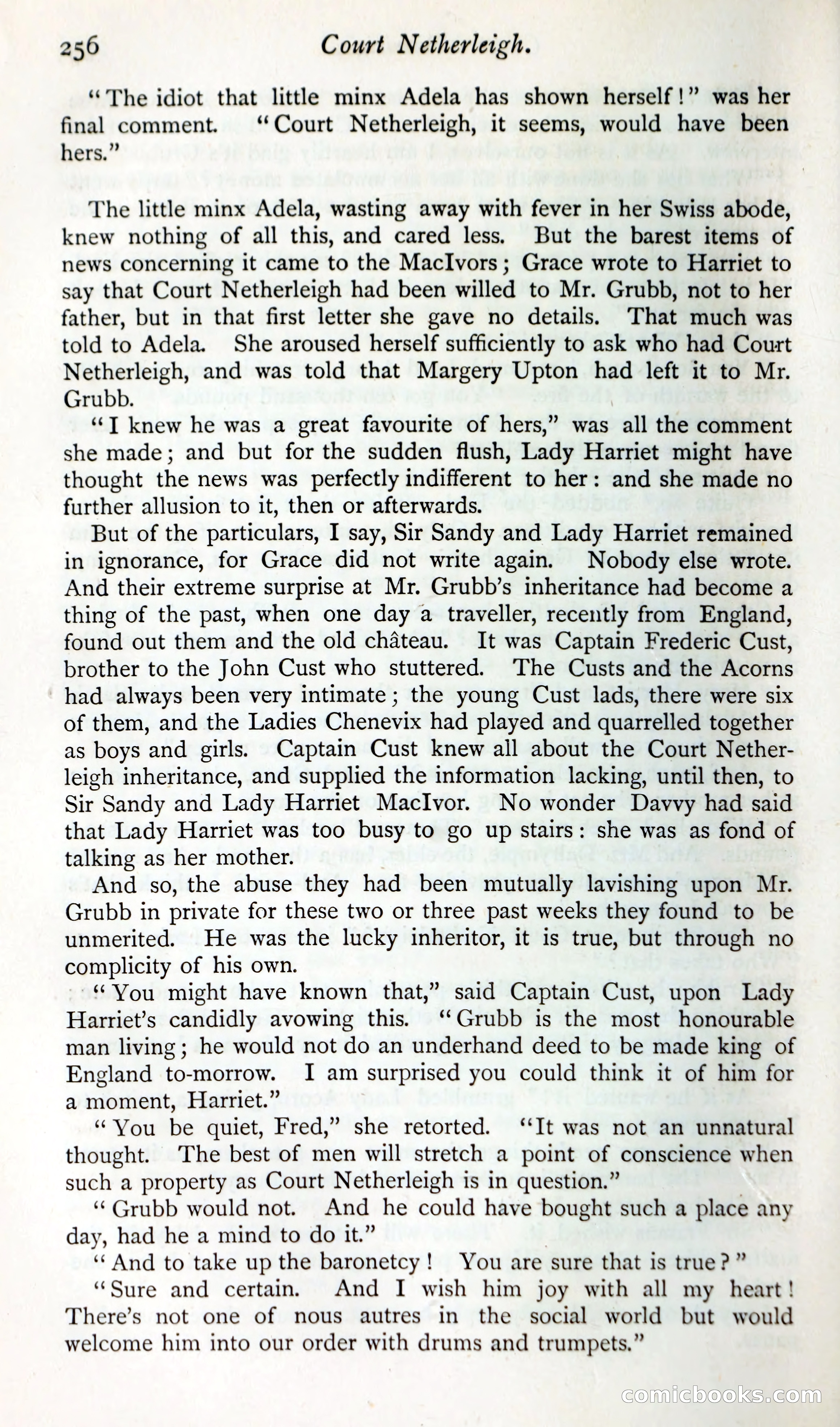
A restored page from Pulp Fiction, 1865. Page through the whole issue in the reader above.
📄 Transcribed text from this page (OCR, searchable)
Machine-transcribed from the original scan — historical spelling and the odd misread are preserved.
256 Court Netherleigh. “The idiot that littlke minx Adela has shown herself!” was her final comment. ‘Court Netherleigh, it seems, would have been hers.” The little minx Adela, wasting away with fever in her Swiss abode, knew nothing of all this, and cared less. But the barest items of news concerning it came to the MacIvors; Grace wrote to Harriet to say that Court Netherleigh had been willed to Mr. Grubb, not to her father, but in that first letter she gave no details. That much was told to Adela. She aroused herself sufficiently to ask who had Court Netherleigh, and was told that Margery Upton had left it to Mr. Grubb. ‘‘T knew he was a great favourite of hers,” was all the comment she made; and but for the sudden flush, Lady Harriet might have thought the news was perfectly indifferent to her: and she made no further allusion to it, then or afterwards. But of the particulars, I say, Sir Sandy and Lady Harriet remained in ignorance, for Grace did not write again. Nobody else wrote. And their extreme surprise at Mr. Grubb’s inheritance had become a thing of the past, when one day a traveller, recently from England, found out them and the old chateau. It was Captain Frederic Cust, brother to the John Cust who stuttered. The Custs and the Acorns had always been very intimate; the young Cust lads, there were six of them, and the Ladies Chenevix had played and quarrelled together as boys and girls. Captain Cust knew all about the Court Nether- leigh inheritance, and supplied the information lacking, until then, to Sir Sandy and Lady Harriet MacIvor. No wonder Davyvy had said that Lady Harriet was too busy to go up stairs: she was as fond of talking as her mother. And so, the abuse they had been mutually lavishing upon Mr. Grubb in private for these two or three past weeks they found to be unmerited. He was the lucky inheritor, it is true, but through no complicity of his own. Vou might have known that,” said Captain Cust, upon Lady Harriet’s candidly avowing this. ‘‘Grubb is the most honourable man living; he would not do an underhand deed to be made king of England to-morrow. I am surprised you could think it of him for a moment, Harriet.” “Vou be quiet, Fred,” she retorted. ‘‘It was not an unnatural thought. The best of men will stretch a point of conscience when such a property as Court Netherleigh is in question.” “Grubb would not. And he could have bought such a place any day, had he a mind to do it.” ‘‘And to take up the baronetcy! You are sure that is true?” “Sure and certain. And I wish him joy with all my heart! There’s not one of nous autres in the social world but would welcome him into our order with drums and trumpets.” COMIC DOO;KS, (EO)