
Pulp Fiction, 1865 · page 265 of 400
The Argosy — page 265: what you’re looking at
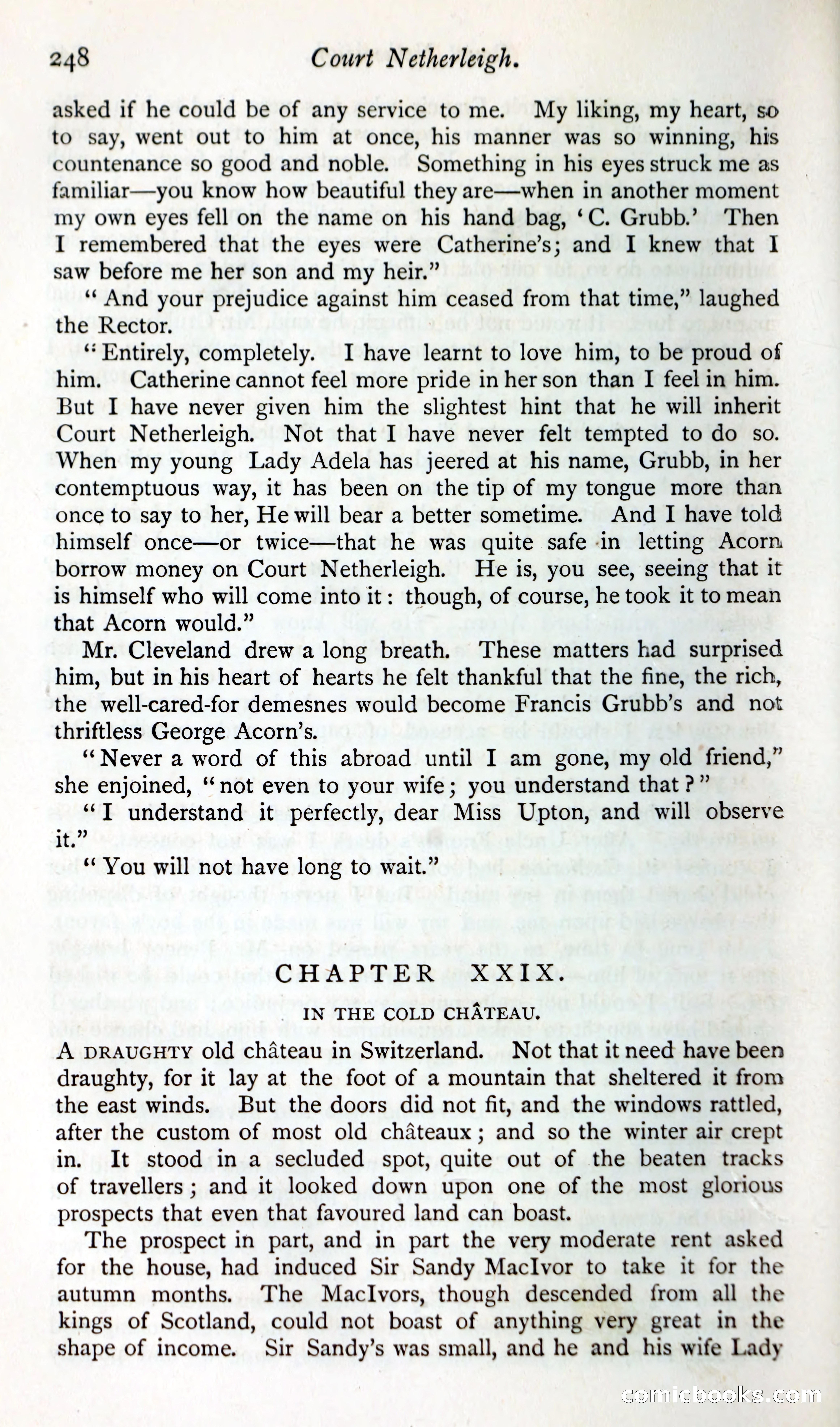
A restored page from Pulp Fiction, 1865. Page through the whole issue in the reader above.
📄 Transcribed text from this page (OCR, searchable)
Machine-transcribed from the original scan — historical spelling and the odd misread are preserved.
248 Court Netherleigh. asked if he could be of any service tome. My liking, my heart, so to say, went out to him at once, his manner was so winning, his countenance so good and noble. Something in his eyes struck me as familiar—you know how beautiful they are—when in another moment my own eyes fell on the name on his hand bag, ‘C. Grubb.’ ‘Then I remembered that the eyes were Catherine’s; and I knew that Il saw before me her son and my heir.” ‘‘ And your prejudice against him ceased from that time,” laughed the Rector. ‘Entirely, completely. I have learnt to love him, to be proud of him. Catherine cannot feel more pride in her son than I feel in him. But I have never given him the slightest hint that he will inherit Court Netherleigh. Not that I have never felt tempted to do so. When my young Lady Adela has jeered at his name, Grubb, in her contemptuous way, it has been on the tip of my tongue more than once to say to her, He will bear a better sometime. And I have told himself once—or twice—that he was quite safe in letting Acorn borrow money on Court Netherleigh. He is, you see, seeing that it is himself who will come into it: though, of course, he took it to mean that Acorn would.” Mr. Cleveland drew a long breath. ‘These matters had surprised him, but in his heart of hearts he felt thankful that the fine, the rich, the well-cared-for demesnes would become Francis Grubb’s and not thriftless George Acorn’s. ‘Never a word of this abroad until I am gone, my old friend,” she enjoined, “‘not even to your wife; you understand that ?” ‘“T understand it perfectly, dear Miss Upton, and will observe i? ‘You will not have long to wait.” CHAPTER XXIX. IN THE COLD CHATEAU. A DRAUGHTY old chateau in Switzerland. Not that it need have been draughty, for it lay at the foot of a mountain that sheltered it from the east winds. But the doors did not fit, and the windows rattled, after the custom of most old chateaux; and so the winter air crept in. It stood in a secluded spot, quite out of the beaten tracks of travellers; and it looked down upon one of the most glorious prospects that even that favoured land can boast. The prospect in part, and in part the very moderate rent asked for the house, had induced Sir Sandy Maclvor to take it for the autumn months. The Maclvors, though descended from all the kings of Scotland, could not boast of anything very great in the shape of income. Sir Sandy’s was small, and he and his wife Lady ECOPMICMIOO KS, Eo)