
Pulp Fiction, 1865 · page 227 of 400
The Argosy — page 227: what you’re looking at
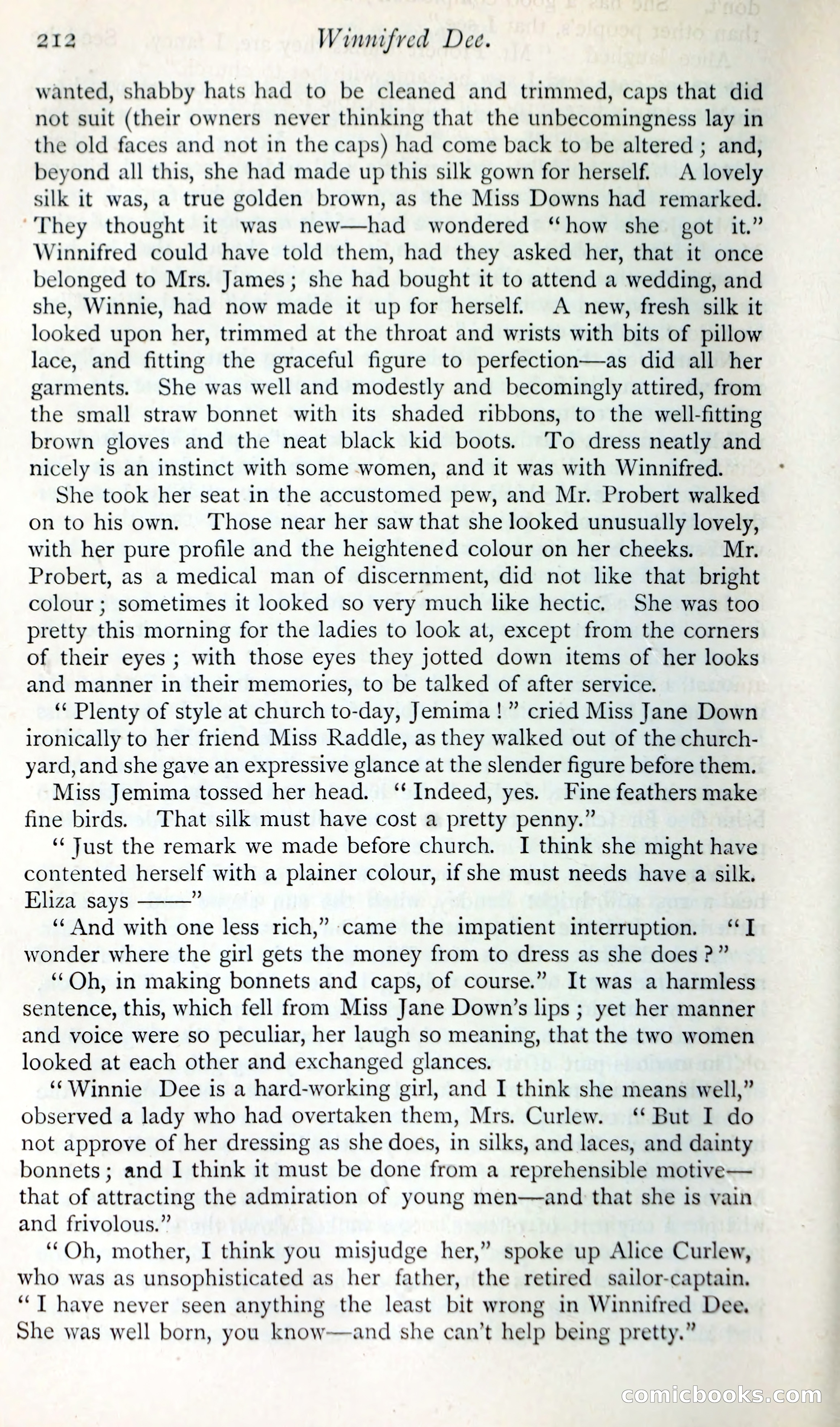
A restored page from Pulp Fiction, 1865. Page through the whole issue in the reader above.
📄 Transcribed text from this page (OCR, searchable)
Machine-transcribed from the original scan — historical spelling and the odd misread are preserved.
212 Winnifred Dee. wanted, shabby hats had to be cleaned and trimmed, caps that did not suit (their owners never thinking that the unbecomingness lay in the old faces and not in the caps) had come back to be altered ; and, beyond all this, she had made up this silk gown for herself. <A lovely silk it was, a true golden brown, as the Miss Downs had remarked. They thought it was new—had wondered “how she got it.” Winnifred could have told them, had they asked her, that it once belonged to Mrs. James; she had bought it to attend a wedding, and she, Winnie, had now made it up for herself. A new, fresh silk it looked upon her, trimmed at the throat and wrists with bits of pillow lace, and fitting the graceful figure to perfection—as did all her garments. She was well and modestly and becomingly attired, from the small straw bonnet with its shaded ribbons, to the well-fitting brown gloves and the neat black kid boots. To dress neatly and nicely is an instinct with some women, and it was with Winnifred. She took her seat in the accustomed pew, and Mr. Probert walked on to his own. ‘Those near her saw that she looked unusually lovely, with her pure profile and the heightened colour on her cheeks. Mr. Probert, as a medical man of discernment, did not like that bright colour; sometimes it looked so very much like hectic. She was too pretty this morning for the ladies to look at, except from the corners of their eyes ; with those eyes they jotted down items of her looks and manner in their memories, to be talked of after service. ‘“‘ Plenty of style at church to-day, Jemima!” cried Miss Jane Down ironically to her friend Miss Raddle, as they walked out of the church- yard, and she gave an expressive glance at the slender figure before them. Miss Jemima tossed her head. ‘‘ Indeed, yes. Fine feathers make fine birds. That silk must have cost a pretty penny.” ‘‘ Just the remark we made before church. I think she might have contented herself with a plainer colour, if she must needs have a silk. Eliza says ———” ‘‘ And with one less rich,” came the impatient interruption. ‘I wonder where the girl gets the money from to dress as she does ?” ‘‘Oh, in making bonnets and caps, of course.” It was a harmless sentence, this, which fell from Miss Jane Down’s lips; yet her manner and voice were so peculiar, her laugh so meaning, that the two women looked at each other and exchanged glances. ‘Winnie Dee is a hard-working girl, and I think she means well,” observed a lady who had overtaken them, Mrs. Curlew. ‘ But I do not approve of her dressing as she does, in silks, and laces, and dainty bonnets; and I think it must be done from a reprehensible motive— that of attracting the admiration of young men—and that she is vain and frivolous.” “Oh, mother, I think you misjudge her,” spoke up Alice Curlew, who was as unsophisticated as her father, the retired sailor-captain. ‘““T have never seen anything the least bit wrong in Winnifred Dee, She was well born, you know—and she can’t help being pretty.” CONNIE OO KS (E)