
Pulp Fiction, 1865 · page 209 of 400
The Argosy — page 209: what you’re looking at
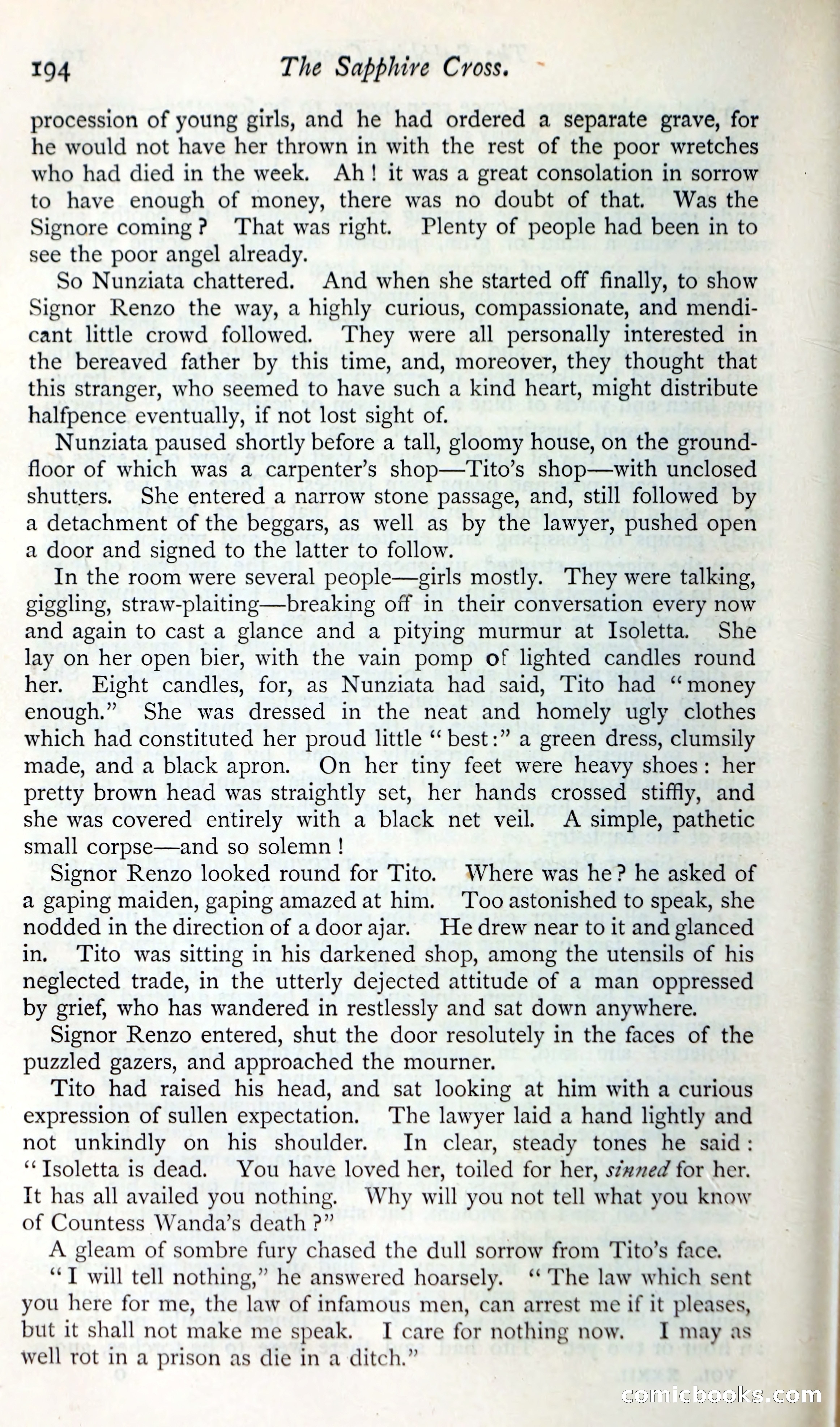
A restored page from Pulp Fiction, 1865. Page through the whole issue in the reader above.
📄 Transcribed text from this page (OCR, searchable)
Machine-transcribed from the original scan — historical spelling and the odd misread are preserved.
194 The Sapphire Cross. procession of young girls, and he had ordered a separate grave, for he would not have her thrown in with the rest of the poor wretches who had died in the week. Ah! it was a great consolation in sorrow to have enough of money, there was no doubt of that. Was the Signore coming? ‘That was right. Plenty of people had been in to see the poor angel already. So Nunziata chattered. And when she started off finally, to show Signor Renzo the way, a highly curious, compassionate, and mendi- cant little crowd followed. ‘They were all personally interested in the bereaved father by this time, and, moreover, they thought that this stranger, who seemed to have such a kind heart, might distribute halfpence eventually, if not lost sight of. Nunziata paused shortly before a tall, gloomy house, on the ground- floor of which was a carpenter’s shop—Tito’s shop—with unclosed shutters. She entered a narrow stone passage, and, still followed by a detachment of the beggars, as well as by the lawyer, pushed open a door and signed to the latter to follow. In the room were several people—girls mostly. ‘They were talking, giggling, straw-plaiting—breaking off in their conversation every now and again to cast a glance and a pitying murmur at Isoletta. She lay on her open bier, with the vain pomp of lighted candles round her. Eight candles, for, as Nunziata had said, Tito had “money enough.” She was dressed in the neat and homely ugly clothes which had constituted her proud little ‘‘ best:” a green dress, clumsily made, and a black apron. On her tiny feet were heavy shoes: her pretty brown head was straightly set, her hands crossed stiffly, and she was covered entirely with a black net veil. A simple, pathetic small corpse—and so solemn! Signor Renzo looked round for Tito. Where was he? he asked of a gaping maiden, gaping amazed at him. Too astonished to speak, she nodded in the direction of a doorajar. He drew near to it and glanced in. ‘Tito was sitting in his darkened shop, among the utensils of his neglected trade, in the utterly dejected attitude of a man oppressed by grief, who has wandered in restlessly and sat down anywhere. Signor Renzo entered, shut the door resolutely in the faces of the puzzled gazers, and approached the mourner. Tito had raised his head, and sat looking at him with a curious expression of sullen expectation. The lawyer laid a hand hghtly and not unkindly on his shoulder. In clear, steady tones he said: ‘““Tsoletta is dead. You have loved her, toiled for her, s¢##ed for her. It has all availed you nothing. Why will you not tell what you know of Countess Wanda’s death ?” A gleam of sombre fury chased the dull sorrow from Tito’s face. ‘T will tell nothing,” he answered hoarsely. ‘The law which sent you here for me, the law of infamous men, can arrest me if it pleases, but it shall not make me speak. I care for nothing now. I may as well rot in a prison as die in a ditch.” EONNIE OOO KS (E(@)