
Pulp Fiction, 1865 · page 201 of 400
The Argosy — page 201: what you’re looking at
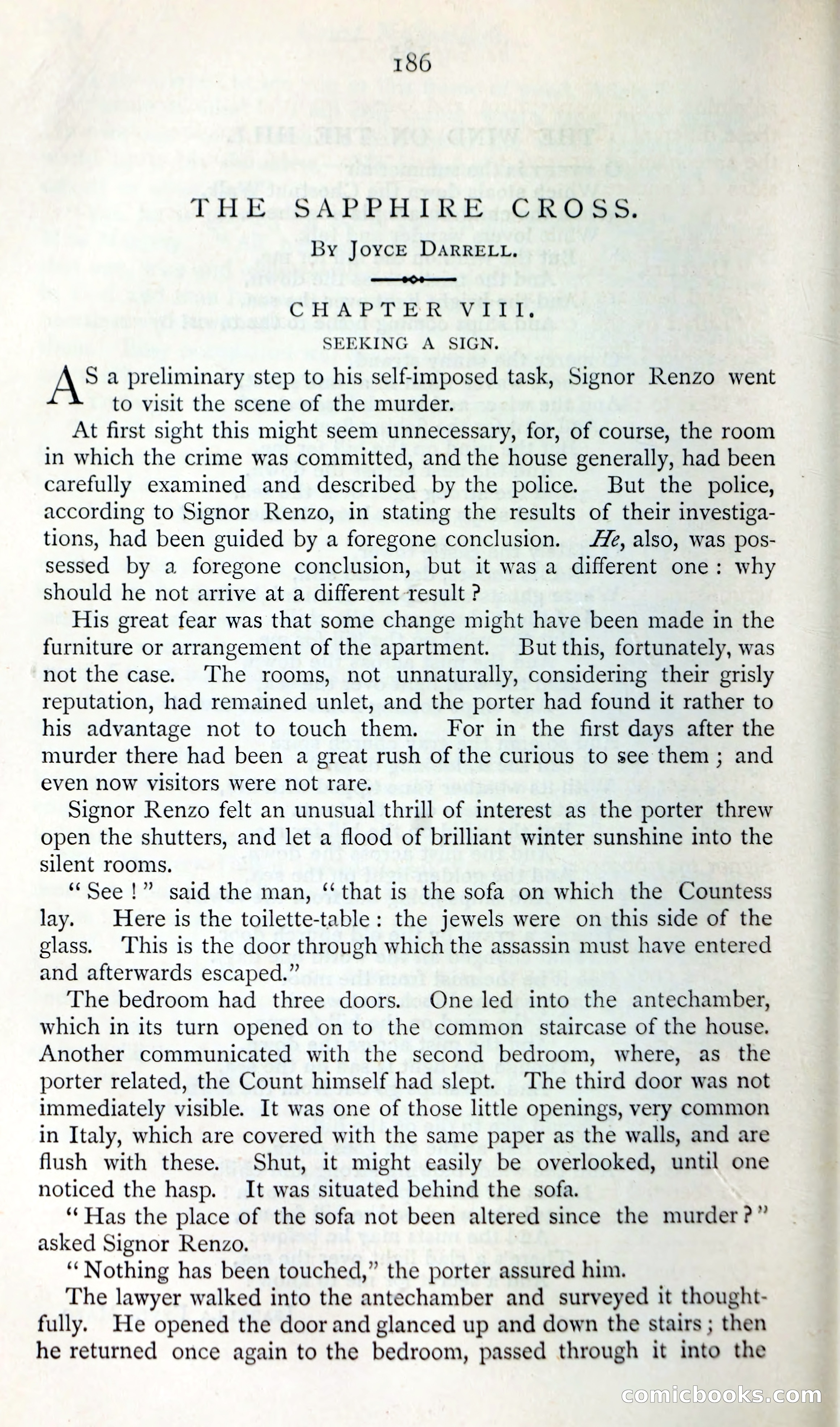
A restored page from Pulp Fiction, 1865. Page through the whole issue in the reader above.
📄 Transcribed text from this page (OCR, searchable)
Machine-transcribed from the original scan — historical spelling and the odd misread are preserved.
186 THE SAPPHIRE..CeROSS, By JoycE DARRELL. CH APL Bey ut ee SEEKING A SIGN. A® a preliminary step to his self-imposed task, Signor Renzo went to visit the scene of the murder. At first sight this might seem unnecessary, for, of course, the room in which the crime was committed, and the house generally, had been carefully examined and described by the police. But the police, according to Signor Renzo, in stating the results of their investiga- tions, had been guided by a foregone conclusion. Ae, also, was pos- sessed by a foregone conclusion, but it was a different one: why should he not arrive at a different result ? His great fear was that some change might have been made in the furniture or arrangement of the apartment. But this, fortunately, was not the case. ‘The rooms, not unnaturally, considering their grisly reputation, had remained unlet, and the porter had found it rather to his advantage not to touch them. For in the first days after the murder there had been a great rush of the curious to see them ; and even now visitors were not rare. Signor Renzo felt an unusual thrill of interest as the porter threw open the shutters, and let a flood of brilliant winter sunshine into the silent rooms. “See!” said the man, ‘that is the sofa on which the Countess lay. Here is the toilette-table: the jewels were on this side of the glass. This is the door through which the assassin must have entered and afterwards escaped.” The bedroom had three doors. One led into the antechamber, which in its turn opened on to the common staircase of the house. Another communicated with the second bedroom, where, as the porter related, the Count himself had slept. The third door was not immediately visible. It was one of those little openings, very common in Italy, which are covered with the same paper as the walls, and are flush with these. Shut, it might easily be overlooked, until one noticed the hasp. It was situated behind the sofa. ‘Has the place of the sofa not been altered since the murder?” asked Signor Renzo. ‘Nothing has been touched,” the porter assured him. The lawyer walked into the antechamber and surveyed it thought- fully. He opened the door and glanced up and down the stairs ; then he returned once again to the bedroom, passed through it into the EORNIE KOO KS (E(@)