
Pulp Fiction, 1865 · page 193 of 400
The Argosy — page 193: what you’re looking at
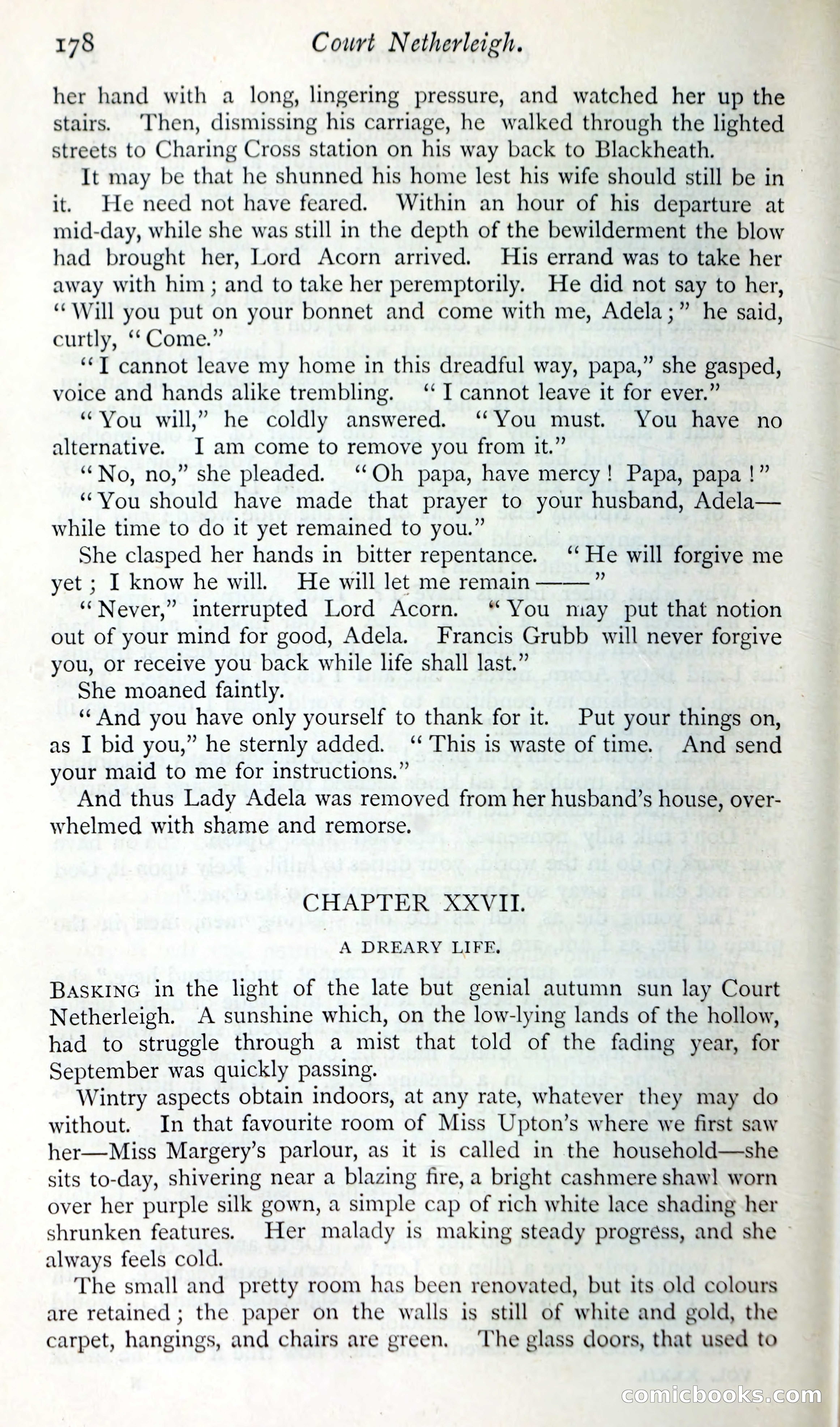
A restored page from Pulp Fiction, 1865. Page through the whole issue in the reader above.
📄 Transcribed text from this page (OCR, searchable)
Machine-transcribed from the original scan — historical spelling and the odd misread are preserved.
178 Court Netherleigh. her hand with a long, lingering pressure, and watched her up the stairs. Then, dismissing his carriage, he walked through the lighted streets to Charing Cross station on his way back to Blackheath. It may be that he shunned his home lest his wife should still be in © it. He need not have feared. Within an hour of his departure at mid-day, while she was still in the depth of the bewilderment the blow had brought her, Lord Acorn arrived. His errand was to take her away with him; and to take her peremptorily. He did not say to her, ‘Will you put on your bonnet and come with me, Adela;” he said, curtly, ‘‘ Come.” ‘‘T cannot leave my home in this dreadful way, papa,” she gasped, voice and hands alike trembling. ‘‘ I cannot leave it for ever.” “Vou will,” he coldly answered. ‘“‘ You must. You have no alternative. I am come to remove you from it.” “No, no,” she pleaded. ‘‘Oh papa, have mercy! Papa, papa!” ‘Vou should have made that prayer to your husband, Adela— while time to do it yet remained to you.” She clasped her hands in bitter repentance. ‘‘ He will forgive me yet ; I know he will. He will let me remain : “Never,” interrupted Lord Acorn. “You miay put that notion out of your mind for good, Adela. Francis Grubb will never forgive you, or receive you back while life shall last.” , She moaned faintly. ‘And you have only yourself to thank for it. Put your things on, as I bid you,” he sternly added. ‘‘ This is waste of time. And send your maid to me for instructions.” And thus Lady Adela was removed from her husband’s house, over- whelmed with shame and remorse. CHAPTER XXVIII. A DREARY LIFE. BASKING in the light of the late but genial autumn sun lay Court Netherleigh. A sunshine which, on the low-lying lands of the hollow, had to struggle through a mist that told of the fading year, for September was quickly passing. Wintry aspects obtain indoors, at any rate, whatever they may do without. In that favourite room of Miss Upton’s where we first saw her—Miss Margery’s parlour, as it is called in the household—she sits to-day, shivering near a blazing fire, a bright cashmere shaw! worn over her purple silk gown, a simple cap of rich white lace shading her shrunken features. Her malady is making steady progréss, and she — always feels cold. The small and pretty room has been renovated, but its old colours are retained; the paper on the walls is still of white and gold, the carpet, hangings, and chairs are green. ‘The glass doors, that used to Eomichooks. co